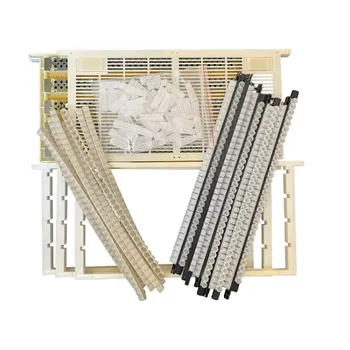
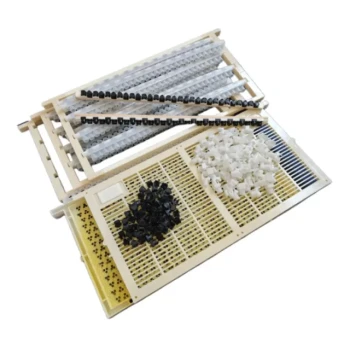
Honey bee reproduction explains exactly why queen-rearing equipment must control larval age, nutrition, orientation, and mating conditions. Workers and queens develop from the same fertilized eggs; the decisive difference is that a young female larva receives abundant royal jelly in a vertically oriented queen cell. Commercial grafting tools, artificial cell cups, cell-builder colonies, mating nuclei, and queen-management hardware convert this biological process into a repeatable production system.
The equipment does not create a queen by itself. It places a correctly aged fertilized larva into a physical and colony environment that encourages nurse bees to provide the nutrition and care required for queen development.
How Reproductive Biology Determines the Grafting Process
The starting material must be a fertilized female larva
Honey bees use haplo-diploid reproduction. Fertilized eggs develop into females, which may become workers or queens, while unfertilized eggs develop into haploid drones.
This means grafting does not involve changing the larva’s genetic sex. The operator selects a young female worker larva and gives it the conditions that redirect development toward the queen pathway.
Larval age is a critical operating variable
Commercial grafting generally uses very young worker larvae, under three days old, with the youngest larvae preferred for consistent queen development.
As a larva ages, its developmental pathway becomes increasingly established. Grafting tools therefore need to support fast, accurate transfers with minimal exposure, drying, crushing, or temperature shock.
Nutrition is the biological trigger
A queen results from sustained access to abundant royal jelly, not from a different egg or a special genetic material.
The practical implication is important: a graft succeeds only when the receiving colony has enough nurse bees, food resources, and appropriate queen-cell conditions to feed the transferred larva continuously.
How Grafting Tools Translate Biology Into a Workflow
Grafting tools provide precision
A grafting needle, Chinese grafting tool, or comparable larvae-transfer instrument allows the operator to lift a young larva from worker comb and place it into an artificial cell cup.
The tool must support precision, speed, cleanliness, and low larval damage. Even a well-designed cell cup cannot compensate for a larva that has been injured or allowed to dry during handling.
Artificial cell cups replace the natural cell base
Artificial cell cups provide a standardized starting point for queen-cell construction. They allow producers to arrange many grafts on a grafting frame and present them efficiently to a cell-builder colony.
The cups are not merely containers. Their shape, spacing, and attachment system help nurse bees accept the grafts and extend them into queen cells.
Vertical orientation supports acceptance
Natural queen cells hang downward and provide a distinctive physical environment for the developing queen larva. Commercial cell-cup hardware and grafting frames reproduce this vertical, suspended arrangement.
Correct orientation is therefore an operational requirement rather than a cosmetic preference. Poorly positioned or unstable cups can reduce acceptance and complicate inspection, harvesting, and transport.
Cell-builder colonies supply the biological workforce
After grafting, the frame is placed into a properly prepared cell-builder colony. Nurse bees then supply royal jelly and care for the larvae.
The equipment creates access and consistency, but the colony supplies the biological labor. Strong nurse populations, suitable colony condition, and correct timing are central to achieving reliable results.
How Mating Biology Extends Beyond Grafting
A virgin queen is not yet a productive queen
A newly emerged queen is virgin and infertile. She must leave the apiary, reach a drone congregation area, mate with multiple drones, and store sperm in her spermatheca.
Only after successful mating can she reliably produce fertilized eggs that develop into workers and future queens.
Mating nuclei provide controlled operating units
Commercial operators use mating nucs to house virgin queens during the mating window. These small colonies provide an economical environment for the queen to mature, take mating flights, return, and begin laying.
Entrance guards, appropriate colony configuration, and secure hive placement help protect the queen during this vulnerable period.
Drone management affects genetic outcomes
Because queens mate with multiple drones in open-air congregation areas, a breeder cannot achieve complete genetic control simply by producing a queen from a selected larva.
Breeding operations therefore use drone-mother colonies, drone comb, mating-yard planning, and—in more controlled programs—drone-exclusion or isolated mating strategies to influence the available genetics. Queen-rearing equipment must be considered alongside mating infrastructure, not as an isolated product category.
Queen cages support transfer and introduction
Once a queen is mated and laying, operators may need to harvest, mark, transport, or introduce her into a production colony.
Queen-marking cages and introduction cages reduce handling risk and help standardize these transitions. The objective is to protect the queen while allowing the receiving colony to accept her pheromonal presence.
How Queen-Rearing Equipment Supports Production Colonies
Queen excluders separate reproductive and honey-storage zones
A productive queen may lay a very large number of eggs during peak conditions. Commercial colonies therefore need a practical way to keep brood production in the brood chambers while allowing workers to use upper supers for honey storage.
A queen excluder restricts the queen’s movement while permitting worker bees to pass. This helps prevent unwanted brood in honey supers and makes inspection and harvesting more efficient.
Frames and foundation create standardized working space
Standardized brood frames, foundation, and brood chambers give the queen predictable cells in which to lay and give the beekeeper a consistent inspection format.
For commercial operations, standardization also improves compatibility across grafting frames, cell cups, hive bodies, transport equipment, and replacement parts.
Marking and inspection tools support queen accountability
Because one queen is normally responsible for the colony’s egg production, identifying her quickly has operational value. Marking tools and inspection equipment help operators confirm her presence, assess laying performance, and identify replacement needs.
This is particularly important when managing large numbers of colonies where delayed queen detection can result in production losses.
Why Equipment Quality Matters to Commercial Apiaries
Reliability is more valuable than isolated tool features
A grafting tool, cell cup, or queen cage must work within a broader process. The relevant performance question is not simply whether a tool is functional, but whether it helps the operator achieve repeatable acceptance, safe handling, and efficient throughput.
For distributors and resellers, this favors complete queen-rearing portfolios rather than disconnected products.
Compatibility reduces operational friction
Cell cups, grafting frames, cell protectors, mating nucs, queen cages, excluders, and frames should be evaluated for compatibility in dimensions, mounting systems, handling procedures, and colony use.
A compatible product range reduces adaptation time, training demands, and the risk that one unsuitable component will compromise the workflow.
Fast fulfillment has biological importance
Queen-rearing schedules are time-sensitive. Larval age, cell-builder readiness, queen emergence, mating flights, and introduction windows cannot always be postponed without consequence.
For suppliers, rapid response, dependable inventory, technical customer service, and efficient order fulfillment are therefore operational benefits—not merely commercial conveniences.
Understanding the Trade-offs
Artificial control does not eliminate biological variation
Grafting tools standardize larval transfer, but acceptance and queen quality still depend on nurse-bee strength, nutrition, colony condition, weather, and timing.
Equipment improves process control; it does not remove the need for sound colony management.
High volume can increase handling risk
Mass grafting improves production capacity, but it also increases the number of larvae exposed to transfer errors, drying, misalignment, and inspection damage.
Operators should balance output targets with worker training, tool ergonomics, sanitation, and inspection capacity.
Open mating limits genetic certainty
A selected grafting source can provide desirable maternal genetics, but the queen’s paternal genetics are influenced by the drones available at mating areas.
Operations seeking tighter genetic control must invest in mating-site management, drone programs, or specialized controlled-mating infrastructure.
Queen excluders require correct colony management
Queen excluders can help separate brood and honey zones, but they are not a substitute for adequate colony strength, correct timing, or swarm management.
Improper use can restrict colony movement or create congestion. Their value comes from being integrated into a well-managed production system.
How to Apply This to Your Apiary or Product Portfolio
The best equipment choice depends on whether the priority is biological consistency, production scale, genetic management, or distribution efficiency.
- If your primary focus is reliable queen production: Prioritize accurate grafting tools, standardized artificial cell cups, stable vertical grafting frames, and strong cell-builder colony procedures.
- If your primary focus is production scale: Build a compatible system around high-capacity grafting frames, cell cups, mating nucs, queen cages, and standardized replacement components.
- If your primary focus is genetic improvement: Combine selected grafting stock with drone-mother colonies, drone comb, mating-yard planning, and appropriate mating-control equipment.
- If your primary focus is commercial colony management: Use queen excluders, brood frames, queen-marking tools, and introduction cages to control brood placement and protect queen performance.
- If your primary focus is distribution and resale: Offer a full-spectrum, compatible product range supported by technical expertise, fast response, dependable supply, and rapid order fulfillment.
When reproductive biology guides equipment selection, commercial apiaries gain a queen-rearing system that is more predictable, scalable, and operationally efficient.
Summary Table:
| Aspect | Biological Principle | Practical Equipment Implication |
|---|---|---|
| Larval Source | Fertilized eggs develop into females | Grafting tools must handle young female larvae, preserving viability |
| Larval Age | Young larvae (<3 days) are most plastic | Grafting must be quick and precise to use larvae at optimal age |
| Nutrition | Royal jelly triggers queen development | Cell-builder colonies must be strong to provide abundant jelly |
| Cell Orientation | Natural queen cells hang vertically | Artificial cups and frames must maintain vertical alignment |
| Mating | Queens mate with multiple drones in air | Mating nucs and drone management control genetic input |
| Space Separation | Queen excluders control egg laying zones | Excluders keep brood out of honey supers |
| Standardization | Consistent brood frames help manage queen laying | Standardized equipment improves workflow efficiency |
Ready to optimize your queen-rearing operation? HONESTBEE offers a comprehensive range of grafting tools, cell cups, mating nucs, and queen management equipment, plus fast delivery and expert support. For distributors and beekeepers seeking one-stop sourcing and reliable supply, contact us today to discuss your wholesale needs — Get a quote.
Related Products
- Retractable Chinese Queen Rearing Grafting Tools Equipment
- Stainless Steel Queen Grafting Tool for Beekeeping and Bee Queen Grafting
- Plastic Chinese Queen Grafting Tool for Bee Queen Rearing
- Stainless Steel Beekeeping Queen Grafting Tool for Honey Bee Rearing
- Plastic Beekeeping Honey Bee Larvae Grafting Tools for Queen Rearing and Chinese Grafting
People Also Ask
- Which specialized tools are necessary for implementing standardized queen rearing? Scale Your High-Yield Apiary
- How does selective queen rearing benefit an apiary? Discover Essential Tools for High-Quality Queen Bees
- Why are specialized queen rearing tools necessary to mitigate winter hive losses? Boost Apiary Survival and Recovery
- What operational workflows and queen rearing tools are required for implementing instrumental insemination and isolated mating in commercial queen breeding programs?
- How do queen-rearing tools facilitate the sustainability and expansion of a commercial apiary? Drive Scalable Growth