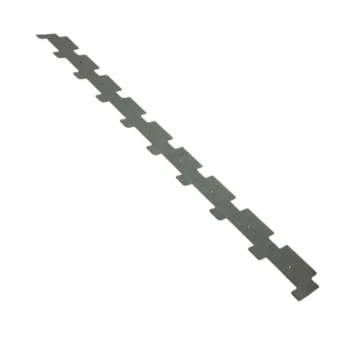
Specialized honey supers and standardized frames fundamentally transform harvesting by physically isolating the product and enabling automation. Supers create an independent storage zone that keeps honey separate from the colony's brood rearing area, ensuring the final product contains no larvae or biological impurities. Meanwhile, standardized frames allow producers to utilize centrifugal extractors, replacing slow manual scraping with rapid, mechanized extraction.
The combination of these tools professionalizes beekeeping by enforcing a strict barrier between biological colony maintenance and food storage. This system guarantees product purity while significantly reducing the labor required for large-scale production.
Enhancing Quality Through Physical Separation
Isolating the Brood
The primary function of a specialized super is to serve as an independent storage space positioned above the brood chamber. By restricting the queen to the lower chamber, often using an excluder, the upper frames remain dedicated solely to honey storage. This prevents the accidental harvesting of larvae, ensuring the purity of the extracted honey.
Reducing Impurities
When honey is harvested from mixed-use combs, filtration becomes a heavy burden. Specialized supers facilitate a clean separation at the source, significantly reducing the amount of pollen, wax debris, and biological matter that enters the extraction line. This naturally enhances the clarity and quality of the final product.
Building Consumer Trust
High-quality equipment supports the production of honey that retains its natural aroma and bioactive components. By utilizing this separation method, producers can provide a physical guarantee of purity. This consistency builds the consumer trust necessary to command premium value in the market.
Maximizing Efficiency with Standardization
Enabling Mechanization
Standardized frames are engineered with precise dimensions to fit centrifugal honey extractors. This compatibility allows beekeepers to spin honey out of multiple frames simultaneously rather than harvesting one comb at a time. This shift from manual to mechanical extraction is the single largest factor in scaling production.
Shortening Production Cycles
Mechanized harvesting drastically reduces the time required to process a hive. Because the extraction process is non-destructive, the empty combs can be immediately returned to the hive. This allows bees to refill existing cells rather than wasting energy rebuilding wax, shortening the cycle for the next harvest.
Minimizing Colony Disturbance
Efficiency is not just about speed; it is about hive health. Standardized systems allow for quick frame removal and replacement. This minimizes the duration the hive is open and reduces stress on the colony, ensuring sustained productivity throughout the season.
Critical Considerations for Success
The Necessity of Capping
While standardized frames speed up extraction, they do not bypass the need for biological maturity. You must ensure frames are at least 80 to 100 percent capped before harvesting. Bees cap honey only when water content drops below 18 percent; extracting uncapped frames early via machine will lead to fermentation and spoilage.
Equipment Maintenance
Using specialized extraction gear introduces a requirement for strict sanitation. Centrifuges and frames must be maintained to prevent cross-contamination between hives. The efficiency gained by machinery is lost if the equipment becomes a vector for disease or introduces foreign residue into the honey.
Optimizing Your Harvest Strategy
To get the most out of specialized equipment, align your usage with your specific production goals:
- If your primary focus is Product Purity: Prioritize the strict use of supers above the brood chamber to ensure zero contamination from larvae or brood wax.
- If your primary focus is Scalability: Invest in standardized frames compatible with large-capacity centrifugal extractors to minimize labor hours per hive.
- If your primary focus is Colony Health: Utilize the non-destructive nature of centrifugal extraction to return drawn comb to the bees, preserving their energy for nectar gathering.
By adhering to standardized dimensions and separation principles, you convert honey harvesting from a chaotic intrusion into a precise, scalable operation.
Summary Table:
| Feature | Impact on Quality | Impact on Efficiency |
|---|---|---|
| Specialized Supers | Isolates honey from brood; eliminates larval impurities. | Facilitates organized storage and easier hive management. |
| Standardized Frames | Ensures uniform cell depth for consistent honey maturity. | Enables use of centrifugal extractors for rapid, non-destructive harvesting. |
| Queen Excluders | Prevents brood contamination in honey cells. | Reduces sorting time and manual filtration requirements. |
| Non-Destructive Extraction | Preserves wax comb integrity and honey aroma. | Allows immediate return of drawn comb; shortens production cycles. |
Elevate Your Commercial Beekeeping Operation with HONESTBEE
Maximize your honey yield and ensure premium product purity with professional-grade equipment. HONESTBEE specializes in supporting commercial apiaries and distributors by providing a comprehensive wholesale catalog of high-efficiency beekeeping tools.
From standardized frames and specialized honey supers to industrial-scale honey-filling and hive-making machinery, we supply the essential hardware and consumables required for large-scale success. Whether you are scaling your extraction line or sourcing honey-themed cultural merchandise, our portfolio is designed to enhance your operational efficiency and market value.
Contact HONESTBEE today to optimize your harvest!
References
- Tadele Hunde, Tolera Kumsa Gemeda. The Combined Effects of Beehive Shade and Feed Supplementation on Honeybee (<i>Apis mellifera</i>) Productivity. DOI: 10.11648/j.ajls.20251303.13
This article is also based on technical information from HonestBee Knowledge Base .
Related Products
- Heavy Duty Castellated Iron Frame Spacer for Honey Supers
- Durable 16 Way Circular Bee Escape for Efficient Honey Harvesting
- Double Wall Honey Heating Stirring Homogenizer Mixing Machine with Various Capacity
- Honey Concentrating Vacuum Heating Thickening Machine Dehumidifier for Honey
- Professional Honey Filter with Tripod Support Stand
People Also Ask
- What are honey super frames and what foundation options are available? Choose the Best Support for Your Bees
- What are the reasons and drawbacks of using nine frames in a ten-frame honey super? Boost Extraction Speed Today
- What are honey super frames and how many are needed per box? A Beekeeper's Essential Guide
- What are honey super frames and their foundation options? Choose the Best Support for Your Hive's Honey Production
- Why might a beekeeper use fewer than the standard number of frames in a honey super? Boost Extraction Efficiency