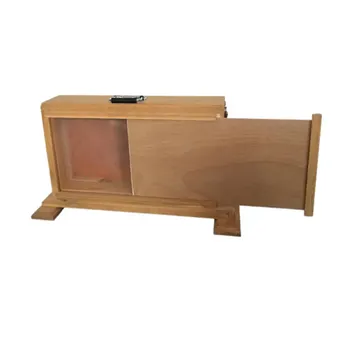
Traditional clay hives are low-tech but difficult to manage commercially, while modern wooden frame hives enable systematic inspection, non-destructive harvesting, and scalable honey production. Cylindrical clay hives generally lack movable frames, which makes colony assessment, disease monitoring, swarm control, and honey extraction labor-intensive. Standardized wooden hives—particularly Langstroth-style boxes—use removable frames that integrate with extractors, foundation systems, pest-control programs, and commercial handling workflows.
Traditional hives may remain useful during a gradual transition, but standardized frame hives provide the operational foundation for higher productivity, better colony management, and efficient commercial processing.
How Traditional Clay Hives and Modern Hives Differ
Hive construction and standardization
Traditional cylindrical clay hives are typically fixed-form units deployed in clusters, historically ranging from dozens to many units. Their dimensions and internal structures are often less standardized, making equipment compatibility and uniform management difficult.
Modern wooden hives are manufactured to consistent dimensions and use interchangeable boxes, frames, and accessories. This standardization allows beekeepers, equipment suppliers, and processors to operate with repeatable components across an entire apiary.
Colony inspection
The absence of movable frames is the central limitation of a clay hive. Inspecting brood, food stores, queen performance, or colony health can require disturbing the structure or removing comb.
Modern frame hives allow individual frames to be lifted, inspected, replaced, and rearranged. This supports more accurate colony management and enables systematic monitoring for pests and diseases, including Varroa mites and foulbrood-related problems.
Honey harvesting
Honey harvesting from a fixed-comb hive is more likely to damage or destroy comb. The colony must then rebuild its production structure, which consumes time and energy.
With removable frames, honey can be extracted centrifugally while preserving the comb. Bees can reuse the comb instead of rebuilding it, allowing more of their effort to be directed toward honey production.
Labor and productivity
Traditional hives require more manual handling and offer fewer opportunities for repeatable management procedures. Their limitations become especially significant when an apiary expands beyond small-scale production.
Modern hives reduce the labor involved in inspection, harvesting, pest control, and colony movement. They also make it easier to standardize operating procedures across workers, apiary sites, and customer orders.
Commercial processing compatibility
Clay hives are poorly suited to mechanized processing because their combs are not held in standardized removable frames. This restricts the use of extractors and downstream honey-filling equipment.
Standardized wooden frames can move through a complete processing chain, from hive inspection to uncapping, extraction, filtering, storage, and filling. This compatibility is particularly important for commercial beekeepers, wholesalers, and honey processors.
Why Standardized Wooden Hives Improve Apiary Operations
More efficient colony management
Frame-based hives allow beekeepers to inspect colonies without dismantling the entire hive. They can evaluate brood development, food reserves, queen activity, and colony strength using a repeatable method.
This improves decision-making during swarm prevention, seasonal expansion, feeding, and preparation for honey flows.
Better pest and disease control
Removable frames make it easier to identify abnormal brood patterns, inspect colony condition, and apply appropriate management measures. They also support more organized monitoring for Varroa destructor and other major colony health threats.
The hive itself does not eliminate disease risk. Its value is that it makes detection, treatment administration, and follow-up inspections more practical.
Non-destructive honey extraction
Honey extractors remove honey from the comb through centrifugal force rather than requiring the comb to be destroyed. Preserving comb reduces the colony’s rebuilding workload and supports repeated use of frames.
This can improve harvesting efficiency, honey handling consistency, and the overall return on hive equipment.
Scalable migratory and commercial operations
Standardized boxes and frames simplify the movement of colonies between apiary locations and flowering areas. They are also better suited to commercial pollination services and larger coordinated production systems.
For distributors and resellers, standardized equipment creates a broader product ecosystem: replacement frames, foundation, boxes, extractors, protective equipment, and processing machinery can all be supplied as compatible components.
Essential Equipment for the Transition
A successful conversion requires more than purchasing wooden hive boxes. The apiary should be equipped with the components needed for housing, inspection, comb construction, harvesting, and processing.
Standardized wooden hive boxes
The core requirement is a consistent frame-hive system, such as standardized Langstroth-style boxes. The system should include compatible brood boxes, honey supers, covers, bottoms, and frames.
Using one standard across the apiary avoids mixing incompatible dimensions and simplifies procurement, staff training, spare-parts management, and future expansion.
Movable frames and wax foundation
Frames provide the removable structure that makes modern hive management possible. Wax foundation or another suitable foundation system helps guide bees to build uniform comb within the frames.
For larger operations, foundation casting molds support local production of consistent foundation sheets. This can help reduce supply delays and improve control over frame preparation.
Hive inspection and handling tools
Beekeepers need the basic tools required to work safely and consistently with frame hives. This includes smokers, hive tools, protective clothing, gloves, and suitable containers or stands for handling frames.
These items are operational necessities rather than optional accessories. Without them, the benefits of removable frames cannot be realized efficiently or safely.
Honey extractor
A honey extractor is essential when the objective is to preserve comb and improve harvesting efficiency. It enables clean centrifugal extraction from removable frames and supports repeated comb reuse.
Extractor capacity should match the number of colonies, expected harvest volume, available labor, and planned expansion. Undersizing the extractor can create a processing bottleneck during peak flowering periods.
Honey-processing and filling equipment
Commercial operations may also require filtering or straining equipment, food-grade storage containers, and honey-filling machinery. These tools help maintain consistent handling and support higher-throughput packaging.
A complete processing setup is especially valuable for B2B buyers that need reliable product quality, predictable order fulfillment, and repeatable packaging outputs.
Pest and disease monitoring equipment
The transition should include tools for routine colony inspection and Varroa monitoring. Frame-based management makes these checks practical, but the apiary still needs an established inspection and record-keeping process.
Equipment suppliers should pair hive hardware with clear operating guidance so customers understand how the components support disease prevention and colony management.
Hive-making machinery for local or large-scale production
Hive-making machinery is not essential for every small apiary, but it becomes important when producing standardized boxes and frames locally or at commercial volume. Precision machinery improves dimensional consistency and supports efficient replacement-part production.
For distributors and wholesalers, a modular offer can serve different buyers: ready-made hives for small operators, component packages for growing apiaries, and machinery for manufacturers or large commercial farms.
A Practical Transition Strategy
Start with a standardized pilot group
Converting the entire apiary at once may create unnecessary operational risk. A pilot group of modern hives allows beekeepers to develop inspection, frame handling, extraction, and maintenance skills before expanding.
The pilot should use the same hive standard and accessories intended for the full operation. This prevents the trial from producing misleading results based on incompatible equipment.
Maintain selected traditional hives temporarily
A mixed system can reduce the financial and technical barriers of modernization. Traditional clay hives may remain in service while the apiary builds modern-hive skills and gradually replaces or relocates colonies.
However, the mixed period should have a clear transition plan. Maintaining too many incompatible hive types indefinitely can increase spare-parts complexity and complicate staff training.
Transfer colonies carefully
Colony transfer should be planned around colony strength, brood condition, available frames, and local seasonal conditions. The objective is to move colonies into a system where comb can be inspected and managed without unnecessary disruption.
Because transfer methods vary by hive design and local practice, suppliers should provide setup guidance and, where appropriate, technical support during commissioning.
Build the processing chain alongside the hives
Buying modern boxes without an extractor or foundation system can leave the apiary unable to capture the full benefit of the upgrade. Harvesting and comb-reuse capabilities should be developed as part of the same investment plan.
A coordinated package reduces compatibility problems and gives commercial customers a clearer path from installation to productive operation.
Understanding the Trade-offs
Higher initial investment
Modern hives, frames, foundation, protective equipment, extractors, and processing tools require more upfront capital than locally made clay structures.
The investment should therefore be evaluated over the equipment’s service life, labor savings, reusable comb, improved management, and potential production gains rather than by purchase price alone.
Greater technical requirements
Frame hives require consistent inspection routines and proper handling. Poorly trained operators can damage frames, disrupt colonies, or fail to use the available monitoring advantages.
Training, operating procedures, and after-sales support are therefore important parts of a commercial equipment package.
Maintenance and replacement needs
Wooden boxes and frames require inspection, cleaning, repair, and periodic replacement. Standardization makes these tasks easier, but it does not remove the need for maintenance.
Suppliers should ensure that replacement frames, foundation, hive parts, and essential tools remain available after the initial sale.
Standardization must be preserved
Mixing different frame dimensions or hive standards can undermine the efficiency gains of modernization. Components may no longer be interchangeable, and extraction equipment may not fit all frames.
Selecting one compatible system at the beginning is usually more valuable than assembling the lowest-cost combination of unrelated products.
Making the Right Choice for Your Goal
A phased, complete-system approach is usually more effective than purchasing hive boxes in isolation.
- If your primary focus is higher honey productivity: Prioritize standardized wooden frame hives, reusable comb, wax foundation, and a correctly sized honey extractor.
- If your primary focus is disease and colony management: Prioritize removable frames, inspection tools, Varroa monitoring equipment, protective gear, and beekeeper training.
- If your primary focus is commercial scale: Standardize the hive format across the apiary and add extraction, storage, filling, and replacement-component capacity.
- If your primary focus is gradual modernization: Run a controlled group of modern hives alongside selected clay hives, then expand after staff and colonies adapt.
- If your primary focus is equipment distribution: Offer compatible one-stop packages covering hive boxes, frames, foundation molds, extraction machinery, protective equipment, and technical support.
The right modernization plan combines standardized hives with compatible tools, processing equipment, technical guidance, and dependable supply support.
Summary Table:
| Aspect | Traditional Clay Hives | Modern Wooden Hives |
|---|---|---|
| Construction | Fixed, non-standardized | Standardized, interchangeable components |
| Inspection | Difficult, destructive | Easy, non-destructive with movable frames |
| Honey Harvest | Damages comb, labor-intensive | Non-destructive centrifugal extraction |
| Productivity | Low, limited scalability | High, commercial-ready |
| Pest Control | Challenging | Practical with frame access |
| Processing | Incompatible with mechanization | Fully compatible with extractors, fillers |
Ready to modernize your apiary with standardized wooden hives? HONESTBEE offers a complete ecosystem of beekeeping equipment—from hive boxes and frames to extractors and honey-filling lines. Our one-stop sourcing, fast response, and professional support ensure seamless upgrades for distributors and beekeepers. Contact us today for a tailored package and boost your operational efficiency!
Related Products
- High-Performance Langstroth Bee Hives for Global Professional Beekeeping
- Wholesales Dadant Size Wooden Bee Hives for Beekeeping
- Australian Langstroth Beehive Boxes for Beekeeping Wholesales
- Professional Observation Hive: The Ultimate Portable Solution for Beekeeping Education, Exhibitions, and Colony Displays
- Wooden Bee Hive Frames for Beekeeping and Wholesale
People Also Ask
- What structural differences should commercial apiary operators consider when selecting between Langstroth hives and Top Bar hives for standardized honey production? Langstroth for standardized honey production
- What are the structural and yield differences between traditional primitive beehives and modern standard wooden hives (such as Langstroth hives) for commercial honey producers? Discover why modern hives boost yield and efficiency.
- Why is the adoption of modern movable-frame hives, such as Langstroth hives, advantageous over traditional hive equipment for commercial apiaries? Key Benefits for Scalable Beekeeping
- How does transitioning to modern hives boost honey yield? Increase production and product quality for your commercial apiary
- What are the key operational differences and structural trade-offs between Langstroth beehives and top-bar beehives for apiary management? Discover which hive system fits your operational needs.