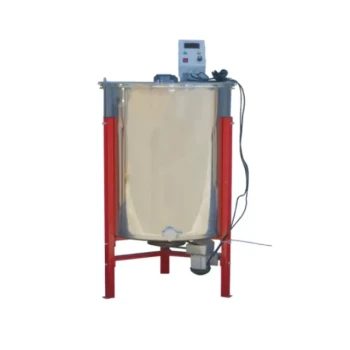
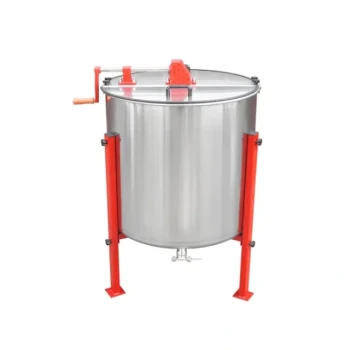
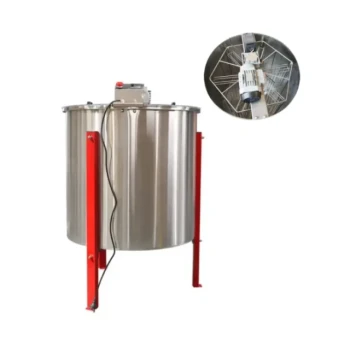
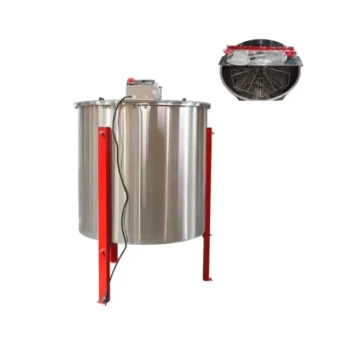
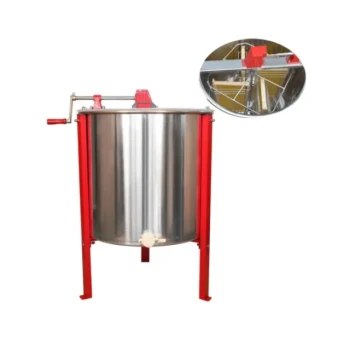
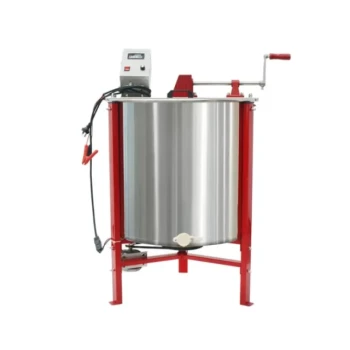
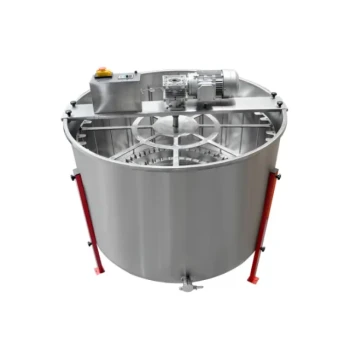
The centrifugal honey extractor fundamentally transforms honey production by using rotational force to separate liquid honey from the comb without destroying the wax structure. By replacing traditional crushing methods, this technology simultaneously purifies the final product and preserves the hive's infrastructure, allowing for immediate reuse of the honeycomb.
By decoupling the harvest process from the destruction of the comb, centrifugal extraction solves the two primary bottlenecks of beekeeping: product contamination during extraction and the biological energy cost of rebuilding wax.
Elevating Product Quality Through Hygiene
Eliminating Contamination Vectors
Traditional extraction often involves crushing the comb, which inadvertently mixes in solid impurities.
A centrifugal extractor isolates the honey solely through rotational force. This mechanical separation prevents larvae, debris, or crushed wax from contaminating the liquid honey, resulting in a significantly more hygienic product.
Achieving Superior Clarity
The centrifugal process achieves high-efficiency liquid-solid separation.
Because the wax foundation remains intact rather than being pulverized, the extracted honey retains high clarity. This reduces the need for aggressive filtration, preserving the honey's natural quality while ensuring it meets standardized production requirements.
Maximizing Efficiency via Biological Conservation
Preserving the Wax Infrastructure
The most critical advantage of this machinery is its ability to empty the honeycomb cells while maintaining the integrity of the wax combs.
Unlike pressing methods that render the comb unusable, centrifugal extraction keeps the structural foundation of the hive intact. This allows the empty combs to be returned immediately to the hive for the next cycle.
Reducing Bee Energy Expenditure
Bees consume a substantial amount of energy and resources (honey and pollen) to secrete wax and build combs.
By recycling intact combs, the colony is spared the burden of reconstruction. The energy that workers would have spent on building infrastructure is instead redirected toward foraging and honey production.
Accelerating the Harvest Cycle
The reuse of honeycombs drastically shortens the turnaround time between harvests.
Because the bees do not need to wait for new storage cells to be built, the production turnover rate increases. This significantly shortens the overall production cycle and increases the annual yield per colony.
Understanding the Operational Requirements
The Necessity of "Mature" Honey
Centrifugal extractors are designed to work with mature honey.
For the centrifugal force to effectively eject the liquid without damaging the comb, the honey must be at the correct viscosity and maturity. Harvesting unripe honey may lead to inefficient extraction or fermentation issues later.
Equipment Standardization
This method relies on the "standardized production" of frames.
To utilize the high-speed rotation safely and effectively, the hives and frames must be compatible with the extractor's basket. This moves the operation away from ad-hoc harvesting toward a more industrialized, mechanical workflow.
Making the Right Choice for Your Goal
While centrifugal extraction is the industry standard for efficiency, understanding your specific objectives will help you maximize its value:
- If your primary focus is Product Purity: Utilize centrifugal extraction to prevent the introduction of larvae and wax particles, ensuring a cleaner raw product.
- If your primary focus is High Yield: Prioritize returning wet, intact combs to the hive immediately after spinning to minimize colony downtime.
- If your primary focus is Colony Health: Use this method to reduce the metabolic stress on your bees, allowing them to conserve energy usually lost to wax secretion.
Adopting centrifugal extraction is not just about faster harvesting; it is a strategic investment in the long-term energy economy of your apiary.
Summary Table:
| Key Feature | Main Benefit | Operational Impact |
|---|---|---|
| Rotational Force | Separates honey without crushing combs | Maintains wax integrity for immediate reuse |
| Mechanical Isolation | Minimizes solid impurities and debris | Produces clearer, higher-quality liquid honey |
| Comb Preservation | Eliminates the need for wax reconstruction | Reduces bee energy drain and colony stress |
| Rapid Turnover | Shortens time between harvest cycles | Increases annual yield and production efficiency |
Scale Your Beekeeping Business with HONESTBEE
Are you looking to optimize your commercial apiary's output and product quality? HONESTBEE caters to commercial apiaries and distributors with a comprehensive wholesale offering designed for industry-scale success.
We supply the full spectrum of professional beekeeping tools, machinery, and equipment, along with a wide array of essential industry consumables. Our portfolio covers everything you need to modernize your workflow—from specialized hardware like hive-making and honey-filling machines to honey-themed cultural merchandise.
Contact HONESTBEE today to discover how our wholesale solutions can enhance your production efficiency and market competitiveness!
References
- V K Rewatkar V K Rewatkar. APICULTURE: A TOOL OF SELF EMPLOYMENT. DOI: 10.29369/ijrbat.2019.02.i.0001
This article is also based on technical information from HonestBee Knowledge Base .
Related Products
- electric honey extractor honey centrifuge 3 frame honey extractor stainless steel honey frame extractor
- Manual Hand Crank 4 Frame Honey Extractor Centrifuge for Beekeeping
- Professional 4 Frame Self Reversing Electric Honey Extractor for Beekeeping
- Electric 4 Frame Tangential Honey Extractor
- 24 Frame Honey Extractor Commercial Radial Honey Frame Extraction Machine
People Also Ask
- What are the characteristics of electric honey extractors? Boost Your Apiary Efficiency with Automated Technology
- What are the disadvantages of using an electric honey extractor? Weighing Cost, Power, and Comb Safety
- What are the advantages of an electric honey extractor? Boost Efficiency and Scale Your Honey Production
- What are the technical advantages of electric honey extractors? Maximize Yield and Protect Your Bee Colony
- How does an electric honey extractor affect the quality of honey? Preserve Flavor & Purity with Precision Extraction