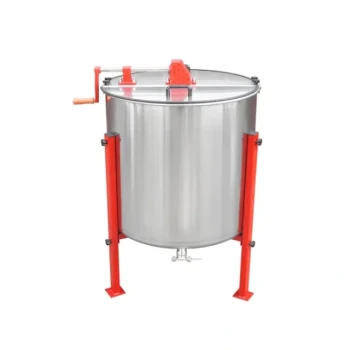
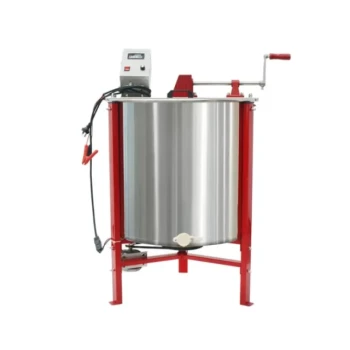
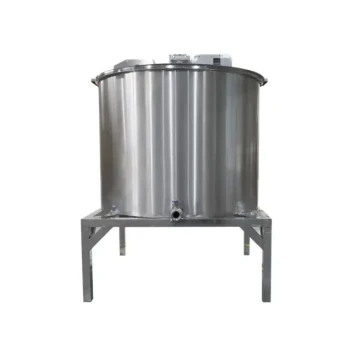
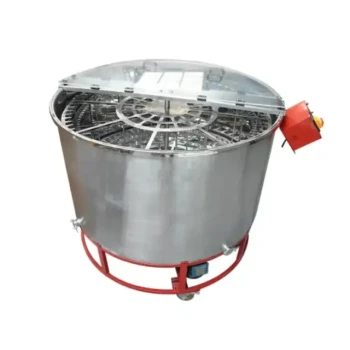
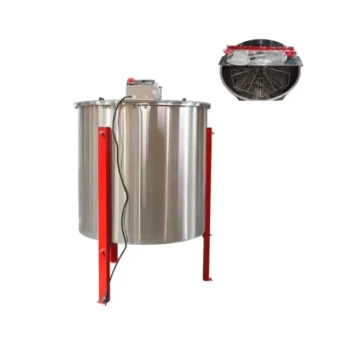
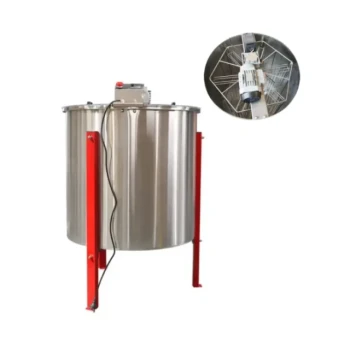
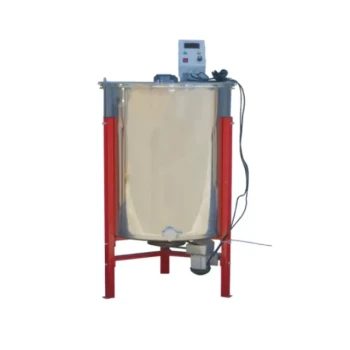
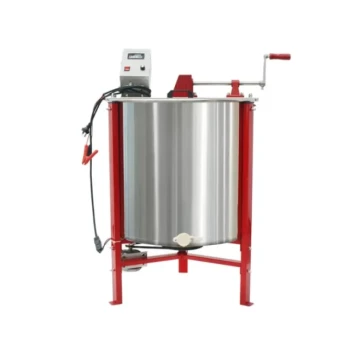
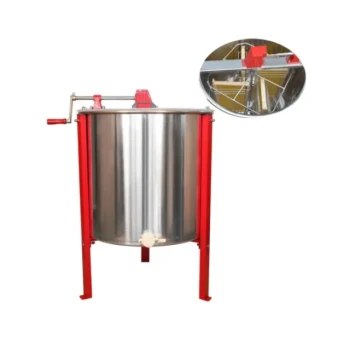
A radial honey extractor works by utilizing centrifugal force to pull honey simultaneously from both sides of the honeycomb frames. The frames are arranged vertically like the spokes of a wheel, with the top bars facing the outer wall of the drum. As the internal basket spins, the honey is ejected from the uncapped cells, hits the inner wall of the drum, and flows to the bottom for collection without the need to ever flip the frames.
Core Takeaway: The defining advantage of a radial extractor is workflow efficiency. By positioning frames outward like wheel spokes, it extracts honey from both sides of the comb at once, completely eliminating the time-consuming step of stopping the machine to reverse the frames.
The Mechanical Configuration
The "Spoke" Arrangement
Unlike tangential extractors where frames form a box shape, a radial extractor positions frames vertically and perpendicular to the center shaft.
Proper Frame Orientation
The orientation is critical for the physics to work. The top bar of the frame must face the outer wall of the drum, while the bottom bar faces the center axle. This aligns the natural upward slant of the honeycomb cells with the direction of the centrifugal force.
The Extraction Process
Simultaneous Extraction
Because of the spoke-like positioning, the spinning motion creates a vacuum effect that pulls honey out of the cells. The unique benefit here is that honey is extracted from both sides of the frame at the same time.
Preserving the Comb
The process relies entirely on centrifugal force. There is no need to scrape or crush the comb. Once the honey is flung out, the wax structure remains intact, allowing beekeepers to return the drawn comb to the hive for immediate reuse by the bees.
Operational Workflow
Starting the Spin
The extraction process usually begins with a slow rotation. This prevents damage to the heavy, full combs. As the honey begins to leave the cells, the weight decreases, and the speed is gradually increased to whip out the remaining thick honey.
Collection
As honey is flung against the drum's inner walls, gravity pulls it down. It pools at the bottom of the extractor, where it is released through a honey gate or tap into a filter and bucket for bottling.
Understanding the Trade-offs
Efficiency vs. Size
Radial extractors are significantly more efficient than tangential models because they remove the manual labor of flipping frames. However, to accommodate frames end-to-end like spokes, the drum diameter is typically larger, requiring more storage space.
Frame Limitations in Smaller Units
In smaller radial units, the centrifugal force near the center axle is weaker than at the outer wall. Consequently, some smaller radial extractors may struggle to fully empty the inner edge of very deep frames. Some models mitigate this by including screens that allow for tangential extraction of large frames if necessary.
Making the Right Choice for Your Apiary
The decision to use a radial extractor depends largely on your volume and desire for automation.
- If your primary focus is time efficiency: Choose a motorized radial extractor, as processing both sides simultaneously cuts your extraction time roughly in half.
- If your primary focus is volume: Choose a radial extractor, as the design typically accommodates a higher capacity (often 6 to 20+ frames) compared to tangential units.
- If your primary focus is budget: Be aware that radial extractors are generally an investment step up from manual tangential models, aimed at serious hobbyists or commercial operations.
A radial extractor turns a labor-intensive chore into a streamlined process, allowing you to process more honey with less physical handling.
Summary Table:
| Feature | Radial Honey Extractor | Tangential Honey Extractor |
|---|---|---|
| Frame Orientation | Vertical, like spokes of a wheel | Parallel to the drum wall |
| Extraction Method | Both sides simultaneously | One side at a time |
| Frame Flipping | Not required | Required to extract second side |
| Efficiency | High (Great for large volumes) | Moderate (Best for small batches) |
| Drum Size | Generally larger | Generally more compact |
| Comb Preservation | Excellent (Preserves wax structure) | Good (Risk of blowout if fast) |
Upgrade Your Apiary with HONESTBEE Professional Equipment
Are you looking to scale your honey production or optimize your distribution workflow? HONESTBEE specializes in supporting commercial apiaries and distributors with high-performance beekeeping solutions. From high-capacity radial extractors to specialized hive-making and honey-filling machinery, we provide the full spectrum of industrial-grade tools and consumables your business needs to thrive.
Partner with HONESTBEE to access:
- Comprehensive Wholesale Offerings: Competitive pricing on bulk beekeeping hardware.
- Advanced Machinery: Reliable equipment designed for heavy-duty commercial use.
- Industry Expertise: Solutions tailored to the needs of professional beekeepers and global distributors.
Ready to enhance your efficiency? Contact our sales team today to discuss our wholesale portfolio and how we can support your growth.
Related Products
- 24 Frame Honey Extractor Commercial Radial Honey Frame Extraction Machine
- Stainless Steel Manual 8 Frame Radial Honey Extractor Machine for Beehives
- 6 Frame Manual Stainless Steel Honey Extractor Beekeeping Equipment
- HONESTBEE 8 Frame Electric and Manual Three Use Honey Extractor
- Electric 4 Frame Tangential Honey Extractor
People Also Ask
- How does a radial honey extractor leverage the natural structure of a honeycomb? Optimize Your Apiary's Efficiency
- How do modern honey extraction machines improve harvest efficiency? Boost Your Yield with Radial Technology
- Why must the head of the honey comb be placed near the center axis? Protect Your Comb During Radial Extraction
- Why is the width of iron rings varied for radial honey extractor tilt? Optimize Your Harvest with Precise Engineering
- What are the operational differences between radial and tangential honey extractors? Maximize Your Harvest Efficiency