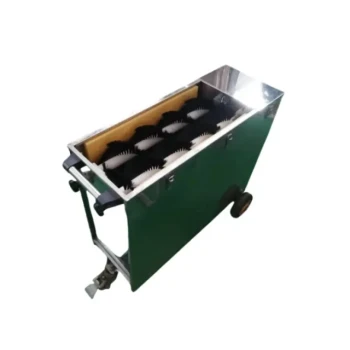
Specialized transport equipment functions as the backbone of migratory beekeeping economics by transforming a stationary apiary into a mobile agricultural service. This hardware enables the continuous relocation of colonies to track flowering cycles, thereby maximizing nectar collection and unlocking a secondary, often more lucrative, revenue stream through crop pollination services. By overcoming the limitations of local geography, beekeepers can maintain production year-round rather than being bound by a single region's floral season.
The true economic power of specialized transport lies in its ability to bridge the gap between apiary and agriculture. While it significantly boosts honey yields, the equipment creates even greater value by supporting the pollination of seeds and fruits—an economic contribution that often far exceeds the direct market value of the honey produced.
The Dual Economic Engine
The economic model of migratory beekeeping relies on two distinct revenue streams, both of which are entirely dependent on reliable mobility.
Overcoming Geographical Limitations
In a fixed-location model, honey production is capped by the local flowering season. Once the local blooms fade, production stops.
Specialized transport breaks this ceiling by allowing beekeepers to follow plant phenology (flowering cycles) across different regions and altitudes. This mobility ensures colonies are constantly exposed to peak nectar flows, significantly increasing the total annual honey yield per hive.
Monetizing Pollination Services
The primary reference highlights a critical economic reality: the value of pollination often surpasses the value of the honey.
Transport equipment allows beekeepers to position hives exactly where crops require pollination, turning the colony into a service asset. This supports broader agricultural stability by ensuring the successful production of seeds and fruits, creating a symbiotic economic relationship between beekeepers and farmers.
Operational Stability and Asset Protection
Beyond revenue generation, specialized equipment plays a vital role in cost control and risk mitigation.
Reducing Colony Loss
Transporting live insects is inherently risky; overheating or physical stress can destroy a colony in transit.
Professional transport equipment is designed with specific ventilation and fixation systems to maintain structural stability and airflow. By ensuring colony survival during long-distance moves, the equipment protects the beekeeper's core capital assets.
Mitigating Environmental Risk
Stationary hives are vulnerable to local environmental anomalies, such as drought, extreme heat, or regional food scarcity.
Mobility allows beekeepers to evacuate colonies from resource-poor or dangerous environments to resource-rich areas. This flexibility flattens the volatility of honey production, ensuring more consistent year-over-year returns.
Enabling Industrial Scale
Transitioning from small-scale to industrialized beekeeping requires moving massive numbers of hives efficiently.
Specialized loading mechanisms and transport accessories reduce the manual labor and time required for relocation. This operational efficiency is the hardware foundation that allows operations to scale up without a linear increase in labor costs.
Understanding the Trade-offs
While specialized transport is a powerful enabler, it introduces specific complexities that must be managed.
Capital Intensity vs. Utilization
Investing in specialized vehicles and securing devices significantly increases the upfront capital expenditure (CapEx) of the operation.
To justify this expense, the equipment must be utilized frequently. This forces the beekeeper into a high-mobility schedule, which can increase operational overhead (fuel, maintenance) compared to stationary beekeeping.
The Logistics of livestock
Even with specialized equipment, moving hives places physiological stress on the bees.
If the equipment is not maintained or if transit times are mismanaged, the stress can delay foraging upon arrival. Beekeepers must balance the economic need for frequent moves against the biological need for colony recovery and acclimatization.
How to Apply This to Your Operations
To leverage specialized transport effectively, align your equipment strategy with your specific revenue goals.
- If your primary focus is Honey Production: Prioritize equipment that offers maximum speed and flexibility to chase ephemeral nectar flows across diverse altitudes and vegetation zones.
- If your primary focus is Pollination Services: Prioritize equipment with high-capacity loading and superior ventilation to ensure large numbers of hives arrive at agricultural sites in prime condition for immediate work.
Ultimately, specialized transport equipment is not just a logistical tool; it is the mechanism that converts a bee colony from a local resource into a scalable agricultural asset.
Summary Table:
| Economic Driver | Role of Specialized Transport Equipment | Key Financial Benefit |
|---|---|---|
| Resource Access | Enables tracking of flowering cycles across regions | Maximizes annual honey production volumes |
| Pollination Income | Facilitates precise hive placement for crop services | Unlocks high-value service-based revenue streams |
| Asset Protection | Advanced ventilation and secure fixation systems | Reduces colony loss and preserves capital |
| Risk Mitigation | Allows evacuation from drought or resource-poor areas | Stabilizes year-over-year production returns |
| Operational Scale | Mechanized loading and high-capacity transit | Lowers per-unit labor costs for large apiaries |
Elevate Your Beekeeping Operation to Industrial Efficiency
Transitioning to a migratory model requires more than just mobility; it demands precision hardware that protects your livestock and maximizes your ROI. HONESTBEE specializes in supporting commercial apiaries and distributors with a comprehensive suite of professional tools.
Whether you need specialized hive-making machinery, high-efficiency honey-filling systems, or rugged transport equipment designed for the rigors of the road, our wholesale portfolio is built for scale. We help you turn bee colonies into high-performing agricultural assets while minimizing labor and environmental risks.
Ready to scale your production? Contact our expert team today to discuss how our equipment can drive your business growth.
References
- Piotr Semkiw, Dariusz Gerula. Economic Determinants of the Honey Market in Poland. DOI: 10.3390/agriculture15232458
This article is also based on technical information from HonestBee Knowledge Base .
Related Products
- Plastic Transporting Bee Packages and Nuc Boxes for Beekeeping
- Stainless Steel J Hook Hive Tool for Beekeeping
- Durable Galvanized Steel Frame Grip
- Professional 600D Oxford Cloth Beekeeping Tool Bag with 8 Pockets and Elastic Loops
- Stainless Steel Queen Grafting Tool for Beekeeping and Bee Queen Grafting
People Also Ask
- What role do bee package boxes play in the commercial transport and expansion of honeybee colonies? - Logistic Essentials
- What are beekeeping boxes called? A Guide to Hive Bodies and Box Types
- How do standardized bee packages serve as a recovery mechanism for commercial beekeeping? Ensure Business Continuity
- What is the commercial value of using standardized bee packages? Drive Scalability in Large-Scale Apiaries
- Why is the timely introduction of high-quality bee packages critical? Save Your Apiary from Asian Hornet Invasions