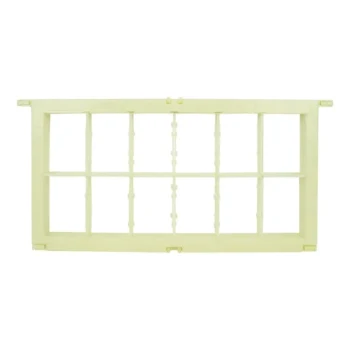
Honey chamber boxes, or "supers," act as modular expansion units that allow beekeepers to vertically scale hive capacity in direct response to nectar flow. By immediately alleviating congestion in the main brood chamber, these boxes suppress the colony's natural instinct to swarm while creating a dedicated, clean zone for surplus honey storage.
By isolating the "nursery" from the "warehouse," supers allow colonies to focus entirely on resource accumulation rather than reproduction. This spatial management is the primary mechanic that transforms a sustainable colony into a surplus-producing commercial asset.
Optimizing Colony Behavior and Space
To understand how supers increase production, one must look at how they manipulate the biological imperatives of the bee colony.
Suppressing the Swarming Instinct
The primary limit on honey production is the colony's natural desire to reproduce via swarming. When the main brood chamber becomes crowded, the colony splits, taking half the workforce and the potential harvest with it.
Adding supers provides immediate relief to this congestion. By expanding the hive vertically, you reduce population density pressure, effectively "convincing" the bees to remain in the current hive and continue foraging.
Redirecting Energy to Collection
Within these supers, the use of high-quality artificial foundation plays a critical supporting role. This precise wax base guides bees to build uniformly and minimizes the metabolic energy required for wax secretion.
Instead of consuming honey to produce wax for comb building, the colony redirects those calories toward nectar collection. This energy efficiency directly correlates to a higher total yield per colony.
Streamlining Commercial Operations
In a commercial context, yield is not just about biology; it is about the efficiency of the harvest. Supers standardize the interaction between the beekeeper and the hive.
Ensuring Product Purity
Supers encourage bees to store surplus honey in a dedicated area, physically separated from the brood (eggs and larvae). This separation is vital for maintaining honey purity.
It prevents the contamination of the harvest with brood cocoons or larval waste. This ensures a cleaner raw product that requires less filtration and processing, preserving the honey's market value.
Facilitating Mechanization
Standardized supers (often with dimensions around 50x40x25 cm) turn beekeeping into a modular process. Because the honey is isolated in these removable units, beekeepers can harvest without dismantling the entire colony.
This uniformity is essential for the use of centrifugal honey extractors and automated filling machines. It allows for mass harvesting and processing, which is the only way to achieve viable commercial scale.
Understanding the Trade-offs
While supers are essential for high yields, their misuse can be detrimental to the colony.
Thermal Regulation Risks
Adding supers too early in the season increases the volume the bees must heat. If the internal space is too large relative to the population, bees must consume their honey reserves to generate warmth, thereby reducing the net harvest.
Transport Logistics
In migratory beekeeping, where platforms move colonies to high-yield forest areas, supers add significant weight and height. While migratory practices can increase yields by over 200%, the added verticality of supers requires specialized securing systems to prevent collapse during transport.
Strategic Implementation for Maximum Yield
To leverage supers effectively, align your management strategy with your specific production goals.
- If your primary focus is Volume: Prioritize the use of supers equipped with pre-made artificial foundation to minimize wax production and maximize nectar storage.
- If your primary focus is Efficiency: Ensure all supers strictly adhere to standard dimensions (e.g., 50x40x25 cm) to ensure compatibility with centrifugal extraction machinery.
- If your primary focus is Colony Health: Monitor hive density closely and only add supers when the brood chamber is near capacity to prevent thermal stress while still averting swarming.
The super is the fundamental hardware component that bridges the gap between biological potential and industrial capacity.
Summary Table:
| Feature | Function | Commercial Benefit |
|---|---|---|
| Vertical Expansion | Alleviates brood chamber congestion | Suppresses swarming and retains the workforce |
| Spatial Isolation | Separates honey storage from brood | Ensures product purity and reduces filtration needs |
| Modular Design | Standardizes hive units (e.g., 50x40x25 cm) | Facilitates use of extractors and filling machines |
| Artificial Foundation | Provides a precise wax base for comb | Saves bee energy, redirecting it to nectar collection |
Maximize Your Apiary's Potential with HONESTBEE
At HONESTBEE, we understand that commercial success depends on the perfect synergy between biological health and industrial efficiency. We cater specifically to commercial apiaries and distributors, providing a comprehensive wholesale catalog designed to scale your operations.
From precision-engineered honey supers and high-quality artificial foundations to industrial-grade honey-filling machines and centrifugal extractors, our portfolio covers the full spectrum of beekeeping hardware and consumables. Whether you are managing a migratory operation or looking to optimize your processing facility, our specialized equipment ensures higher yields and lower labor costs.
Ready to elevate your production? Contact us today to discuss our wholesale offerings and discover how HONESTBEE can streamline your path to a more profitable harvest.
References
- Esubalew Shitaneh, Amssalu Bezabeh. Performance evaluation of local honey bee race ( <i>Apis melifera secutellata)</i> in the Metekel Zone of North Western Ethiopia. DOI: 10.1002/vms3.885
This article is also based on technical information from HonestBee Knowledge Base .
Related Products
- Plastic Honey Comb Frames Cassette Box for Honey
- Automatic Heat Preservation 6 Frame Pro Nuc Box for Honey Bee Queen Mating
- Twin Queen Styrofoam Honey Bee Nucs Mating and Breeding Box
- Langstroth Honey Bee Box Hive Boxes for Different Depths
- Professional Sectional Comb Honey Frame with 250g Cassette System for Beekeeping
People Also Ask
- How are honeybee combs utilized for non-destructive colony monitoring? Master Population Density Tracking
- What is the significance of sampling honeycomb frames and hive bottoms? A Guide to Scientific Sanitation Monitoring
- What is a honeycomb frame? The Key to Modern, Sustainable Beekeeping
- What is the technical purpose of exchanging honeycomb frames? Master Apiary Equalization for Growth
- What frame to use for honeycomb? Choose the Right System for Pure, Edible Comb