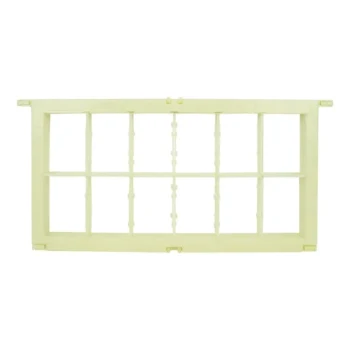
Standardized brood frames act as the essential control variable in the complex process of selecting hygienic queens. By creating a consistent area of capped larvae at a uniform developmental stage, these frames allow researchers and breeders to define a fixed test area of consecutive cells. This mechanical consistency eliminates the noise of irregular cell arrangement or scattered larval distribution, ensuring that the selection of queens is based on reliable phenotypic data rather than environmental randomness.
The Core Efficiency Principle High-quality breeding requires distinguishing genetic potential from random chance. Standardized frames provide the uniform "canvas" necessary to prove that a colony’s hygienic efficiency is a result of the queen's superior genetics, not the structure of the comb.
The Mechanics of Precision Breeding
Creating a Uniform Test Substrate
To accurately measure hygienic behavior, you must compare "apples to apples." Standardized brood frames provide a consistent foundation of capped larvae at the exact same stage of development. This uniformity creates a high-quality substrate that serves as a baseline for all subsequent testing.
Eliminating Structural Variables
In natural or non-standardized combs, larvae may be scattered, or cells may be arranged irregularly. By defining a fixed test area of consecutive cells on a standardized frame, you significantly reduce experimental errors. This ensures that the time taken to clean the cells is a reflection of behavior, not the difficulty of the comb structure.
Enabling Reliable Phenotypic Data
The ultimate goal of this testing is to select queens with superior traits. The standardized approach transforms vague observations into concrete, reliable phenotypic data. This accuracy is a non-negotiable requirement for large-scale breeding programs aiming for high hygienic traits.
The Role of Hardware in Data Reliability
Facilitating Large-Scale Comparisons
Standardized hive systems, such as Dadant or Langstroth, utilize removable frames that ensure consistency across different colonies and geographical regions. Because the hardware is uniform, a test result in one location can be reliably compared to a test result in another. This standardization allows for the extraction of combs for photographic recording and manual intervention without disrupting the colony's architecture.
Distinguishing Genetics from Colony Strength
Efficiency is not just about genetics; it is also about the workforce. Standardized frames allow you to count "bee spaces" to measure colony strength quantitatively. By correlating worker bee density with cleaning speeds (e.g., hours to 100% removal), you can determine if a colony is hygienic because of its genes or simply because it has a larger population.
Understanding the Trade-offs
Hardware Does Not Fix Management
While standardized frames reduce structural error, they cannot compensate for poor colony management. If a colony is weak or under stress, even a perfect test frame will yield misleading data. You must rigorously monitor colony strength (bee spaces) to ensure the data is valid.
The Risk of Over-Reliance on Snapshots
A standardized frame provides a snapshot of behavior at a specific developmental stage. Relying solely on a single test without accounting for seasonal changes or external environmental factors can lead to "false positives" in selection. Standardization aids accuracy but does not replace the need for repeated measures.
How to Apply This to Your Project
Before implementing a hygienic testing protocol, clarify your primary objective to ensure you are gathering the right data.
- If your primary focus is Commercial Queen Breeding: Prioritize the use of uniform Langstroth or Dadant frames to create a scalable, repeatable testing workflow that minimizes labor and maximizes data comparison.
- If your primary focus is Genetic Research: rigorous adherence to a fixed test area of consecutive cells is required to statistically eliminate irregular cell arrangement as a variable in your phenotype analysis.
Standardization turns the biological chaos of a beehive into a measurable dataset, giving you the power to breed with confidence.
Summary Table:
| Key Factor | Role in Efficiency | Impact on Selection |
|---|---|---|
| Uniform Substrate | Provides consistent capped larvae stages | Eliminates age-related variables |
| Structural Consistency | Defines fixed areas of consecutive cells | Reduces noise from irregular comb |
| Hardware Standard | Compatibility across Dadant/Langstroth | Enables large-scale data comparison |
| Colony Metrics | Allows quantitative bee-space counting | Separates genetics from colony strength |
Elevate Your Breeding Precision with HONESTBEE
To achieve reliable genetic selection, your hardware must be as precise as your science. HONESTBEE supports commercial apiaries and distributors with high-quality, standardized beekeeping tools and machinery designed for peak efficiency.
Whether you need precision-manufactured Langstroth frames for consistent testing or advanced honey-filling and hive-making machinery to scale your operations, our comprehensive wholesale portfolio has you covered. Let us provide the essential infrastructure that turns your biological data into breeding success.
Ready to upgrade your apiary’s performance? Contact HONESTBEE Today
References
- H. Rasolofoarivao, Johanna Clémencet. Assessing hygienic behavior of Apis mellifera unicolor (Hymenoptera: Apidae), the endemic honey bee from Madagascar. DOI: 10.4238/2015.june.1.5
This article is also based on technical information from HonestBee Knowledge Base .
Related Products
- Assembled Wooden Bee Frames with Plastic Foundation for Durability and Convenience by HONESTBEE
- Professional Galvanized Steel Frame Rest for Beehives
- JZBZ Langstroth Queen Rearing Frame for Beekeeping
- Assembled Wooden Bee Frames with Beeswax Foundation Ready to Use by HONESTBEE
- Professional Sectional Comb Honey Frame with 250g Cassette System for Beekeeping
People Also Ask
- When should frames with new foundation be given to colonies? Master Timing for a Thriving Hive
- Can beekeepers switch between wooden and plastic frames? Optimize Your Hive's Performance
- Do you have to wire bee frames? Essential Guide to Frame Strength & Honey Harvesting
- What are bee frames and how are they sized? A Professional Guide to Standardization & Material Choice
- How do you re-wax bee frames? A Simple Guide to Faster Comb Building