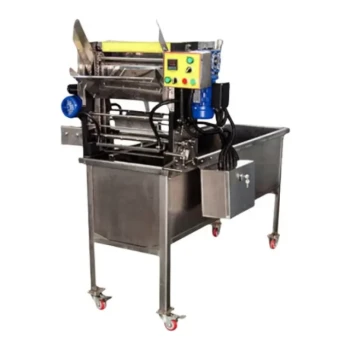
Automated hive-making machines fundamentally transform large-scale apiary management by delivering a level of geometric precision and consistency that manual construction cannot rival. The primary benefit is the establishment of standardized dimensions, which directly enables the use of mechanized honey extraction systems, streamlines the industrial transport of colonies, and significantly boosts overall production efficiency.
The Core Insight Success in commercial beekeeping relies less on the volume of hives and more on the interchangeability of equipment. Automated manufacturing ensures every component is identical, creating a uniform infrastructure that supports rapid scalability, mechanized processing, and long-term durability.
The Strategic Value of Standardization
Enabling Mechanized Processing
Modern commercial apiaries rely on automated extraction lines to process honey efficiently. Hive-making machines produce frames and boxes with strict dimensional tolerances. This precision prevents equipment jams and ensures compatibility with unstackers, uncappers, and extractors, eliminating manual adjustments during harvest.
Seamless Interchangeability
In a large operation, managing thousands of unique components is impossible. Machine-made hives ensure that frames and bodies are perfectly uniform and interchangeable between different units. This simplifies complex biological tasks, such as splitting colonies, merging hives, or replacing damaged parts without disrupting the bee cluster.
Optimized Logistics
Standardized dimensions facilitate the industrial movement of colonies. Because every hive box is identical, they stack securely on pallets and trucks for migratory beekeeping. This uniformity reduces the risk of transit damage and speeds up loading and unloading procedures.
Scaling Operations Efficiently
Removing Growth Bottlenecks
Manual hive construction often lags behind the biological expansion of colonies, limiting an apiary's growth. Automated machines utilize high-speed cutting and assembly to provide a rapid, continuous supply of hardware. This autonomous production capability ensures that physical infrastructure never hinders the expansion of colony sizes or breeding density.
Reducing Long-Term Costs
While the initial machinery investment is significant, it lowers the unit cost of each hive. By reducing reliance on manual labor and minimizing material waste through precision cutting, operations can deploy high-performance equipment at a lower cost per unit. This economic efficiency is crucial for maintaining profitability in competitive markets.
Impact on Colony Health
Accurate "Bee Space" Design
Machine-made hives adhere to precise scientific structures, specifically the "bee space" (the specific gap bees need to move freely). Accurate dimensions prevent bees from gluing frames together with propolis or building stray comb (burr comb). This facilitates easier inspections and reduces the time required for pest monitoring.
Enhanced Durability and Overwintering
High-precision assembly results in tighter joints and structurally sound hives. These standardized units offer better insulation and protection against the elements, improving overwintering survival rates. Furthermore, the structural durability extends the service life of the equipment, providing a stable environment that enhances disease resistance.
Understanding the Trade-offs
Capital Expenditure vs. Operational Expense
Implementing industrial-grade hive-making machinery requires a substantial upfront capital investment. For smaller operations, this cost may outweigh the efficiency gains. It is a solution designed for enterprises where labor and scale are the primary cost drivers, not for hobbyists.
Loss of Customization
Automated machines excel at producing identical units but lack flexibility. If your local environment or specific bee breed requires non-standard hive dimensions or unique modifications, reliance on automated machinery can become a constraint rather than a benefit.
Making the Right Choice for Your Goal
To determine if automated hive-making technology aligns with your operational needs, consider your primary objectives:
- If your primary focus is rapid scalability: Prioritize automation to eliminate hardware shortages and ensure your infrastructure keeps pace with aggressive colony splitting.
- If your primary focus is efficiency: Leverage machine-made hives to enable the use of automated extraction lines and palletized transport.
- If your primary focus is colony health: Use precision-milled equipment to ensure accurate bee space, reducing stress on the colony and minimizing burr comb.
Ultimately, automated hive manufacturing is not just about woodworking; it is the hardware foundation that allows an apiary to transition from a labor-intensive craft to a streamlined industrial operation.
Summary Table:
| Key Benefit | Description | Strategic Impact |
|---|---|---|
| Standardization | Precision dimensions and strict tolerances | Enables mechanized extraction and seamless interchangeability |
| Scalability | High-speed, continuous hardware production | Removes growth bottlenecks for rapid colony expansion |
| Logistics Efficiency | Uniform stackable units for transport | Reduces transit damage and speeds up migratory loading |
| Colony Health | Perfect "bee space" and tighter joints | Minimizes burr comb and improves overwintering survival |
| Economic Value | Reduced labor and minimized material waste | Lowers the long-term cost per unit for large-scale operations |
Revolutionize Your Beekeeping Infrastructure with HONESTBEE
Transitioning from manual labor to industrial efficiency requires a partner who understands the scale of commercial success. HONESTBEE specializes in empowering commercial apiaries and distributors with high-performance automated hive-making and honey-filling machinery.
Our comprehensive wholesale catalog offers more than just tools; we provide the precision hardware and essential industry consumables needed to maintain a competitive edge. Whether you are looking to standardize your fleet of hives or scale your production capacity, our expert team is ready to support your growth.
Ready to optimize your operations? Contact HONESTBEE Today to explore our full spectrum of beekeeping equipment and industrial machinery.
References
- Vidal Salazar Solano, Isaac Shamir Rojas Rodríguez. La configuración del mercado global de la miel: un análisis de equivalencia estructural. DOI: 10.22201/enesl.20078064e.2023.25.82397
This article is also based on technical information from HonestBee Knowledge Base .
Related Products
- Automatic High-Speed Bee Hive Box Stapling Machine
- Automatic Finger Joints Joint Making Machine for Bee Box and Hive Making
- High-Efficiency Pneumatic Bee Hive Making Machine for Rapid Box Assembly
- Mini Desktop Bee Hive Frame Forming Making Machine
- Beehive Handle and Frame Rest Cutting Machine: Your Specialized Hive Machine
People Also Ask
- How is the Bee Box machine adjusted for different box sizes? Maximize Your Woodworking Versatility and Precision
- How is the Bee Box machine operated? Optimize Your Commercial Hive Production with Scalable Staffing Solutions
- How was the Bee Box machine designed? Industrial Engineering for High-Volume Beekeeping Production
- What is the production capacity of the Bee Box machine? Boost Output up to 1,000 Boxes Daily
- What are the power requirements and control system for the Bee Box machine? Optimize Your Apiary Equipment Production