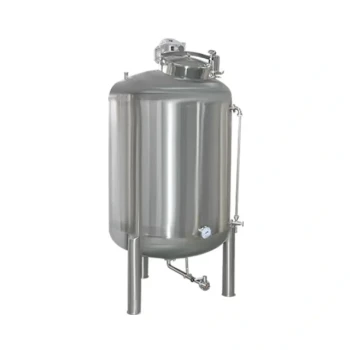
The primary function of industrial-grade large sedimentation tanks is to serve as a passive, non-invasive purification stage within the honey processing line. These tanks provide a controlled, static environment that utilizes gravitational force to naturally separate physical contaminants—specifically wax debris, air bubbles, and microscopic impurities—thereby establishing the product's clarity and stability.
By relying on natural density differences rather than aggressive mechanical processing, sedimentation tanks enhance visual clarity and prevent fermentation while preserving the honey's delicate nutritional and enzymatic activity.
The Mechanics of Natural Purification
Leveraging Gravitational Principles
The core mechanism of these tanks is the use of specific gravity to separate unwanted elements from the pure honey.
Because the tank provides a strictly static environment, lighter impurities such as micro-bubbles and wax residues naturally rise to the surface to be skimmed off.
Simultaneously, heavier sediments and foreign particles sink to the bottom, leaving the middle layer as purified, clear liquid honey.
Enhancing Sensory Quality
This physical separation is critical for meeting industrial sensory standards.
The removal of suspended solids and air pockets transforms cloudy raw honey into a transparent, visually appealing product suitable for high-end retail markets.
Chemical and Biological Stability
Preventing Fermentation
Proper sedimentation tanks, typically constructed from food-grade stainless steel, feature an airtight design.
This is vital because honey is hygroscopic (it absorbs moisture from the air); an airtight environment prevents moisture intake, which is the primary cause of fermentation and spoilage.
Ensuring Chemical Stability
By stabilizing the moisture content and removing impurities that could act as catalysts for degradation, the tanks ensure the physical and chemical stability of the honey prior to bottling.
Preservation of Bio-Activity
Avoiding Thermal Damage
Unlike aggressive filtration methods that may require high heat, sedimentation is a gentle process.
It allows for purification while preserving the original nutritional content and flavor profile of the honey.
Maintaining Enzymatic Integrity
The process protects the honey's "living" qualities, ensuring that the final product retains the nutritional activity that consumers expect from a premium natural product.
Understanding the Trade-offs
Time vs. Throughput
The sedimentation process is inherently slower than active filtration systems. It requires the honey to sit undisturbed for significant periods to allow gravity to work effectively.
Efficiency bottlenecks can occur if production volume exceeds tank capacity, making this method a potential choke point in high-speed processing lines.
Separation Limits
While effective for macro-impurities and air bubbles, sedimentation alone may not remove ultrafine particles.
It is often most effective when used as a precursor to, or in conjunction with, multi-stage precision filters for markets requiring absolute optical brilliance.
Making the Right Choice for Your Goal
To maximize the efficacy of your processing line, align your equipment usage with your specific end-product requirements:
- If your primary focus is nutritional integrity: Prioritize sedimentation time over mechanical filtration to maximize the retention of pollen and enzymes while ensuring clarity.
- If your primary focus is shelf-life stability: Ensure your sedimentation tanks are strictly airtight and made of stainless steel to prevent moisture absorption and subsequent fermentation.
Success in honey processing lies in balancing the patience required for natural sedimentation with the efficiency needed for commercial scalability.
Summary Table:
| Key Feature | Functional Benefit | Impact on Honey Quality |
|---|---|---|
| Gravitational Separation | Naturally removes wax, bubbles, and debris | Enhanced visual clarity and transparency |
| Airtight Construction | Prevents moisture absorption (hygroscopic) | Prevents fermentation and extends shelf-life |
| Non-Invasive Process | Avoids aggressive heat or mechanical force | Preserves enzymes, pollen, and bio-activity |
| Passive Purification | Acts as a pre-filtration stabilization stage | Ensures chemical stability before final bottling |
Elevate Your Honey Production with HONESTBEE Professional Solutions
At HONESTBEE, we understand that maintaining the delicate balance between high-volume throughput and premium honey quality is the foundation of a successful commercial apiary or distribution business. As a leading global supplier of professional beekeeping machinery and tools, we provide everything from large-scale sedimentation tanks and honey-filling machines to essential consumables and specialized hardware.
Whether you are a commercial apiary looking to scale up or a distributor seeking a comprehensive wholesale partner, our team is ready to optimize your processing line with durable, food-grade equipment designed for excellence.
Ready to upgrade your facility? Contact us today to explore our full equipment catalog and see how our expertise can drive your business growth.
References
- أحمد على سید إبراهیم الدرس, بهاء فؤاد مبروک سلیمان مُقبلة. نحل العسل ومنتجاته فی محافظة بنی سویف - دراسة فی الجغرافیا الاقتصادیة. DOI: 10.21608/agj.2021.228503
This article is also based on technical information from HonestBee Knowledge Base .
Related Products
- Stainless Steel Honey Storage Tank with Lid for Honey
- Heavy Duty Stainless Steel Honey Processing Machine Decrystallizing Tank
- Professional Honey Storage Tank with Agitation System
- Stainless Steel Honey Storage and Settling Tank with Double Strainer
- Stainless Steel Uncapping Tank with Stand and Strainer
People Also Ask
- What economic role do honey storage tanks play? Boost Your Revenue Through Strategic Inventory Management
- What roles do industrial honey storage tanks and filtration meshes play in processing? Ensure Purity & Consistency
- What is the purpose of a honey storage tank? Streamline Your Honey Processing for Quality & Efficiency
- What are honey storage tanks used for? Essential Features for Quality Preservation and Profit
- How do large honey storage tanks and gravity fall filling systems improve honey packaging efficiency and safety?