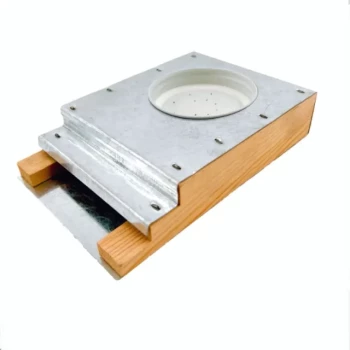
Selecting the right honey bee feeder depends on balancing convenience with the specific needs of your colony. The beekeeping industry primarily utilizes six distinct feeder designs: entrance feeders, top feeders, baggie feeders, frame (or division board) feeders, bucket (gravity) feeders, and open (community) feeders.
While all feeders serve the same basic purpose, the optimal choice depends entirely on your specific hive configuration, current weather conditions, and the need to balance ease of access against the risk of robbing.
Exterior and Entrance-Based Options
These feeders are generally designed for ease of access and monitoring, allowing the beekeeper to check food levels without fully inspecting the colony.
Entrance Feeders (Front Feeders)
This device consists of a base that slides directly into the hive entrance, holding an inverted jar (usually glass or plastic).
The lid of the jar contains small holes, allowing syrup to drip down for the bees to access.
The primary advantage is visibility; you can monitor syrup levels instantly without opening the hive or disturbing the colony.
Bucket or Gravity Feeders
These are typically large, inverted pails placed over the inner cover hole or directly on top of the frames.
They operate on the principle of vacuum pressure and gravity, categorized as "contact feeders" because the bees access the feed directly through a mesh or perforated lid.
They generally hold a larger volume of feed than entrance feeders, reducing the frequency of refills.
Interior and Top-Mounted Options
These designs are integrated more deeply into the hive structure. They often protect the feed from the elements and keep the syrup closer to the warmth of the cluster.
Top Feeders
These units are placed directly underneath the main telescoping lid and on top of the inner cover.
They typically consist of a large tray or reservoir.
Because they sit at the top of the hive where heat rises, the syrup often stays warmer, which can help bees consume it more efficiently in cooler weather.
Frame Feeders (Division Board Feeders)
This internal option is designed to replace one or two actual frames inside the brood box.
It sits essentially as a hollow division board filled with syrup, often with a roughened texture or floats to prevent bees from drowning.
The key benefit is security; the feed is located inside the hive, reducing the scent that attracts predators or robber bees.
Baggie Feeders
This is a simplified method involving a plastic bag filled with syrup placed directly on the top bars of the frames.
Small slits are cut into the bag to allow bees to feed.
It is a cost-effective, disposable solution often used when specific equipment is unavailable or for emergency feeding.
Collective Feeding Strategies
Open or Community Feeders
Unlike the other specific options, these are placed at a distance from the hives rather than attached to them.
They are designed to feed the entire apiary or "community" of bees simultaneously.
This method mimics a natural nectar flow but requires careful management to prevent disease spread between colonies.
Understanding the Trade-offs
Every feeder type comes with operational risks that must be weighed against its convenience.
The Risk of Robbing
Entrance feeders are notorious for triggering robbing behavior. Because the syrup is positioned at the hive's front door, the scent can attract wasps and strong neighboring colonies to attack a weaker hive.
Frame feeders significantly reduce this risk by keeping the scent contained deep within the hive.
Disruption vs. Convenience
Frame feeders require you to open the hive box and remove the inner cover to refill them. This disturbs the colony and releases hive heat.
Top feeders and entrance feeders generally allow for refilling with minimal disturbance to the bees' core cluster.
Temperature Constraints
In cold weather, liquid in an entrance feeder is far from the cluster and can freeze or become too cold for bees to metabolize.
Top feeders and frame feeders benefit from the colony's internal heat, keeping the syrup at a consumable temperature for longer periods.
Making the Right Choice for Your Goal
Select your equipment based on the season and the strength of your colony.
- If your primary focus is non-intrusive monitoring: Use an Entrance Feeder so you can check levels at a glance without opening the hive.
- If your primary focus is winter preparation or volume: Use a Top Feeder or Bucket Feeder to provide large quantities of feed quickly while retaining hive heat.
- If your primary focus is preventing robbing in weak hives: Use a Frame (Internal) Feeder to keep the food source secure inside the brood box.
- If your primary focus is low cost or emergency use: Use a Baggie Feeder for a simple, disposable solution that requires no specialized hardware.
The best feeder is the one that ensures your bees have consistent access to nutrition while minimizing stress on the colony.
Summary Table:
| Feeder Type | Location | Capacity | Best For | Key Advantage |
|---|---|---|---|---|
| Entrance Feeder | Hive Front | Low | Monitoring | Easy to check syrup levels |
| Top Feeder | Above Frames | High | Large Volume | High capacity; minimal disturbance |
| Frame Feeder | Inside Box | Medium | Weak Hives | Prevents robbing; stays warm |
| Bucket Feeder | Top of Hive | High | Winter Prep | Gravity-fed; vacuum pressure |
| Baggie Feeder | Top Bars | Low/Med | Emergency | Cost-effective; disposable |
| Open Feeder | Away from Hive | High | Group Feeding | Low labor; feeds entire apiary |
Elevate Your Beekeeping Operations with HONESTBEE
At HONESTBEE, we specialize in empowering commercial apiaries and beekeeping distributors with high-performance tools and equipment. Whether you need specialized hive-making machinery, precision honey-filling systems, or a bulk supply of industry-standard feeders and consumables, our comprehensive wholesale portfolio is designed to scale your business.
Why partner with us?
- Wholesale Excellence: Access the full spectrum of beekeeping hardware and essential industry consumables.
- Targeted Solutions: From specialized machinery to honey-themed merchandise, we cater to every aspect of the honey industry.
- Proven Reliability: We provide the durability and efficiency required for large-scale commercial success.
Contact HONESTBEE today to streamline your supply chain and discover how our professional beekeeping equipment can drive your productivity forward!
Related Products
- HONESTBEE Round Hive Top Bee Feeder for Syrup
- HONESTBEE Entrance Bee Feeder Efficient Hive Front Liquid Feeding Solution for Beekeeping
- HONESTBEE Professional Entrance Bee Feeder Hive Nutrition Solution
- HONESTBEE Entrance Bee Feeder Professional Hive Nutrition Solution for Beekeeping
- HONESTBEE Square Top Hive Bee Feeder Top Bee Feeder
People Also Ask
- What can the round hive top feeder be used for? A Guide to Efficient, Safe Bee Feeding
- What types of hive boxes is the round hive top feeder compatible with? Universal Fit for 8 & 10-Frame Langstroth Hives
- What is the capacity of the round hive top feeder for syrup and pollen? A Guide to Targeted Apiary Support
- What types of feed can be used with the round hive top feeder? Versatile Feeding for Optimal Apiary Health
- What are the different types of top feeders for bees? Choosing the Best Feeder for Your Apiary