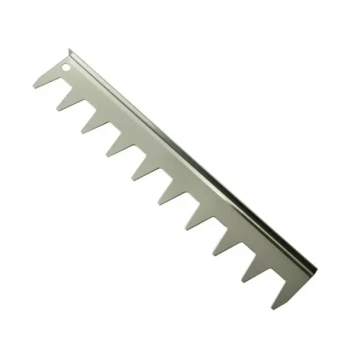
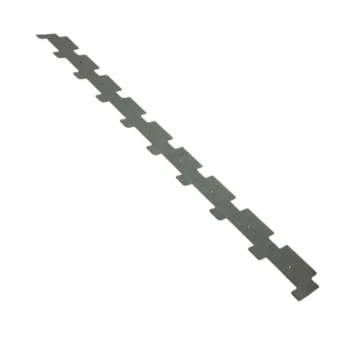
The primary technical advantage of the 10-frame Langstroth hive lies in its strictly standardized deep hive body and robust bottom board structure. This design ensures high physical space consistency across all colonies, which is critical for minimizing environmental variables. It facilitates the precise installation of management accessories, such as entrance reducers and trap lights, while allowing operators to adjust colony strength to maintain uniformity in both experimental and commercial contexts.
Core Takeaway
The 10-frame Langstroth configuration functions as a calibrated instrument rather than just a container. By fixing the internal volume and thermal mass, it isolates colony performance as the primary variable, enabling high-precision data collection in research and mechanized efficiency in commercial operations.
Achieving Environmental Uniformity
Standardization of Internal Volume
The 10-frame deep hive body provides a strictly uniform internal volume. This ensures that every colony occupies an identical physical space.
In research settings, this consistency is vital. It guarantees that variations in internal temperature or humidity are driven by the thermoregulation capabilities of the bees, not by inconsistencies in the container's insulation or size.
The Foundation of the Bottom Board
The primary reference highlights the robust structure of the bottom board. This is not merely a floor; it is a standardized docking port for essential hardware.
Because the dimensions are fixed, accessories like entrance reducers and trap lights fit universally without modification. This allows for identical treatment application across hundreds of colonies, reducing the risk of data skewing due to equipment fitting errors.
Modularity and Operational Scale
The Movable Frame Principle
The 10-frame design relies on the "movable frame" concept, utilizing a scientifically calculated bee space. This precise gap prevents bees from cementing frames together with propolis or burr comb.
This technical feature allows for the non-destructive inspection of the brood chamber. Operators can visually assess pest levels (such as Varroa mites) or diseases (like American Foulbrood) early, without disrupting the colony's structural integrity.
Mechanization and Compatibility
For commercial scalability, the standardized dimensions of the 10-frame box support industrial workflows.
Because the components are uniform, honey harvesting can be performed using mechanized extracting lines. This machinery can uncap and spin frames without crushing the delicate wax comb, preserving the drawn comb for immediate reuse by the colony.
Geographic Comparability
Standardization allows for valid comparisons across different geographic locations.
When studies or commercial trials are conducted at multiple sites, the use of identical 10-frame hardware ensures that the container variable is neutralized. Differences in honey production or survival rates can be attributed to local forage or climate, rather than the hive architecture.
Enhancing Data Precision
Integration with Monitoring Hardware
The 10-frame Langstroth is the industry standard for integrating digital monitoring tools.
Its uniform footprint facilitates the use of high-precision weighing equipment and load cell sensors. Because the "tare weight" of the equipment (woodenware and frames) is consistent, sensors can accurately track real-time changes in biomass and honey stores.
Adjusting Colony Strength
A unique advantage highlighted in the primary reference is the ability to precisely adjust colony strength.
Because frames are interchangeable, brood and food resources can be equalized among hives. This allows researchers to start an experiment with colonies that are statistically identical in population, creating a perfect baseline for testing treatments.
Understanding the Trade-offs
While the 10-frame Langstroth is the standard for uniformity, it presents specific technical challenges that must be managed.
Weight and Ergonomics
A fully loaded 10-frame deep box is significantly heavier than 8-frame alternatives or nucleus colonies. This requires robust lifting equipment or significant manual labor, which can be a limiting factor in rapid management operations.
Thermal Volume Management
The large, fixed internal volume provides excellent thermal mass stability for strong colonies. However, for weaker colonies or small experimental clusters, this volume can be difficult to thermoregulate, potentially skewing data if colony strength is not initially equalized as suggested.
Making the Right Choice for Your Goal
To maximize the utility of the 10-frame Langstroth configuration, align your usage with your specific objectives:
- If your primary focus is Research: Leverage the standardized internal volume and thermal mass to ensure that sensor data reflects biological activity rather than structural variance.
- If your primary focus is Commercial Production: Utilize the strict dimensional standardization to implement mechanized extraction lines and interchangeable components for rapid scalability.
Ultimately, the 10-frame Langstroth hive serves as the technical baseline that transforms beekeeping from a variable craft into a measurable science.
Summary Table:
| Feature | Technical Advantage | Impact on Operations |
|---|---|---|
| Standardized Volume | Uniform internal space and thermal mass | Eliminates environmental variables for precise research data. |
| Robust Bottom Board | Universal docking for entrance reducers & traps | Allows consistent application of hardware across all colonies. |
| Movable Frame Design | Scientifically calculated bee space | Facilitates non-destructive inspections and disease monitoring. |
| Dimensional Consistency | Full compatibility with extraction machinery | Enables high-speed mechanized harvesting and scalability. |
| Digital Integration | Uniform footprint for weighing & sensors | Supports high-precision digital monitoring and biomass tracking. |
Elevate Your Apiary with HONESTBEE Professional Solutions
Maximize your operational efficiency and data precision with the industry-standard equipment your business deserves. HONESTBEE specializes in catering to commercial apiaries and distributors, offering a comprehensive wholesale catalog designed for scale and durability.
Our Value to You:
- Complete Equipment Spectrum: From standardized 10-frame hive components to advanced hive-making and honey-filling machinery.
- Industrial Scalability: High-quality beekeeping tools and consumables that support mechanized workflows and commercial growth.
- Global Distribution: Reliable supply chains for specialized hardware and unique honey-themed cultural merchandise.
Ready to standardize your production or expand your distribution? Contact HONESTBEE Today to access our full wholesale portfolio and expert support!
References
- Cameron Jack, Jamie Ellis. Seasonal differences in Varroa destructor population growth in western honey bee (Apis mellifera) colonies. DOI: 10.3389/fevo.2023.1102457
This article is also based on technical information from HonestBee Knowledge Base .
Related Products
- Durable Plastic Frame Spacer
- Rapid Bee Feeder White Plastic 2L Round Top Feeder for 8 or 10-Frame Bee Hives
- Stainless Steel 9 Frame Hive Spacer Durable Precise for Commercial Beekeeping
- Long Langstroth Style Horizontal Top Bar Hive for Wholesale
- Wooden Bee Hive Frames for Beekeeping and Wholesale
People Also Ask
- Are plastic bee hive frames good? A Guide to Modern Durability vs. Natural Appeal
- Are plastic bee frames good? A Guide to Durability, Efficiency & Bee Acceptance
- What are the advantages of using Standard Langstroth 10-frame equipment? Scale Your Commercial Apiary Efficiency
- How do you clean plastic frames? A Gentle Guide to Preserving Your Frames
- How must plastic frames be prepared for bees? Expert Tips for 100% Acceptance & Success