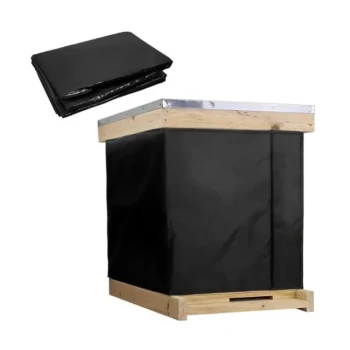
High-insulation synthetic hives technically distinguish themselves by significantly reducing the rate of heat loss from the honeybee cluster to the external environment. This thermal barrier increases the hive's overall thermal inertia, ensuring that internal conditions are driven by biological activity rather than environmental volatility.
Core Insight: The primary value of high-insulation synthetic hives in research is data signal isolation. They decouple the colony from external weather noise, ensuring that recorded temperature fluctuations are the result of the bees' active thermoregulation, not passive environmental heating or cooling.
The Mechanics of Thermal Stability
Minimizing Heat Loss
The fundamental advantage of these hives is their ability to retain heat generated by the cluster. By minimizing the transfer of thermal energy to the outside air, the hive reduces the metabolic load on the bees required to maintain survival temperatures.
Increasing Thermal Inertia
These hives possess high thermal inertia, meaning they resist rapid changes in temperature. This stability creates a buffer that prevents sharp spikes or drops in ambient temperature from immediately affecting the colony's internal microclimate.
Enhancing Data Integrity
Capturing Active Regulation
In standard wooden equipment, internal sensors often pick up "passive influences" caused by external weather shifts. High-insulation synthetic hives dampen this noise.
Consequently, any temperature data recorded by internal sensors can be attributed with high confidence to active thermal regulation by the bees.
Analyzing Brood Rearing
Brood rearing requires precise, constant temperature control. Because these hives eliminate environmental interference, they provide a reliable platform for analyzing exactly how and when the colony engages in the heating required to raise brood during overwintering.
Understanding the Trade-offs
Experimental Precision vs. Commercial Representation
While high-insulation hives are superior for physiological data collection, they may differ from the "standard" environment used in commercial beekeeping.
As noted in broader contexts, the Langstroth hive is the industry standard due to its modularity and honey yield potential. Data gathered in high-performance synthetic hives may represent an "idealized" thermal scenario that does not perfectly reflect the stress factors bees face in standard, lower-insulation wooden boxes.
Standardization vs. Biological Variability
Using specialized hives prioritizes the measurement of specific variables (like heat) but requires careful control. Standardized 10-frame hives are often preferred when the goal is simply to ensure uniformity in entrance dimensions and internal volume across large test groups, rather than isolating specific thermal behaviors.
Making the Right Choice for Your Goal
To select the correct hive infrastructure for your experiment, consider the specific nature of your data requirements:
- If your primary focus is physiological thermal regulation: Choose high-insulation synthetic hives to isolate bee-driven temperature changes from external weather noise.
- If your primary focus is commercial scalability: Choose standard Langstroth hives to ensure your findings translate directly to common apiary management and yield expectations.
- If your primary focus is behavioral observation: Consider modified nucleus hives with side ports or observation hives to facilitate counting and pheromone application without thermal disruption.
Select the hive material that eliminates the variables you are not studying to ensure your data remains pure and actionable.
Summary Table:
| Feature | High-Insulation Synthetic Hives | Standard Wooden Hives |
|---|---|---|
| Thermal Conductivity | Extremely low; retains cluster heat | Moderate to high; heat escapes easily |
| Thermal Inertia | High; resists external temp spikes | Low; fluctuates with ambient weather |
| Data Signal Quality | High; isolates biological heat activity | Low; clouded by environmental noise |
| Best Use Case | Physiological & thermal regulation research | Commercial scalability & field trials |
Elevate Your Apiary Operations with HONESTBEE
Are you looking to optimize colony survival or scale your commercial honey production? HONESTBEE is your dedicated partner in the beekeeping industry. We cater specifically to commercial apiaries and distributors, providing a comprehensive wholesale catalog that includes everything from precision beekeeping tools to advanced hive-making and honey-filling machinery.
Whether you need high-performance synthetic equipment for research or standard commercial hardware for large-scale operations, our portfolio of essential consumables and specialized machinery ensures your success.
Ready to upgrade your equipment? Contact us today to discuss our wholesale offerings and discover how HONESTBEE can deliver the quality and reliability your business demands.
References
- Fabian Nürnberger, Ingolf Steffan‐Dewenter. The influence of temperature and photoperiod on the timing of brood onset in hibernating honey bee colonies. DOI: 10.7717/peerj.4801
This article is also based on technical information from HonestBee Knowledge Base .
Related Products
- Professional Insulated Plastic Bee Hives
- Professional Insulated Winter Hive Wrap for Beekeeping
- Inner Beehive Cover for Beekeeping Bee Hive Inner Cover
- Plastic Bee Hive Stand for Beekeeping
- High Security Emlock Strap System
People Also Ask
- What are the advantages of plastic bee hives? Boost Efficiency & Durability for Your Apiary
- Are plastic bee hives any good? Unlock Durability & Efficiency for Your Apiary
- How do plastic bee hives compare to wooden hives in handling? Reduce Strain & Boost Efficiency
- Are plastic bee hives good? Durable, Low-Maintenance Hives for Modern Apiaries
- What are the disadvantages of plastic beehives? Key Operational and Environmental Risks Exposed