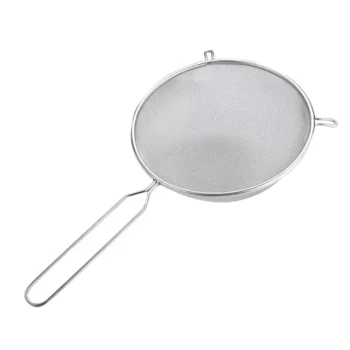
The primary function of a 0.5mm fine mesh sieve in wild honey preparation is to physically separate impurities—specifically beeswax debris and hive fragments—from the liquid honey. By utilizing this specific aperture size, producers can achieve a "cold filtration" process that purifies the product without using heat, thereby preserving critical enzymes like diastase and maintaining the honey's nutritional integrity.
Core Takeaway The 0.5mm sieve acts as a precise mechanical filter that removes macroscopic contaminants (wax and debris) while preserving microscopic nutritional elements. Its usage defines the difference between "raw" honey, which retains its biological activity, and processed honey, which often relies on heat that degrades natural enzymes.
The Mechanics of Cold Filtration
Physical Separation of Contaminants
The extraction process, particularly when using cut comb methods or centrifugation, inevitably introduces debris into the honey.
Beeswax particles and other hive fragments are suspended in the liquid. The 0.5mm aperture is sufficiently small to catch these visible solids, resulting in a visually clean product.
Preservation of Enzyme Activity
The most critical advantage of using a sieve of this size is the ability to filter at ambient temperatures.
This method is known as cold filtration. It eliminates the need for heating the honey to make it flow through tighter filters, which is a common practice in commercial processing.
By avoiding heat, you prevent the thermal destruction of diastase and other sensitive enzymes. This ensures the honey remains a biologically active, natural product rather than just a sugar syrup.
Impact on Honey Composition
Retention of Microscopic Elements
While the 0.5mm sieve stops wax and bee parts, it is generally coarse enough to allow microscopic particles to pass through.
Pollen grains, which are significantly smaller than 0.5mm, remain in the honey. This is vital for maintaining the honey's nutritional profile and botanical identity.
Homogenization
The sieving process does more than just clean; it assists in homogenizing the honey sample.
By removing large irregularities, the sieve creates a uniform substrate. This consistency is essential if the honey is to be used for microscope slide preparation or precise pollen counting.
Understanding the Trade-offs
Flow Rate and Viscosity
The primary challenge of using a 0.5mm sieve without heat is the flow rate.
Cold honey is highly viscous. Passing it through a fine mesh often requires patience, reliance on gravity, or the application of pressure to force the mixture through the sieve cloth.
Visual Clarity vs. Purity
Honey processed this way may not have the ultra-clear, polished look of commercial supermarket honey.
Because microscopic particles and pollen remain, the honey may appear slightly cloudy or opaque. This should be viewed as a mark of quality and authenticity, not a defect.
Making the Right Choice for Your Goal
If you are determining the correct filtration method for your honey extraction, consider your end-use requirements.
- If your primary focus is Nutritional Potency: Stick to the 0.5mm sieve to ensure all wax is removed while keeping enzymes and pollen intact.
- If your primary focus is Pollen Analysis: Use this sieve as a preparatory step to remove debris so you can accurately count and classify pollen grains under a microscope.
The 0.5mm sieve represents the industry standard for balancing physical cleanliness with the preservation of biological life.
Summary Table:
| Feature | 0.5mm Fine Mesh Sieve | Impact on Honey Quality |
|---|---|---|
| Filtration Method | Cold Mechanical Filtration | Preserves biological activity and enzymes. |
| Impurity Removal | Beeswax debris, hive fragments | Ensures visual cleanliness and purity. |
| Pollen Retention | Allows grains to pass through | Maintains nutritional profile and authenticity. |
| Viscosity Handling | Gravity or pressure-based | No heating required; prevents thermal damage. |
| Final Appearance | Slightly opaque/natural | Signals high-quality, raw, unprocessed honey. |
Elevate Your Honey Quality with HONESTBEE Professional Equipment
Are you looking to scale your commercial apiary or supply top-tier filtration tools to your clients? HONESTBEE specializes in providing commercial apiaries and distributors with high-performance beekeeping tools, machinery, and essential consumables.
From precision 0.5mm stainless steel sieves to industrial honey-filling machines and specialized hive-making hardware, our portfolio is designed to maximize your efficiency while preserving the natural integrity of your honey.
Partner with HONESTBEE to access comprehensive wholesale solutions tailored to the modern beekeeping industry.
References
- Оксана Михайлівна Січенко, Olena Tytariova. Conservation of wild western honey bees Apis Mellifera in the Polissia natural zone of Ukraine: history, sources of nectar and pollen. DOI: 10.33245/2310-9289-2024-190-2-109-121
This article is also based on technical information from HonestBee Knowledge Base .
Related Products
- Professional Stainless Steel Honey Filter with Support Handle
- 0.5T Capacity Honey Dehumidifier Dryer with Vacuum Heating and Thickening Filtering Machine
- Stainless Steel Triangle Support Honey Strainer and Filters
- Stainless Steel Double Layer Honey Strainer Sieve Filters
- Nylon Honey Strainer Square Filter Cloth for Honey Filters
People Also Ask
- Why are stainless steel filters essential during the initial purification phase of honey processing? Ensure Purity
- What are the benefits of using a high-quality honey filter? Elevate Purity and Preserve Natural Flavor
- What is the primary purpose of honey filters? Achieve Professional Clarity & Pure Honey Quality
- What micron filter should I use for honey? Choose the Right Filter for Sales or Competitions
- Why do people filter honey? For Clarity, Stability, and Consumer Appeal