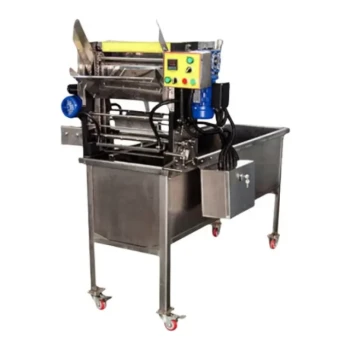
Mechanized post-harvest processing acts as the critical operational bridge between the farm and the consumer. Its primary function is to drastically increase handling efficiency while significantly reducing product loss after harvest. By automating these processes, producers ensure the transition from field to market adheres to strict organic hygiene standards and supports the economic viability of the entire supply chain.
While manual methods are traditional, they often introduce variability and contamination risks. Mechanization standardizes the process, securing product purity and enabling the scalability required for village-level industrial growth.
Enhancing Efficiency and Reducing Waste
Streamlining the Farm-to-Market Transition
Time is a critical factor in preserving the quality of organic goods. Mechanized equipment accelerates processing, ensuring that raw materials are converted into market-ready products with minimal delay.
This speed is essential for maintaining freshness and nutritional value. It prevents the bottlenecks that occur with manual processing, ensuring a smooth flow through the supply chain.
Minimizing Physical Losses
Post-harvest loss is a major economic drain on agricultural operations. Automated equipment provides consistent, regulated handling that reduces the physical damage often caused by human error or rough manual sorting.
By standardizing how products are treated, the volume of wasted goods decreases significantly. This directly improves the yield that actually reaches the point of sale.
Preserving Organic Integrity and Hygiene
Eliminating Secondary Contamination
One of the greatest risks in organic processing is contamination during the packaging phase. Manual handling increases the likelihood of introducing foreign substances or bacteria.
Advanced machinery, such as automatic honey filling equipment, minimizes human contact. This ensures products remain additive-free and maintain the high purity levels expected by organic consumers.
Ensuring Compliance and Traceability
High-end commercial markets have rigorous safety standards. Mechanized systems are designed to meet specific hygiene requirements that are difficult to guarantee with manual labor.
These systems also support better traceability. By automating the packaging line, producers can easier track batches, ensuring they adhere to organic production policies and safety regulations.
Economic and Structural Impact
Supporting Village-Level Industrial Clusters
Mechanization does more than process food; it structures the industry. It facilitates the development of village-level industrial clusters, allowing decentralized communities to process goods at an industrial standard.
This clustering effect brings professional processing capabilities to rural areas. It allows smaller producers to aggregate their output and compete in broader markets.
Improving Economic Efficiency
The ultimate function of this equipment is to bolster the economic health of the organic industry. By reducing waste and labor costs while increasing output speed, the cost-per-unit drops.
This efficiency makes organic farming more financially sustainable. It transforms organic agriculture from a niche, labor-intensive practice into a viable, scalable industry.
Understanding the Trade-offs
The Balance of Capital vs. Labor
While mechanization improves long-term efficiency, it introduces a high barrier to entry. The initial capital expenditure for industrial-grade machinery is significantly higher than the cost of manual labor.
Producers must weigh the upfront investment against the projected reduction in losses. For very small operations, the ROI may take longer to realize without forming the clusters mentioned earlier.
Maintenance and Complexity
Automated systems eliminate manual sorting errors but introduce technical complexity. These machines require regular maintenance, calibration, and a reliable power supply.
Adopting this technology requires a shift in skill sets. Operators must be trained not just in farming, but in the operation and troubleshooting of processing hardware.
Making the Right Choice for Your Goal
When integrating mechanized equipment into your supply chain, consider your immediate objectives:
- If your primary focus is Market Access: Prioritize equipment that guarantees hygiene and traceability to meet high-end commercial standards.
- If your primary focus is Economic Scalability: Focus on machinery that supports village-level clustering to aggregate volume and reduce per-unit processing costs.
- If your primary focus is Product Purity: Invest in automated filling and packaging systems to eliminate the risk of human-caused secondary contamination.
Mechanization is not just an upgrade in speed; it is the fundamental tool that allows the organic supply chain to scale without compromising on quality or safety.
Summary Table:
| Key Function | Primary Benefit | Strategic Impact |
|---|---|---|
| Waste Reduction | Minimizes physical damage and manual sorting errors | Increases total yield and profit margins |
| Hygiene Control | Eliminates secondary contamination through automation | Ensures compliance with organic safety standards |
| Speed & Scaling | Accelerates the farm-to-market transition | Supports village-level industrial clustering |
| Economic Efficiency | Lowers per-unit costs and reduces labor dependency | Makes organic operations financially sustainable |
Elevate Your Beekeeping Operation with HONESTBEE
Transitioning from manual labor to industrial-grade efficiency is the key to scaling your organic production. HONESTBEE specializes in empowering commercial apiaries and distributors with high-performance beekeeping tools, honey-filling machinery, and essential consumables.
Whether you are establishing a village-level industrial cluster or seeking to eliminate contamination with automated systems, our comprehensive wholesale solutions are designed to maximize your ROI and preserve product purity.
Ready to modernize your supply chain? Contact us today to explore our specialized hardware and cultural merchandise!
References
- Gora Shiva Prasad, Rajesh Debnath. A Bird Eye View on Status of Organic Farming in the World: An Indian Prospective. DOI: 10.20546/ijcmas.2020.904.337
This article is also based on technical information from HonestBee Knowledge Base .
Related Products
- Professional Wide Blade Honey Scraper for Beekeeping and Honey Processing
- Fully Automatic Honey Filling Packaging Machine for Processing Line
- High Quality Honey Dehumidifier Dryer Thickening Machine for Beekeeping
- Manual Honey Filling Machine Bottling Machine for Honey
- Electric Honey Press Machine for Squeezing Honey Comb Press Equipment
People Also Ask
- What tools and machinery are essential to resolve common operational constraints such as equipment shortages and improper honey harvesting? Discover the complete honey-harvesting equipment lineup for commercial apiaries and distributors.
- How does environmental temperature control influence the efficiency of honey scraping equipment? Optimize Your Flow
- What operational considerations are critical during honey harvesting, and how do specialized honey processing tools add value to the final product? Optimize Quality and Yield
- What are the core functions of a honey processor? Master Moisture Control and Purification for Quality Honey
- What are the technical requirements for beekeeping equipment used in the production of comb honey compared to filtered honey?