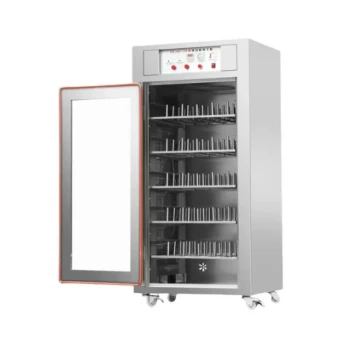
The integrated heater and fan system functions as the primary engine for moisture removal in convective bee-bread dryers. These components work in strict unison to generate a controlled stream of heated air, which acts as the active drying medium to extract moisture from the product.
The system performs a dual function: it transfers thermal energy to trigger evaporation and simultaneously sweeps away the resulting water vapor. This continuous cycle maintains the critical humidity gradient necessary to draw moisture from the bee-bread's core to its surface.
How the System Drives Drying
Generating the Drying Medium
The fundamental role of this hardware is to create a specific atmospheric condition. The heater warms the air to increase its energy-carrying capacity, while the fan mobilizes this air into a consistent stream.
Transferring Thermal Energy
Once the heated air reaches the bee-bread, it transfers thermal energy directly to the product. This energy transfer is the catalyst that forces liquid water within the bee-bread to change state and evaporate into vapor.
Removing Surface Moisture
As evaporation occurs, water vapor accumulates around the surface of the bee-bread. The fan's continuous airflow physically displaces this vapor, preventing a layer of saturated air from stagnating around the product.
The Critical Role of the Humidity Gradient
Preventing Saturation
For drying to continue, the air surrounding the bee-bread must remain drier than the product itself. By constantly removing water vapor, the system ensures the local atmosphere never reaches saturation, allowing evaporation to persist.
Promoting Core Migration
The ultimate goal of convective drying is not just drying the surface, but drying the center. By keeping the surface dry and warm, the system maintains a "humidity gradient."
Continuous Extraction
This gradient acts as a physical force. It encourages moisture trapped deep within the internal core of the bee-bread to migrate outward toward the surface, where it can be evaporated and removed.
Operational Dependencies
The Necessity of Tandem Operation
The text emphasizes that these components work "in tandem," meaning neither is effective in isolation. Heat without airflow would cause moisture to pool on the surface (saturation).
Balancing Energy and Flow
Conversely, airflow without sufficient heat lacks the thermal energy required to efficiently evaporate moisture from the dense bee-bread structure. The system relies on the precise balance of both heat transfer and mass transport (vapor removal).
Making the Right Choice for Your Goal
To ensure efficient processing, understanding the relationship between heat and airflow is vital.
- If your primary focus is evaporation rate: Ensure the heater provides sufficient thermal energy to facilitate the phase change from water to vapor.
- If your primary focus is deep drying: Prioritize consistent airflow to maintain the humidity gradient that draws moisture from the internal core.
The effectiveness of a convective dryer relies entirely on this synchronized exchange of heat and air to sustain moisture migration.
Summary Table:
| Component | Primary Function | Role in Drying Process |
|---|---|---|
| Integrated Heater | Thermal Energy Generation | Triggers evaporation by converting liquid water to vapor. |
| Integrated Fan | Airflow & Mass Transport | Displaces saturated air and maintains the humidity gradient. |
| Tandem System | Moisture Migration | Facilitates moisture movement from the core to the surface. |
| Humidity Gradient | Continuous Extraction | Prevents air saturation to ensure efficient, deep drying. |
Scale Your Apiary Operations with HONESTBEE
Are you looking to optimize your bee-bread production or upgrade your facility? HONESTBEE specializes in supporting commercial apiaries and distributors with high-performance beekeeping machinery and essential tools.
Our comprehensive wholesale range includes everything from advanced bee-bread processing equipment and honey-filling machines to specialized hive-making hardware and industry consumables. We don't just supply equipment; we provide the thermal efficiency and operational reliability your business needs to thrive.
Ready to enhance your efficiency? Contact our expert team today to discuss how our specialized machinery and wholesale solutions can support your growth.
References
- Sergei Oskin, Dmitry Tsokur. Improving the efficiency of the bee-bread drying process. DOI: 10.1088/1755-1315/1052/1/012104
This article is also based on technical information from HonestBee Knowledge Base .
Related Products
- High Quality Honey Dehumidifier Dryer Thickening Machine for Beekeeping
- HONESTBEE Professional Cabinet Bottle Dryer
- 0.5T Capacity Honey Dehumidifier Dryer with Vacuum Heating and Thickening Filtering Machine
People Also Ask
- Can you dehumidify honey? A Beekeeper's Guide to Preventing Fermentation
- How to dry up honey? The Safe Guide to Stabilizing Honey and Preventing Fermentation
- How can the moisture content of honey be reduced? A Guide to Safe, Effective Drying Methods
- How to remove humidity from honey? Protect Your Harvest from Fermentation
- How to decrease moisture in honey? Prevent Fermentation and Ensure Long-Term Quality