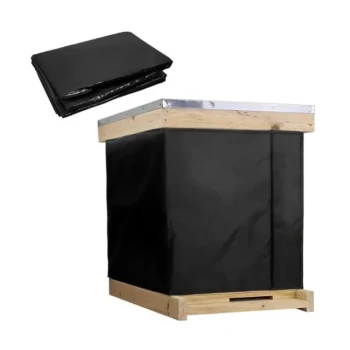
Knowing the physical properties of hive walls is the prerequisite for accurate thermal modeling. Specifically, the thickness and thermal conductivity of the panels are the critical variables required to solve heat conduction equations. Without precise values for these parameters, it is impossible to calculate the rate at which heat transfers from the colony's interior to the outside environment.
By precisely defining wall thickness and thermal conductivity, researchers can use computational models to reverse-calculate internal hive temperatures based solely on external measurements. This data is critical for non-invasively assessing a colony’s ability to regulate heat and survive winter conditions.
The Physics of Heat Transfer in Hives
The Role of Energy Balance Equations
To understand the temperature gradient, you must view the hive as a system defined by energy balance equations. Heat generated by the bees does not simply disappear; it travels through the physical structure.
This process begins with conduction through the hive walls. Once the heat reaches the exterior surface, it dissipates via convection and radiation.
Defining the Barrier
Thickness and thermal conductivity act as the primary variables in these calculations. Thickness determines the distance heat must travel to escape the hive.
Thermal conductivity defines how easily the material allows that heat to pass through. Together, these physical specifications determine the wall's total thermal resistance.
Computational Modeling and Diagnostics
Reverse-Calculating Internal Conditions
The primary utility of these physical properties lies in non-invasive monitoring. When you know the exact specifications of the wall, you do not need to open the hive to know the internal temperature.
Instead, computational models can utilize monitored external wall temperatures. By applying the known conductivity and thickness to these external readings, the model can mathematically "reverse-calculate" the real-time conditions inside the hive.
Evaluating Survival Probability
The ultimate goal of this mathematical modeling is biological assessment. Accurate internal temperature gradients provide a clear picture of the colony's thermoregulation capabilities.
This data allows for a precise evaluation of the colony's health. It helps predict the probability of survival during critical winter months when maintaining core temperature is a matter of life or death.
Understanding the Limitations
Sensitivity to Input Errors
The accuracy of the "reverse-calculation" method is entirely dependent on the quality of your input data. If the stated thickness is off by a few millimeters, or the thermal conductivity value is generic rather than specific to the material used, the model's output will be flawed.
The Assumption of Uniformity
Calculations often assume the wall properties are uniform throughout the structure. In reality, variations in material density or physical defects can alter local thermal conductivity. Relying on average values without verifying the specific panels in use can lead to miscalculations regarding the colony's actual thermal stress.
Applying These Principles to Hive Management
To effectively utilize thermal modeling for beehive health, align your approach with your specific objectives:
- If your primary focus is computational accuracy: Measure the exact thickness and test the specific thermal conductivity of the wall material rather than relying on generic textbook values.
- If your primary focus is colony survival: Use the calculated internal temperature gradients to monitor winter thermoregulation trends without physically disturbing the hive seal.
Accurate physical inputs transform simple external temperature readings into a vital diagnostic tool for colony welfare.
Summary Table:
| Physical Property | Role in Thermal Modeling | Impact on Colony Monitoring |
|---|---|---|
| Wall Thickness | Determines the distance heat must travel | Essential for calculating total thermal resistance |
| Thermal Conductivity | Measures how easily heat passes through material | Defines the rate of heat loss to the environment |
| Energy Balance | Theoretical framework for heat flow | Allows reverse-calculation of internal temperatures |
| Material Uniformity | Ensures consistent calculation inputs | Prevents diagnostic errors due to density variations |
Optimize Your Apiary with Scientific Precision
At HONESTBEE, we understand that high-performance beekeeping requires more than just basic tools—it requires an understanding of thermal efficiency and colony health. Whether you are a commercial apiary seeking to improve winter survival rates or a distributor looking for scientifically-backed equipment, we provide the comprehensive solutions you need.
Our extensive portfolio includes:
- Advanced Hive-Making & Honey-Filling Machinery for streamlined production.
- Precision-Engineered Beekeeping Tools designed for durability and performance.
- Premium Consumables & Cultural Merchandise to support every aspect of your business.
Partner with HONESTBEE to equip your operations with the industry's most reliable hardware. Contact us today to discuss your wholesale needs and see how our expertise can drive your success.
References
- Luis López-Fernández, Diego González‐Aguilera. Close-Range Photogrammetry and Infrared Imaging for Non-Invasive Honeybee Hive Population Assessment. DOI: 10.3390/ijgi7090350
This article is also based on technical information from HonestBee Knowledge Base .
Related Products
- Wooden Bee Hive Frames for Beekeeping and Wholesale
- Assembled Wooden Bee Frames with Plastic Foundation for Durability and Convenience by HONESTBEE
- Plastic Bee Frame Beekeeping Hive Frames for Wholesale
- HONESTBEE Wired and Assembled Wooden Bee Frames Foundation for a Thriving Hive
- Langstroth Solid Bottom Board for Beekeeping
People Also Ask
- How does balancing the number of frames impact hive productivity? Optimize Your Apiary's Biological Output
- How do wooden and plastic hive frames compare in terms of durability? Wood vs. Plastic Longevity & Repairability
- What are the main considerations when choosing between wooden and plastic bee hive frames? Optimize Your Apiary's Efficiency
- How should beehive frames be maintained to prolong their lifespan? 5 Pro Tips for Durable Beekeeping Equipment
- How are plastic frames different from traditional wooden frames? Choose the Right Frame for Your Apiary