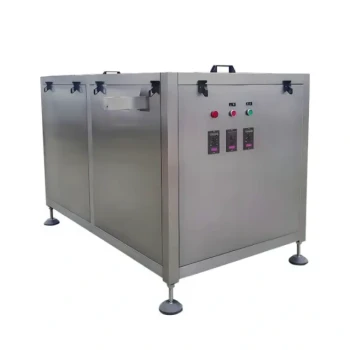
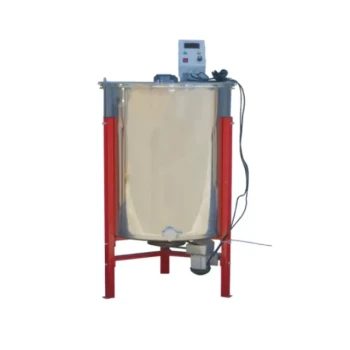
The primary function of a high-speed industrial centrifuge in this context is to mechanically separate and concentrate probiotic bacteria from their liquid growth medium. By generating powerful centrifugal force, the device rapidly precipitates bacterial cells—such as Lactobacillus—out of suspension, allowing manufacturers to harvest a dense biomass and wash away impurities.
In the production of beekeeping probiotics, volume does not equal value; potency does. The centrifuge is the critical processing bridge that transforms a dilute liquid culture into the high-concentration, pure biomass required for effective hive health formulations.
From Culture to Concentrate
The efficacy of a probiotic formulation relies heavily on the density of the active biological agents.
Utilizing Centrifugal Force
The core mechanism involves spinning the liquid culture at high velocities. This generates powerful centrifugal force that acts upon the suspended particles.
Because bacterial cells are denser than the liquid media they grow in, this force pushes them outward.
Precipitating the Biomass
As the force is applied, the probiotic bacteria are forced out of the liquid suspension.
This process is known as precipitation, effectively separating the solid biological material from the liquid supernatant.
Achieving Potency and Purity
Mere separation is not the end goal; the objective is to create a product suitable for specific beekeeping applications.
Maximizing Colony-Forming Units (CFUs)
To be effective in a hive, probiotic formulations often require extremely high bacterial counts.
The centrifuge concentrates the harvested cells to achieve these high Colony-Forming Unit (CFU) concentrations. This ensures that even small doses of the final product deliver a functional load of beneficial bacteria.
Ensuring Formulation Purity
The liquid growth media used to culture bacteria contains nutrients and metabolic byproducts that may not be desired in the final product.
The centrifuge facilitates essential washing steps. By removing these residual media components, the process ensures the final output is a pure, clean probiotic ingredient.
Operational Considerations and Trade-offs
While centrifugation is the standard for harvesting, it introduces physical variables that must be managed to protect the biological payload.
Balancing Force and Viability
The "powerful centrifugal force" required for separation applies significant mechanical stress to the bacteria.
If the force is too aggressive, it can damage the cell walls of the bacteria, reducing the percentage of live, active cells in the final product.
Efficiency vs. Loss
The goal of the washing step is purity, but every cycle carries a risk of yield loss.
Operators must balance the need to remove residual culture media against the potential for losing viable biomass during the fluid exchange.
Optimizing the Process for Beekeeping Applications
The choice of centrifugation parameters defines the quality of the final probiotic supplement.
- If your primary focus is Potency: Prioritize separation efficiency to maximize the recovery of high-CFU biomass, ensuring the highest possible bacterial count per dose.
- If your primary focus is Purity: Emphasize the washing cycles to thoroughly remove culture media residues, ensuring a clean product free of metabolic byproducts.
Ultimately, the centrifuge allows you to convert a raw biological culture into a precise, high-grade tool for apiary management.
Summary Table:
| Feature | Function in Probiotic Processing | Impact on Final Product |
|---|---|---|
| Centrifugal Force | Separates bacterial cells from liquid media | High concentration of active biomass |
| Precipitation | Forces solid biological material out of suspension | Enables harvesting of dense bacterial loads |
| Washing Cycles | Removes residual nutrients and byproducts | Ensures ingredient purity and stability |
| CFU Maximization | Concentrates live Colony-Forming Units | Increases potency per dose for hive health |
Scale Your Probiotic Production with HONESTBEE
At HONESTBEE, we specialize in empowering commercial apiaries and beekeeping distributors with the advanced machinery needed to lead the industry. Whether you are producing high-potency probiotic formulations or managing large-scale honey processing, our comprehensive wholesale portfolio includes everything from high-speed industrial centrifuges and honey-filling machines to specialized hive-making hardware and consumables.
Why partner with HONESTBEE?
- Precision Technology: Maximize your CFU recovery and product purity.
- End-to-End Solutions: From raw culture processing to branded cultural merchandise.
- Expert Support: Tailored equipment advice for distributors and large-scale operations.
Ready to enhance your production efficiency? Contact us today to explore our full spectrum of beekeeping tools and industrial machinery!
References
- Brendan A. Daisley, Elina L. Niño. Delivery mechanism can enhance probiotic activity against honey bee pathogens. DOI: 10.1038/s41396-023-01422-z
This article is also based on technical information from HonestBee Knowledge Base .
Related Products
- Fully Automatic High Speed Centrifugal Bottle Unscrambler
- electric honey extractor honey centrifuge 3 frame honey extractor stainless steel honey frame extractor
- Professional 4 Frame Self Reversing Electric Honey Extractor for Beekeeping
- Manual Hand Crank 4 Frame Honey Extractor Centrifuge for Beekeeping
People Also Ask
- What is the technical purpose of using a high-speed centrifuge in honey analysis? Ensure Purity and Quality Standards
- What role does a high-speed centrifuge play in the preliminary processing of raw honey? Enhancing Purity and Clarity
- Why are 15ml centrifuge tubes essential for honey sampling? Ensure Sample Integrity and Analytical Accuracy
- How does a rotational viscometer contribute to the quality assessment of honey? Ensure Perfect Texture and Flow
- What are the advantages of using 15 mL centrifuge tubes for bee pollen? Enhance Sample Integrity and Chemical Resistance