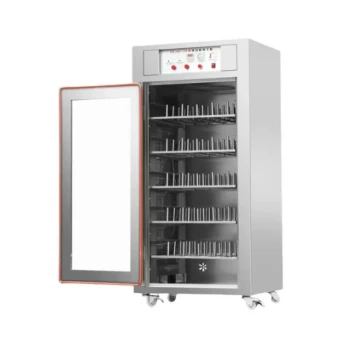
The primary role of an industrial forced-air drying oven in artificial bee bread fermentation is to execute precise moisture control without degrading the product's nutritional value. Specifically, it is used to dry raw pollen to 10-12% moisture for initial storage and to reduce the final fermented product to 16-17% moisture. By utilizing enhanced internal ventilation at controlled low temperatures (38–40°C), the oven inhibits unwanted microbial activity while preserving heat-sensitive bioactive components.
Core Takeaway The oven's value lies in its ability to decouple drying from high heat. By relying on efficient airflow rather than thermal intensity, it stabilizes the fermentation process and prevents spoilage while ensuring fragile compounds like carotenoids remain intact.
Managing the Fermentation Lifecycle
The Pre-Treatment Phase: Establishing a Baseline
Before fermentation begins, the oven serves a critical preparatory function. It dries natural pollen at a constant 40°C until the residual moisture content reaches 10-12%.
This step is essential for preserving the integrity of pollen granules during storage. It also establishes a controlled baseline, allowing for accurate moisture standardization (to 26-29%) later when lactic acid bacteria cultures are introduced.
The Post-Fermentation Phase: Biological Stabilization
Once the fermentation process is complete, the bee bread is biologically active and susceptible to spoilage. The oven is employed to reduce the moisture content of the finished product to 16-17%.
This reduction is achieved over a period of approximately 5.5 to 6 hours. Reaching this specific moisture target is vital to inhibit further microbial activity, effectively locking the product in a stable state for consumption.
The Mechanism of Preservation
Enhanced Internal Ventilation
The defining feature of this industrial oven is its use of enhanced internal ventilation. This mechanism ensures uniform heat exchange throughout the drying chamber.
By prioritizing air circulation over static heat, the system removes moisture efficiently without creating "hot spots." This ensures consistent drying across the entire batch of bee bread.
Low-Temperature Retention of Bioactives
The process is strictly controlled at a low temperature range of 38–40°C. This specific range is selected to protect the product's chemical profile.
High temperatures would degrade the health benefits of the bee bread. The low-temperature approach ensures the maximum retention of bioactive compounds, specifically carotenoids and flavonoids.
Understanding the Trade-offs
The Time vs. Temperature Balance
Using low temperatures (38-40°C) necessitates a longer processing time compared to high-heat drying methods.
Operators must accept a drying cycle of 5.5 to 6 hours for the finished product. Attempting to rush this process by increasing the temperature runs the risk of destroying the very nutrients that make bee bread valuable.
Precision vs. Throughput
The process requires strict adherence to specific moisture targets (10-12% initial, 16-17% final).
This demands precise monitoring rather than continuous, high-volume throughput. Deviating from these targets can lead to either microbial spoilage (if too wet) or unnecessary texture degradation (if too dry).
Making the Right Choice for Your Goal
To optimize the artificial fermentation process, align your drying strategy with your specific quality objectives:
- If your primary focus is Nutrient Preservation: Strictly maintain the temperature ceiling of 40°C to protect heat-sensitive carotenoids and flavonoids.
- If your primary focus is Shelf Stability: Ensure the final drying phase runs the full 5.5-6 hours to reliably hit the 16-17% moisture target, preventing mold growth.
- If your primary focus is Process Consistency: Use the initial drying phase to standardize all raw pollen to 10-12% moisture before introducing bacterial cultures.
Success in artificial bee bread production relies not on how fast you can dry the product, but on how effectively you control moisture while mimicking the gentle conditions of a natural hive.
Summary Table:
| Process Phase | Target Temperature | Target Moisture Content | Drying Duration | Key Objective |
|---|---|---|---|---|
| Pre-Treatment | 40°C | 10–12% | Variable | Pollen storage stability & baseline standardization |
| Fermentation | 38–40°C | 26–29% | Process dependent | Facilitate lactic acid bacteria activity |
| Post-Fermentation | 38–40°C | 16–17% | 5.5–6 Hours | Biological stabilization & microbial inhibition |
Elevate Your Bee Bread Production with HONESTBEE
Are you looking to scale your apiary operations or expand your distribution of premium bee products? HONESTBEE specializes in empowering commercial apiaries and distributors with professional-grade solutions.
Our comprehensive wholesale range includes everything from specialized forced-air drying ovens and honey-filling machinery to high-quality hive-making equipment and essential consumables. By choosing HONESTBEE, you gain a partner dedicated to preserving the integrity of your harvest while maximizing production efficiency.
Ready to upgrade your facility? Contact our specialists today to explore our full spectrum of beekeeping tools and machinery!
References
- G. Madzgarashvili, J. Natchkebia. Making Bee Bread from Pollen without honeycombs. DOI: 10.30574/gscbps.2022.20.2.0316
This article is also based on technical information from HonestBee Knowledge Base .
Related Products
- HONESTBEE Professional Cabinet Bottle Dryer
- Economy Small Scale Honey Dryer Dehumidifier Thickening Machine
- Solar Beeswax Melter Easy Solar Wax Melter for Beeswax
- Professional Thermostatic Conical Honey Melter
- Premium Traditional Copper Bee Smoker with Bellows
People Also Ask
- Why use a Cabinet Drier for pollen at 38–41°С? Protect Sample Integrity and Heavy Metal Data Accuracy
- What is the primary purpose of a constant temperature drying oven in bee bread production? Achieve Perfect Fermentation
- How do forced circulation drying ovens sterilize beekeeping tools? Efficient Oxidation for Metal Equipment Safety
- What are the technical requirements for using a constant temperature drying oven for raw propolis? Expert Guide
- How do professional-grade Pollen Drying Ovens preserve active ingredients? Ensure Bioactive Potency with Precision