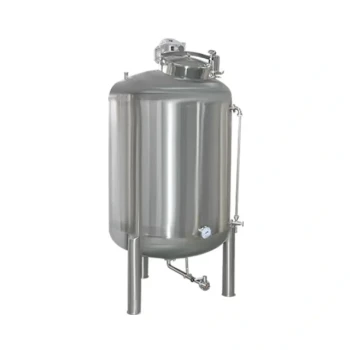
Industrial-grade filter tanks serve as the critical infrastructure for quality control in large-scale honey processing operations. By providing a sealed, high-capacity environment, they facilitate the combination of natural sedimentation and professional depth filtration to remove fine impurities and stabilize the product.
Core Takeaway These tanks are not merely storage vessels; they are active processing units that utilize gravity and depth filtration to ensure honey achieves the visual clarity and uniformity required for wholesale distribution and cooperative marketing channels.
Enhancing Quality Through Controlled Environments
The Role of Natural Sedimentation
At an industrial scale, rapid processing often introduces air bubbles and disturbs particulates. Industrial-grade tanks provide the volume necessary for gravity-based separation. This allows honey to settle into layers, permitting air bubbles to rise and heavier impurities to precipitate naturally before mechanical filtration begins.
Depth Filtration and Clarity
Beyond simple straining, these tanks utilize professional filtration components to perform depth filtration. This process captures fine impurities that escape basic sieving, resulting in a product that is both transparent and chemically stable.
Ensuring Hygiene and Purity
The sealed environment of an industrial filter tank is essential for food safety. It protects the honey from external contaminants during the critical settling phase, ensuring the final output remains pure and meets rigorous health standards.
Meeting the Demands of Commercial Scale
Standardization for Wholesale Markets
For operations selling to cooperatives or wholesale channels, product consistency is non-negotiable. Industrial tanks allow for the processing of large, uniform batches. This eliminates the variations found in smaller, fragmented harvests, ensuring every jar meets the same specification.
Efficiency in Bulk Processing
These tanks are designed to handle significant volumes, utilizing gravity to separate impurities during the "preliminary processing" stage. By allowing impurities to separate naturally first, the load on final filtration systems is reduced, streamlining the overall workflow and increasing throughput.
Understanding the Operational Trade-offs
The Requirement of Time
While efficient, the sedimentation process within these tanks relies on physics and gravity. This is a passive process that requires time to settle, meaning these tanks cannot be used for instant throughput; they act as a necessary buffer in the production line.
Preliminary vs. Final Processing
It is important to recognize that settling tanks often serve as preliminary processing steps. While they achieve a high degree of clarity and uniformity, they are typically part of a larger chain that prepares the honey for the final bottling or finishing stages.
Making the Right Choice for Your Goal
- If your primary focus is Wholesale Distribution: Prioritize tanks with massive capacity and professional filtration components to ensure the batch-to-batch consistency required by cooperatives.
- If your primary focus is Product Clarity: Focus on the tank's ability to facilitate sedimentation and air bubble removal to guarantee a transparent, premium appearance.
Investing in industrial-grade filtration is the definitive step in moving from hobbyist beekeeping to a standardized, commercial enterprise.
Summary Table:
| Feature | Benefit for Large-Scale Operations | Impact on Final Product |
|---|---|---|
| Gravity Sedimentation | Natural separation of air bubbles and heavy particulates | Improved visual clarity and texture |
| Sealed Environment | Protection from external environmental contaminants | Guaranteed food safety and purity |
| Depth Filtration | Capture of fine impurities post-straining | Professional-grade transparency |
| Bulk Batch Processing | Processing of large volumes simultaneously | Product consistency for wholesale |
| Efficiency Buffering | Reduced load on final mechanical filtration systems | Streamlined workflow and throughput |
Elevate Your Honey Production with HONESTBEE
Transitioning from hobbyist beekeeping to a professional commercial enterprise requires precision equipment that guarantees consistency and quality. At HONESTBEE, we specialize in supporting commercial apiaries and distributors with our comprehensive wholesale range. From high-capacity industrial filter tanks and honey-filling machines to advanced hive-making hardware and honey-themed merchandise, we provide the tools you need to succeed in the global market.
Ready to scale your operation? Contact us today to discover how our professional beekeeping machinery and essential industry consumables can optimize your processing center and drive your business forward.
References
- Miriti Lydiah, Maina Immaculate. GENDER GAPS IN THE LEVELS OF PARTICIPATION IN IMPROVED BEE KEEPING: CASE OF THE MAASAI COMMUNITY IN TRANS MARA, NAROK COUNTY, KENYA. DOI: 10.47604/jlp.v1i1.846
This article is also based on technical information from HonestBee Knowledge Base .
Related Products
- Heavy Duty Stainless Steel Honey Processing Machine Decrystallizing Tank
- Electric Double Wall Honey Filtering Machine Purifier Equipment for Honey Processing Plant
- Stainless Steel Uncapping Tank with Stand and Strainer
- Professional Stainless Steel Honey Filter with Support Handle
- Professional Honey Filter with Tripod Support Stand
People Also Ask
- What are the features of the processing tanks offered? Engineered for Purity and Efficiency
- What types of stainless steel processing tanks are used for honey? Essential Equipment for Quality Honey Production
- What design options are available for honey processing tanks? Optimize Efficiency with Custom Geometries
- What types of stainless steel are used for honey processing? Ensure Food Safety with 304 & 316 Grade Equipment
- Why is industrial-grade stainless steel processing equipment required for honey harvesting? Ensure Purity & Compliance