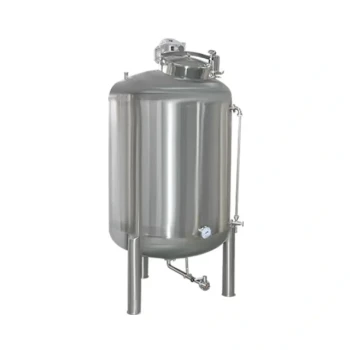
Decanting tanks serve as the final purification stage in the honey refining process, acting as a critical safeguard for product clarity. By holding the honey stationary, these tanks utilize gravity to separate the mixture into distinct layers based on density. This allows air bubbles and wax to rise while heavier particulate matter sinks, ensuring the honey is free of impurities before bottling.
Decanting is a passive quality control checkpoint that relies on natural density differences to stratify honey. It guarantees a transparent, debris-free product that meets commercial standards without requiring aggressive mechanical processing.
The Mechanics of Gravity Sedimentation
The Principle of Density
Decanting tanks operate on the principle of gravity sedimentation. Rather than forcing honey through a mesh, the vessel allows the laws of physics to do the work. Materials with different densities naturally separate over time when the liquid is left undisturbed.
Natural Stratification
During this resting period, a natural stratification occurs. Lightweight impurities, such as tiny air bubbles and fine wax debris, migrate to the surface to form a foam or scum. Simultaneously, heavier fine particles settle at the bottom of the tank.
The "Middle Cut"
The result of this separation is a large, central layer of pure honey. By drawing honey from this middle section, producers can extract the cleanest portion of the batch. This leaves the sediment at the bottom and the foam at the top behind.
The Role in Quality Control
Ensuring Visual Clarity
The primary output of the decanting process is clarity. By removing the suspended air bubbles and fine particles that cause cloudiness, the tank ensures the honey is transparent. This visual appeal is essential for high-quality commercial presentation.
A Critical Control Point
The decanting tank acts as the final guarantee of quality. It is often the last step before the honey enters commercial packaging. This step ensures that no stray impurities that may have bypassed earlier filtration stages make it into the final jar.
Meeting Export Standards
For producers aimed at international markets, this step is non-negotiable. The removal of impurities ensures the honey meets strict international export standards regarding hygiene and purity. It ensures the product has a pure taste and a pristine appearance.
Understanding the Trade-offs
Passive vs. Active Processing
Unlike professional filtration systems, which actively force honey through media to remove debris, decanting is a passive process. It relies entirely on time and gravity.
Time Implications
Because the honey must remain stationary to settle effectively, decanting introduces a pause in the production line. It is not an instant fix but a waiting period required to achieve the highest level of clarity.
Making the Right Choice for Your Goal
To maximize the value of your honey refining process, consider how decanting fits into your specific production targets:
- If your primary focus is Visual Appeal: Prioritize a sufficient settling time in the decanting tank to ensure all micro-bubbles rise, resulting in a glass-like transparency.
- If your primary focus is Export Compliance: Utilize the decanting stage as a mandatory quality control node to verify the removal of all wax and particulate matter before final testing.
By allowing nature to separate impurities from the product, decanting tanks transform raw extraction into a polished, market-ready commodity.
Summary Table:
| Feature | Mechanism | Benefit for Producers |
|---|---|---|
| Stratification | Uses density differences to separate wax/air from honey. | Ensures a debris-free, transparent product. |
| Gravity Sedimentation | Passive separation without aggressive mechanical force. | Preserves honey quality while removing heavy particles. |
| The Middle Cut | Extraction from the central layer of the tank. | Guarantees the cleanest honey for final bottling. |
| Quality Control | Final checkpoint before commercial packaging. | Meets strict international export and hygiene standards. |
Elevate Your Honey Quality with HONESTBEE Professional Equipment
Are you looking to scale your production or upgrade your refining line? At HONESTBEE, we specialize in supporting commercial apiaries and distributors with high-performance beekeeping machinery and tools. From specialized honey-filling machines to durable decanting tanks, we provide the full spectrum of equipment needed to achieve market-ready purity.
Our value to you:
- Comprehensive Wholesale Range: One-stop shop for hardware, consumables, and cultural merchandise.
- Export-Ready Solutions: Equipment designed to help you meet rigorous international hygiene standards.
- Industry Expertise: Tailored support for large-scale operations and distribution networks.
Ready to enhance your processing efficiency? Contact us today to discuss our wholesale offerings and how we can support your business growth!
References
- Arianna Pignagnoli, Aldo Dal Prà. Carbon Footprint of Honey in Different Beekeeping Systems. DOI: 10.3390/su131911063
This article is also based on technical information from HonestBee Knowledge Base .
Related Products
- Heavy Duty Stainless Steel Honey Processing Machine Decrystallizing Tank
- Plastic Honey Uncapping Tub Tank for Beekeeping
- Stainless Steel Uncapping Tank with Stand and Strainer
- Stainless Steel Honey Storage and Settling Tank with Double Strainer
- Professional Honey Storage Tank with Agitation System
People Also Ask
- What are the features of the processing tanks offered? Engineered for Purity and Efficiency
- What types of stainless steel processing tanks are used for honey? Essential Equipment for Quality Honey Production
- What design options are available for honey processing tanks? Optimize Efficiency with Custom Geometries
- What types of stainless steel are used for honey processing? Ensure Food Safety with 304 & 316 Grade Equipment
- Why is industrial-grade stainless steel processing equipment required for honey harvesting? Ensure Purity & Compliance