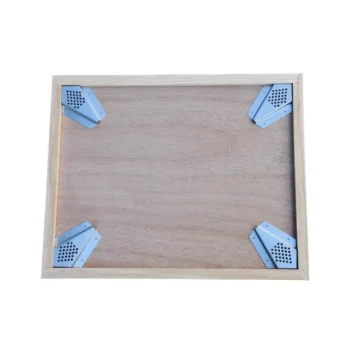
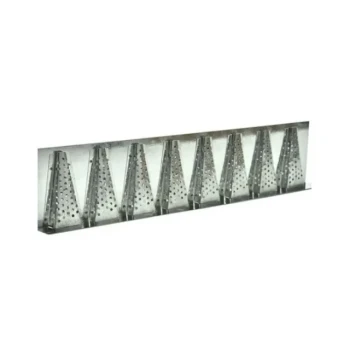
Metal beetle barriers serve as precise mechanical filters installed at the hive entrance to secure the colony against specific predators. These devices exploit the physical size difference between the honeybee and the Large African Hive Beetle, functioning as an isolation gate. By restricting the aperture size at the entrance, the barrier physically blocks the larger adult beetles from entering while allowing smaller worker bees to pass through for foraging.
Core Insight: Metal beetle barriers are a hardware-based solution that prioritizes colony safety through geometry rather than chemistry. They provide a passive, continuous defense that prevents large beetles from congregating and destroying critical brood combs.
The Mechanics of Exclusion
Exploiting Physical Dimensions
The efficacy of a metal beetle barrier relies entirely on precise calibration. The device is engineered with openings that are strictly measured to accommodate the body size of a worker bee but are too narrow for the Large African Hive Beetle.
Selective Traffic Control
This hardware creates a semi-permeable boundary. Worker bees, responsible for foraging and resource gathering, can navigate the barrier without obstruction. Simultaneously, the barrier creates a "hard stop" for the larger beetles, isolating them outside the hive environment.
Impact on Colony Health
Preventing Brood Destruction
The primary objective of this barrier is the protection of the brood combs. Once inside, large beetles can congregate and decimate the developing brood. By blocking entry at the perimeter, the barrier neutralizes this threat before damage occurs.
A Passive Defense System
Unlike active interventions that require beekeeper presence, these barriers provide continuous, autonomous protection. They are particularly valuable in infested regions where constant monitoring is impractical.
Comparative Principles of Entrance Modification
The Size-Exclusion Principle
The concept behind beetle barriers is similar to that of queen excluders or entrance gates. Both devices utilize rigid geometry to manage hive populations. However, while queen excluders restrict the queen to prevent absconding or manage breeding, beetle barriers focus solely on external predator exclusion.
Specificity vs. General Defense
It is important to distinguish beetle barriers from standard entrance reducers. While reducers minimize the entrance size to help a colony defend against robbing by other bees, beetle barriers are specialized screens designed specifically for the distinct morphology of the Large African Hive Beetle.
Operational Considerations
Limitations of Size Reliance
Because these barriers rely on size differentiation, they are only effective against predators significantly larger than a worker bee. They may not prevent the entry of smaller pests or parasites that fit through standard bee-sized openings.
Maintenance Requirements
Any physical screen placed at a hive entrance introduces the potential for congestion. Just as heater safety screens must be kept clear of debris to ensure airflow, beetle barriers require monitoring to ensure they do not become clogged with pollen, propolis, or dead bees, which could impede forager traffic.
Making the Right Choice for Your Goal
To select the correct entrance hardware, you must identify the primary threat or objective for your colony.
- If your primary focus is excluding Large African Hive Beetles: Install metal beetle barriers to physically block these predators from reaching the brood combs.
- If your primary focus is preventing colony absconding: Utilize queen excluders or entrance gates to restrict the queen's movement while allowing workers to fly.
- If your primary focus is stopping resource robbing: Apply standard entrance reducers to shrink the defensible area against intruding foragers from other hives.
Successful hive management relies on matching the mechanical properties of your equipment to the specific biological behavior of the threat you face.
Summary Table:
| Feature | Metal Beetle Barrier | Queen Excluder | Entrance Reducer |
|---|---|---|---|
| Primary Function | Blocks large beetle predators | Restricts queen movement | Limits robbing by other bees |
| Mechanism | Rigid geometry/Size-exclusion | Wire/Plastic grid spacing | Reduced entrance aperture |
| Target Pest | Large African Hive Beetle | N/A (Population Management) | Intruding forager bees |
| Protection Area | Brood combs & colony integrity | Brood nest management | Hive resources (honey) |
| Operation Mode | Passive, continuous defense | Internal management | Defensive perimeter reduction |
Maximize Your Colony's Security with HONESTBEE Professional Hardware
Protecting your commercial apiaries from pests requires precision-engineered solutions that don't compromise hive productivity. At HONESTBEE, we specialize in supporting commercial beekeepers and global distributors with a comprehensive range of high-quality tools, from specialized metal beetle barriers and queen excluders to advanced honey-filling and hive-making machinery.
Whether you are scaling your operation or stocking essential consumables, our wholesale offerings provide the durability and performance you need to succeed.
Ready to elevate your beekeeping standards? Contact our team today to discuss how our full spectrum of beekeeping equipment and industrial machinery can add value to your business.
References
- Benjamin P. Oldroyd, Michael H. Allsopp. Risk assessment for large African hive beetles (Oplostomus spp.)—a review. DOI: 10.1007/s13592-017-0493-7
This article is also based on technical information from HonestBee Knowledge Base .
Related Products
- Metal Hive Feet Bee Hive Stand for Ant Protection
- HONESTBEE 4-Way Metal Corner Wooden Bee Escape Board
- Reusable Aluminium Beetle Trap for Small Hive Beetles Silver Bullet
- Metal Bee Hive Stand Bee Box Stand for Beekeeping
- Beehive Entrance Reducer Guardian Metal Hive Entrance for Bees
People Also Ask
- What are the benefits of elevating a bee hive with a stand or base? Protect Your Colony and Your Back
- How does a beehive stand protect against predators and pests? Essential Strategies for Colony Security
- How should the height of a beehive stand be determined? Find Your Ergonomic Sweet Spot
- What to stand a beehive on? The Best Foundation for a Healthy, Manageable Apiary
- What is the best base for a beehive? Choose the Right Stand for Colony Health