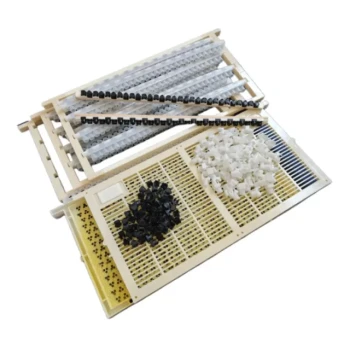
Modern queen rearing and colony splitting equipment acts as the foundational control mechanism for the entire honey value chain. Rather than relying on natural swarming or random genetics, this technology allows producers to actively manage the biological source of their product. Through the use of grafting needles and specialized rearing boxes, beekeepers can optimize honey-gathering traits and disease resistance, while scientific splitting tools ensure a scalable and secure supply of raw honey.
Core Insight: By shifting beekeeping from passive collection to active genetic and population management, these technologies secure the "first mile" of the value chain. They provide the necessary volume stability to buffer against market price fluctuations and ensure consistent commercial supply.
Optimizing Production at the Source
Artificial Selection and Genetic Control
Modern equipment, specifically grafting needles and rearing boxes, enables precise artificial selection. Instead of accepting the genetics of wild queens, beekeepers can selectively breed for specific, high-value traits. This ensures that the biological engines of the value chain—the bees themselves—are optimized for maximum honey-gathering efficiency.
Enhancing Disease Resistance
The sustainability of the honey supply relies heavily on colony health. By using specialized rearing tools to propagate queens from hygienic and disease-resistant stock, producers reduce colony collapse rates. This stabilizes the foundational assets of the apiary, preventing the supply shocks caused by widespread disease outbreaks.
Maximizing Yield per Hive
Supplementary data indicates that specialized equipment facilitates the regular replacement of older queens, typically every two years. Young, vigorous queens reared through these methods produce stronger pheromones that enhance colony cohesion. This biological efficiency directly translates to significantly higher honey yields per hive, increasing the economic output without increasing the apiary footprint.
Strategic Supply Management
Rapid Colony Expansion
Scientific colony splitting equipment allows for the calculated and rapid expansion of colony sizes. This capability transforms the apiary into a scalable operation, allowing producers to quickly ramp up population numbers to meet projected harvest goals. This elasticity is critical for commercial operations that must meet large-scale contracts.
Mitigating Price Volatility
The primary function of this equipment in the economic value chain is the management of price pressures. By securing a continuous supply capacity at the source, producers can smooth out the "boom and bust" cycles often associated with agricultural commodities. A stable supply helps neutralize price spikes and drops caused by market demand fluctuations.
Operational Efficiency and Labor
Suppressing the Swarming Instinct
Natural swarming is a significant risk to commercial productivity, as it results in the loss of bees and honey production. Controlled rearing allows beekeepers to preemptively replace queens to suppress this natural instinct. This ensures that the colony's energy is directed toward honey production rather than reproduction and migration.
Reducing Commercial Labor Costs
While modern equipment requires an upfront investment, it ultimately reduces operational friction. High-quality queens and standardized splitting procedures reduce the need for emergency interventions and hive rehabilitation. This lowers the labor hours required per pound of honey produced, improving the overall margin of the value chain.
Understanding the Operational Trade-offs
The Requirement for Technical Expertise
While equipment like grafting needles is inexpensive, the skill required to use them is high. Successful artificial selection requires a level of biological knowledge and manual dexterity that exceeds traditional beekeeping. Without proper training, the misuse of this equipment can damage larvae and fail to produce viable queens.
Genetic Diversity Risks
A reliance on a narrow set of "optimal" genetics can be a double-edged sword. While it maximizes short-term yields, aggressive artificial selection can reduce the overall genetic diversity of the apiary. If not managed carefully, this can make the entire operation susceptible to new pathogens that the selected strain cannot resist.
Making the Right Choice for Your Goal
- If your primary focus is Supply Security: Prioritize colony splitting equipment to enable rapid scaling and volume consistency to meet large commercial contracts.
- If your primary focus is Profit Margin: Focus on queen rearing tools (grafting/boxes) to maximize the yield-per-hive and reduce the labor costs associated with managing swarms.
- If your primary focus is Sustainability: Use rearing equipment to strictly select for local disease resistance, ensuring your value chain is resilient against environmental stressors.
Mastering the upstream equipment of queen rearing and splitting is the single most effective way to transition from a hobbyist approach to a secure, industrial-grade honey supply chain.
Summary Table:
| Feature | Impact on Value Chain | Key Equipment |
|---|---|---|
| Genetic Control | Optimizes honey-gathering traits and disease resistance | Grafting needles, rearing boxes |
| Population Scaling | Enables rapid colony expansion to meet large contracts | Scientific splitting tools |
| Yield Optimization | Increases honey output per hive via young, vigorous queens | Queen cages, cell cups |
| Risk Mitigation | Suppresses swarming and prevents supply shocks | Standardized splitting kits |
| Labor Efficiency | Reduces manual hive interventions and maintenance costs | High-quality queen rearing systems |
Secure Your Apiary’s Growth with HONESTBEE
At HONESTBEE, we empower commercial apiaries and global distributors by securing the 'first mile' of the honey value chain. From high-precision queen rearing tools and colony splitting equipment to industrial honey-filling machines and hive-making hardware, we provide the full spectrum of equipment needed to scale your operations.
Whether you are looking to enhance genetic resistance or maximize industrial yield, our comprehensive wholesale offerings ensure you remain competitive in an evolving market. Contact us today to discover how our specialized machinery and industry consumables can drive your commercial success.
References
- Esther Kiwalaka. Factors Influencing the Price of Honey; A Case of Mvomero District. DOI: 10.51505/ijebmr.2023.7309
This article is also based on technical information from HonestBee Knowledge Base .
Related Products
- Retractable Chinese Queen Rearing Grafting Tools Equipment
- No Grafting Queen Rearing Kit: System for Royal Jelly Production and Queen Rearing
- Stainless Steel Queen Grafting Tool for Beekeeping and Bee Queen Grafting
- Plastic Beekeeping Honey Bee Larvae Grafting Tools for Queen Rearing and Chinese Grafting
- Stainless Steel Beekeeping Queen Grafting Tool for Honey Bee Rearing
People Also Ask
- Which specialized tools are necessary for implementing standardized queen rearing? Scale Your High-Yield Apiary
- Why are specialized queen rearing tools necessary to mitigate winter hive losses? Boost Apiary Survival and Recovery
- How do queen-rearing tools facilitate the sustainability and expansion of a commercial apiary? Drive Scalable Growth
- In what ways do modern queen rearing equipment and grafting tools improve competitiveness? Boost Breeding Success Rate
- What role do specialized queen rearing tools and consumables play in modern large-scale apiculture? Drive Production & Scale