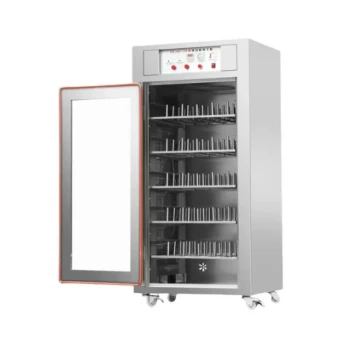
Vacuum freeze-drying functions as the definitive quality benchmark in the processing of drone pupae. While often too expensive for mass commercialization, it acts as the "gold standard" reference point used to measure nutrient retention and physical appearance against industrial hot air drying methods.
Core Takeaway Vacuum freeze-drying is primarily a reference tool for evaluating quality rather than a mass-production solution. It sets the baseline for maximum nutrient and color retention, allowing producers to assess the efficiency and degradation levels of more cost-effective methods like hot air circulation.
The Role of the Benchmark
Setting the Standard for Nutrient Retention
Vacuum freeze-drying removes moisture through sublimation at low temperatures. This process avoids the heat damage associated with thermal drying.
Because of this, it serves as the baseline for preserving heat-sensitive components, specifically unsaturated fatty acids. By comparing other methods to this standard, researchers can quantify exactly how much nutritional value is lost during higher-temperature processing.
Establishing Visual Quality Metrics
Appearance is a critical indicator of process quality in insect protein. Freeze-drying preserves the natural coloration of the pupae better than any other method.
It maintains high L and b values** (measures of lightness and yellowness), ensuring the product looks as close to its natural state as possible. This creates a visual target that industrial drying methods aim to approximate.
Comparing to Industrial Hot Air Drying
The Reality of Commercial Scale
While freeze-drying offers superior quality, it incurs significantly higher operational costs. This makes it less feasible for large-scale production in commercial apiaries.
Industrial hot air circulation ovens are the practical alternative. They typically operate between 41.6 and 58.4 °C, offering a balance between throughput and quality.
Safety and Efficiency
Hot air drying is far more effective than traditional methods, such as sun drying, at reducing water activity.
This reduction is vital for lowering the risk of lipid oxidation and microbial contamination. While hot air drying may not hit the perfect nutrient retention numbers of freeze-drying, it provides high safety standards at a cost viable for the market.
Understanding the Trade-offs
Quality vs. Cost
The core trade-off is between the "perfect" preservation of freeze-drying and the economic viability of hot air drying.
Freeze-drying maximizes quality but drives up the price per unit. Hot air drying accepts a marginal degree of quality loss (relative to the benchmark) to achieve lower operating costs and higher production volume.
Thermal Impact
Using freeze-drying as a control allows producers to monitor the impact of heat.
Since hot air ovens use thermal energy to remove moisture, there is an inherent risk of degrading sensitive compounds. The freeze-dried sample proves what is theoretically possible, helping engineers tune hot air ovens to minimize thermal damage.
Making the Right Choice for Your Goal
- If your primary focus is Research or High-End Supplements: Choose vacuum freeze-drying to maximize unsaturated fatty acid retention and visual appeal, regardless of cost.
- If your primary focus is Commercial Mass Production: Choose industrial hot air drying to balance safety, uniform drying, and operational costs while maintaining acceptable quality standards.
Understanding the gap between the freeze-dried benchmark and the hot-air reality is the key to optimizing drone pupae production.
Summary Table:
| Feature | Vacuum Freeze-Drying (Benchmark) | Industrial Hot Air Drying (Commercial) |
|---|---|---|
| Drying Mechanism | Sublimation at low temperatures | Thermal evaporation (41.6 - 58.4 °C) |
| Nutrient Retention | Maximum (especially fatty acids) | Moderate (some thermal degradation) |
| Visual Quality | High lightness and yellowness (natural) | Slight darkening possible |
| Production Cost | High (expensive operation) | Economical (high throughput) |
| Primary Use | Research, high-end supplements | Mass commercial production |
Scale Your Apiary Production with Professional Equipment
At HONESTBEE, we understand the delicate balance between product quality and operational costs. Whether you are conducting research or scaling up for mass distribution, we provide the industrial tools necessary to optimize your honey and bee-product processing.
Our value to commercial apiaries and distributors includes:
- Comprehensive Machinery: From high-efficiency honey-filling machines to industrial-grade drying solutions.
- Specialized Hardware: Precision-engineered hive-making equipment and essential beekeeping tools.
- Wholesale Consumables: A full spectrum of supplies to keep your operations running smoothly.
- Branding & Culture: Honey-themed merchandise to enhance your market presence.
Ready to elevate your beekeeping business? Contact HONESTBEE today to discuss our wholesale offerings and how we can support your growth!
References
- Seung-Hee Baek, In Sik Nam. Optimization of the Heat-Drying Conditions of Drone Pupae by Response Surface Methodology (RSM). DOI: 10.3390/foods12163062
This article is also based on technical information from HonestBee Knowledge Base .
Related Products
- 0.5T Capacity Honey Dehumidifier Dryer with Vacuum Heating and Thickening Filtering Machine
- HONESTBEE Professional Cabinet Bottle Dryer
- High Quality Honey Dehumidifier Dryer Thickening Machine for Beekeeping
- Economy Small Scale Honey Dryer Dehumidifier Thickening Machine
People Also Ask
- What is the primary function of professional dehumidification equipment in honey processing? Stability & Quality
- How to dry up honey? The Safe Guide to Stabilizing Honey and Preventing Fermentation
- What is the process for using a dehumidifier to lower honey's moisture content? Expert Drying Techniques
- How to decrease moisture in honey? Prevent Fermentation and Ensure Long-Term Quality
- How to remove humidity from honey? Protect Your Harvest from Fermentation