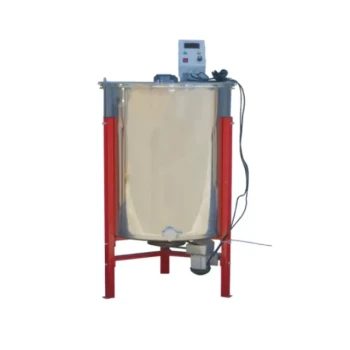
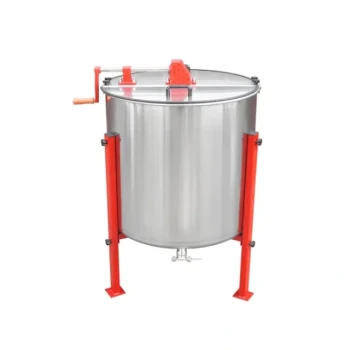
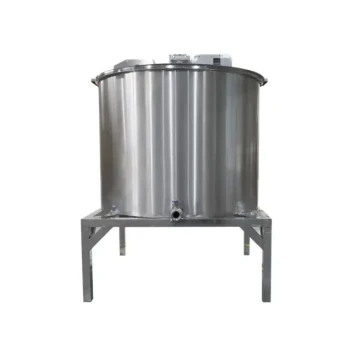
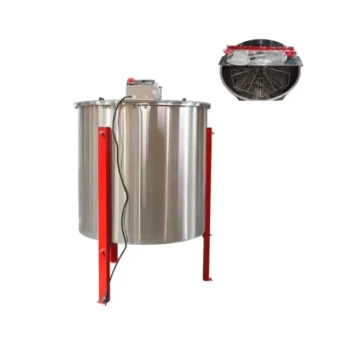
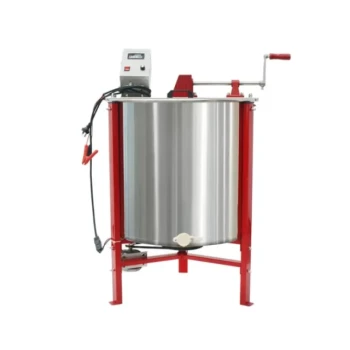
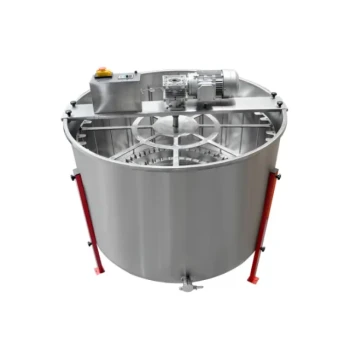
Industrial-grade centrifugal extractors and high-precision scales are essential for isolating the genetic performance of a bee colony from environmental variables. Unlike standard harvesting tools, these instruments function as a calibrated system to ensure that recorded honey yields reflect true biological output rather than harvesting inefficiencies or impurities.
Core Takeaway Accurate breeding programs rely on precise "differential weighing"—measuring frames before and after extraction—to determine the exact mass of pure honey produced. This method eliminates variables like comb weight and impurities, providing the objective data necessary for Best Linear Unbiased Prediction (BLUP) models used to secure genetic gain.
Eliminating Variables in Yield Measurement
The Necessity of Differential Weighing
To assess a colony's true economic value, breeders cannot simply weigh the harvested liquid.
Instead, they must employ a differential measurement strategy. High-precision scales record the total weight of the capped honeycombs before extraction and the weight of the empty frames immediately after.
Calculating Pure Yield
By subtracting the post-extraction weight from the pre-extraction weight, breeders isolate the exact mass of the honey.
This method removes unrelated variables, such as the weight of the wooden frames, the beeswax structure, and moisture content fluctuations. It ensures the final data point represents pure honey yield, which is the primary indicator of a colony's physical health and genetic potential.
Preserving Data Integrity via Extraction
Controlled Centrifugal Force
Industrial-grade extractors are required because they utilize controlled high-speed rotation to generate precise centrifugal force.
This force throws liquid honey out of the cells at specific intervals (e.g., 15 minutes) without physically damaging the delicate beeswax structure. Preserving the comb is critical not just for the bees, but for the data; if the comb breaks, beeswax mixes with the honey, altering the weight and invalidating the yield measurement.
Maintaining Comb Structure for Re-use
Because the extraction is non-destructive, the structural integrity of the honeycomb frames is maintained.
This allows the frames to be returned to the hive for immediate reuse. Consequently, the colony does not need to expend energy or resources building new wax, allowing breeders to measure honey production efficiency rather than wax production capability.
Standardization for Genetic Evaluation
Feeding BLUP Models
Modern breeding programs use Best Linear Unbiased Prediction (BLUP) models to estimate the genetic merit of livestock.
These statistical models require data that is objective and free from human error or estimation. The combination of industrial extraction and precision weighing provides the standardized, high-quality data inputs required to make these models scientifically sound.
Economic Correlation
The data derived from this equipment serves as a direct economic indicator.
By accurately quantifying the yield, breeders can correlate specific hive designs and genetic lines with output efficiency. This quantitative evidence supports the selection of the most economically viable breeding lines for commercial apiaries.
Understanding the Trade-offs
Process Efficiency vs. Data Granularity
Implementing this level of measurement introduces a significant bottleneck in the harvesting workflow.
Weighing individual frames or chambers before and after extraction is time-consuming compared to bulk commercial harvesting. While this granularity is non-negotiable for breeding data, it significantly reduces the speed of operations during peak season.
Capital Investment and Maintenance
Industrial-grade equipment requires a higher initial capital investment than standard apiary tools.
Furthermore, to maintain the integrity of the data, the equipment demands strict maintenance protocols. Scales must be frequently calibrated to ensure precision, and extractors must be maintained to ensure consistent rotational speeds, as deviations can lead to incomplete extraction or comb damage.
Making the Right Choice for Your Goal
To determine if this level of precision is required for your operation, consider your primary objective:
- If your primary focus is Genetic Improvement: You must invest in high-precision scales and industrial extractors to generate the clean, differential weight data required for valid BLUP modeling.
- If your primary focus is Commercial Production: You should prioritize the industrial extractor for its ability to reuse combs and reduce bee energy consumption, though the granular weighing protocols may be unnecessary.
Precision in measurement is the only path to predictability in genetic selection.
Summary Table:
| Equipment Type | Key Role in Breeding Programs | Benefit to Data Integrity |
|---|---|---|
| High-Precision Scales | Differential weighing (Pre/Post extraction) | Isolates pure honey mass from frame/wax weight. |
| Industrial Extractor | Controlled high-speed centrifugal rotation | Ensures complete extraction without damaging comb structure. |
| BLUP Models | Statistical genetic merit estimation | Provides objective data for scientifically sound selection. |
| Calibrated Systems | Standardization across all test colonies | Eliminates environmental variables and harvesting errors. |
Maximize Your Genetic Gain with HONESTBEE
Precise data is the foundation of every successful breeding program. At HONESTBEE, we understand that commercial apiaries and distributors require more than just basic tools—they need precision-engineered solutions to drive economic efficiency.
We provide a comprehensive wholesale range, including:
- Industrial-Grade Machinery: From high-capacity honey-filling machines to robust hive-making equipment.
- Precision Beekeeping Tools: Professional extractors and hardware designed for durability and accuracy.
- Essential Consumables: A full spectrum of supplies to keep your operations running at peak performance.
Whether you are refining genetic lines or scaling commercial production, HONESTBEE delivers the equipment you need to succeed.
Contact Us Today to Upgrade Your Apiary
References
- Mustafa Kösoğlu. Honey Bee Breeding and Some Basic Approaches. DOI: 10.52520/masjaps.107
This article is also based on technical information from HonestBee Knowledge Base .
Related Products
- electric honey extractor honey centrifuge 3 frame honey extractor stainless steel honey frame extractor
- Manual Hand Crank 4 Frame Honey Extractor Centrifuge for Beekeeping
- Professional 4 Frame Self Reversing Electric Honey Extractor for Beekeeping
- Electric 4 Frame Tangential Honey Extractor
- 24 Frame Honey Extractor Commercial Radial Honey Frame Extraction Machine
People Also Ask
- What are the characteristics of electric honey extractors? Boost Your Apiary Efficiency with Automated Technology
- What are the disadvantages of using an electric honey extractor? Weighing Cost, Power, and Comb Safety
- What are the advantages of an electric honey extractor? Boost Efficiency and Scale Your Honey Production
- What are the technical advantages of electric honey extractors? Maximize Yield and Protect Your Bee Colony
- How does an electric honey extractor affect the quality of honey? Preserve Flavor & Purity with Precision Extraction