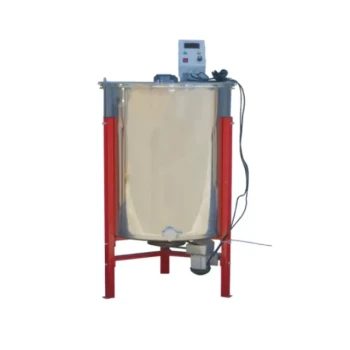
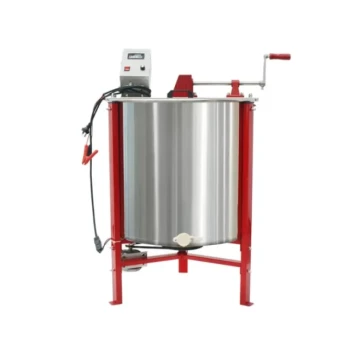
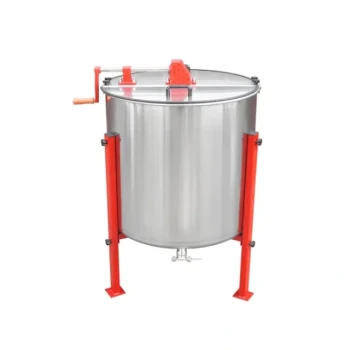
Cold water is the critical first step when rinsing a honey extractor because it preserves the solid state of residual beeswax. While hot water is excellent for dissolving sugar, it melts the wax cappings left behind during extraction. This turns manageable solids into a gummy, adhesive mess that smears across the equipment and makes cleaning significantly more difficult.
Core Insight: Effective cleaning requires prioritizing the removal of wax over the dissolution of honey. Cold water keeps wax brittle and easy to dislodge, whereas hot water transforms it into a sticky film that is nearly impossible to simply rinse away.
The Physics of Wax and Water
The Reaction to Heat
Beeswax has a relatively low melting point. Introducing hot water immediately causes the leftover wax cappings to liquefy.
Instead of washing away, this melted wax spreads out and coats the interior surfaces of the extractor. Once the water cools, the wax re-hardens as a thin, stubborn layer that requires aggressive scrubbing to remove.
The Reaction to Cold
Cold water has the opposite effect on beeswax. It causes the material to contract and harden, making it brittle.
Because the wax is brittle, the force of the water helps it flake off easily. It remains in distinct chunks or particles that can be rinsed out of the drain or wiped up without smearing.
Efficiency and Equipment Maintenance
Reducing Physical Effort
Using cold water significantly reduces the physical labor involved in cleaning.
When wax remains solid, it does not adhere strongly to stainless steel or plastic. You can often rinse the bulk of the waste away without needing to scrape the sides of the drum.
Protecting Internal Mechanisms
If wax melts, it can flow into areas where it shouldn't be, such as the bottom bearings or the gate valve hinge.
Cold water prevents this migration. By keeping the wax solid, you ensure it stays in the main drum area where it is easily accessible and removable.
Common Pitfalls to Avoid
The Premature Heat Mistake
A common error is assuming that because honey dissolves faster in hot water, the entire tank should be sprayed with heat immediately.
This ignores the presence of wax. You must always perform a "cold flush" first to remove the wax solids; only after the wax is gone should you introduce heat to dissolve the remaining sticky honey film.
The Smearing Effect
Once wax has been melted and smeared by hot water, applying cold water afterward will not fix the problem.
It will simply freeze the smear in place. At that stage, you are forced to use solvents or very hot water and heavy mechanical agitation to clean the surface.
Making the Right Choice for Your Maintenance
To ensure a long life for your extractor and a quick cleanup process, follow these guidelines based on your immediate goal:
- If your primary focus is rapid cleanup: Start with a high-pressure cold water rinse to blast away wax flakes before they have a chance to stick.
- If your primary focus is deep sanitation: Remove all wax with cold water first, then switch to hot water and soap to sterilize the metal surfaces.
By respecting the properties of beeswax and starting cold, you transform a sticky, labor-intensive chore into a simple two-step process.
Summary Table:
| Cleaning Phase | Water Temperature | Primary Goal | Effect on Beeswax |
|---|---|---|---|
| Initial Rinse | Cold | Remove wax cappings | Hardens wax, making it brittle and easy to flake off |
| Secondary Wash | Warm/Hot | Dissolve honey residue | Melts wax into a sticky film (Avoid if wax is present) |
| Final Sanitation | Hot & Soap | Sterilize surfaces | Removes remaining bacterial film and honey stickiness |
| The Mistake | Premature Heat | N/A | Liquefies wax, causing it to smear and clog bearings |
Streamline Your Commercial Apiary with HONESTBEE
Maintaining industrial beekeeping equipment shouldn't be a struggle. At HONESTBEE, we understand the nuances of honey production—from the physics of beeswax to the mechanics of high-capacity extraction. We provide commercial apiaries and distributors with premium honey extractors, honey-filling machines, and specialized hive-making equipment designed for durability and easy maintenance.
Whether you are scaling your operation or sourcing high-quality beekeeping consumables for distribution, our comprehensive wholesale portfolio offers the reliability you need to stay productive. Let us help you optimize your workflow with professional-grade machinery and expert industry insights.
Ready to upgrade your honey production facility? Contact HONESTBEE today for a custom quote and wholesale catalog!
Related Products
- HONESTBEE 72 Frame Industrial Electric Honey Extractor for Beekeeping
- Commercial Electric 12 Frame Honey Extractor Spinner Motorized Honey Extractor
- HONESTBEE 6 Frame Self Reversing Electric Honey Extractor for Beekeeping
- HONESTBEE 3-Frame Manual Acrylic Honey Extractor
- Stainless Steel Manual 8 Frame Radial Honey Extractor Machine for Beehives
People Also Ask
- What is the importance of balancing honeycomb frames within a honey extractor? Ensure Stability and Protect Machinery
- How is honey separated from the frames after they are uncapped? Efficient Extraction Methods for High Yields
- What are the main benefits of using a honey extractor? Maximize Yields and Protect Your Honeycomb
- What are the recommended methods for removing honey from the honeycomb? Top Extraction Techniques for Maximum Efficiency
- How do manual honey extractors compare to electric honey extractors? Choosing the Right Tool for Your Apiary Growth