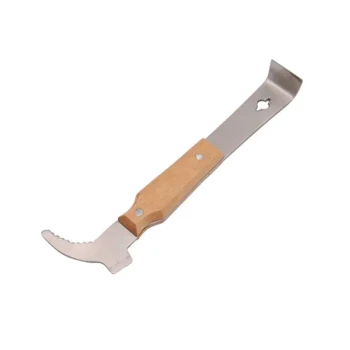
Standardizing beekeeping consumables and hardware is the only way to establish a reliable baseline for data collection. By maintaining strict uniformity in items such as frames, wax foundations, and hive accessories, you effectively eliminate equipment quality as a variable. This ensures that any observed fluctuations in honey production are accurate indicators of environmental changes rather than the result of inconsistent colony management.
In long-term agroecosystem monitoring, your equipment constitutes the experimental control. If your hardware varies, your data becomes noisy; standardized consumables ensure that yield changes are attributed solely to climatic fluctuations and floral resource availability.
The Role of Standardization in Data Integrity
Minimizing Interference Variables
In scientific monitoring, the goal is to isolate specific causes for specific effects. Beekeeping hardware acts as a structural variable within the hive.
If you introduce inconsistent frames or foundations, you introduce interference. The colony may expend different amounts of energy adapting to irregular equipment, which skews the performance data of that specific hive.
Isolating Environmental Factors
The primary objective of agroecosystem monitoring is often to track the health of plant resources and climatic conditions. To do this effectively, the "instrument" measuring these changes—the honey bee colony—must be calibrated.
Standardized equipment ensures that the colony's output is a direct reflection of external forage availability. This allows researchers to confidently attribute shifts in honey production to environmental trends rather than mechanical inconsistencies.
The Risks of Inconsistency
Impact on Colony Development
The primary reference highlights that variations in equipment can directly alter colony development. For example, low-quality wax foundations may retard comb building, while irregular frames can affect brood patterns.
If one colony struggles due to poor hardware while another thrives with superior hardware, the data will falsely suggest a difference in environmental carrying capacity where none exists.
Distorting Multi-Year Trends
Long-term monitoring relies on year-over-year comparisons. If the hardware profile changes halfway through a five-year study, the dataset is compromised.
Maintaining the same standard of consumables ensures that a drop in production in Year 3 is statistically significant to the ecosystem's health, rather than a byproduct of a supply chain change.
Common Pitfalls to Avoid
Overlooking "Minor" Consumables
It is easy to assume that small accessories do not impact the macro data of a hive. However, cumulative inconsistencies create noise. Even minor differences in hive accessories can alter ventilation or ease of access, subtly impacting colony productivity over a full season.
Confusing Vendor Availability with Consistency
Buying from the same vendor does not guarantee consistency. Product lines change. To ensure valid monitoring, you must verify that the specifications of the wax and frames remain identical, regardless of the brand or batch.
Ensuring Reliability in Your Monitoring Strategy
To generate actionable data from your agroecosystem monitoring, apply these principles:
- If your primary focus is Floral Resource Assessment: Standardize all wax foundations to ensure comb building rates remain constant across all test colonies.
- If your primary focus is Long-Term Climate Impact: Maintain identical hive dimensions and ventilation accessories to rule out micro-climate variations within the hive boxes.
Consistency in your gear is the prerequisite for clarity in your data.
Summary Table:
| Factor | Role in Monitoring | Impact of Inconsistency |
|---|---|---|
| Wax Foundations | Calibrates comb-building energy | Skews energy expenditure data |
| Hive Frames | Maintains brood patterns | Distorts colony health assessments |
| Hardware Accessories | Regulates hive micro-climate | Creates noise in environmental trends |
| Equipment Specs | Acts as an experimental control | Invalidates year-over-year comparisons |
Secure Your Research Accuracy with HONESTBEE
Precise data starts with consistent hardware. At HONESTBEE, we understand that commercial apiaries and distributors require more than just equipment—they need reliable standards for long-term success.
We provide a comprehensive wholesale range, including:
- Precision Machinery: Hive-making and honey-filling machines for exact specifications.
- Standardized Hardware: Uniform beekeeping tools and equipment to eliminate variables.
- Essential Consumables: High-quality foundations and accessories to ensure colony stability.
Whether you are scaling a commercial operation or supplying the industry, our portfolio ensures your gear never compromises your results. Partner with HONESTBEE today for reliable wholesale solutions.
References
- Rosana Yacqueline Díaz, Horácio Heinzen. A Conceptual Framework for the Apibotanical Evaluation of Different Landscapes. DOI: 10.3390/ecologies6010003
This article is also based on technical information from HonestBee Knowledge Base .
Related Products
- Stainless Steel J Hook Hive Tool for Beekeeping
- Classic Wooden Bee Brush with Double-Row Boar Bristles
- Stainless Steel Honey Bee Smoker Hive and Honeycomb Smoker for Beekeeping
- HONESTBEE 15-in-1 Beekeeper Multi-Tool with Hammer and Pliers for Beekeeping
- Professional Bee Smoker with Elongated Spout and Durable Bellows for Beekeeping
People Also Ask
- What specific challenges do beekeeping hive tools address during hive maintenance? Essential Solutions for Apiaries
- What are the features of a J-hook hive tool? Effortlessly Lift Frames with Superior Leverage
- What is a J-hook hive tool and why is it favored by some beekeepers? Master Gentle Frame Handling
- What is the purpose of the J-hook hive tool? Effortlessly Lift Frames with Superior Leverage
- How is a J-hook hive tool designed and what is its primary use? Master Effortless Hive Inspections