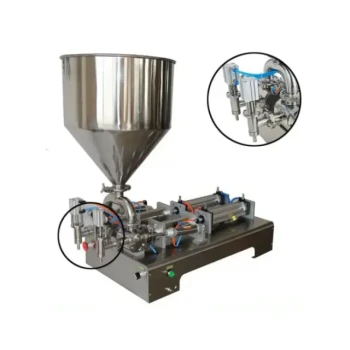
High-standard honey filling and packaging equipment acts as a critical firewall against contamination. It ensures products strictly adhere to microbiological indicators by automating processes to eliminate the risks associated with manual handling. Beyond safety, professional machinery guarantees the high-quality aesthetic presentation and production efficiency required to secure added value and competitiveness in global markets.
Automation in honey processing is not merely about speed; it is a fundamental requirement for achieving the precise hygiene control, seal integrity, and measurement accuracy needed to bypass strict non-tariff trade barriers in international jurisdictions.
Eliminating Contamination Risks
Automating for Microbiological Safety
Manual intervention is the primary vector for product contamination. High-standard automation removes the "human factor" from the filling process.
By utilizing automated flows, you drastically reduce the risk of introducing pathogens. This ensures the final product meets the rigorous microbiological indicators demanded by international food safety regulators.
Preventing Environmental Exposure
Industrial-grade machines often employ closed systems that protect the honey during the filling phase. This prevents secondary contamination from dust or airborne particles.
Maintaining a controlled environment is essential for preserving the honey's physical and chemical stability. This protects critical quality indicators, such as moisture content and sucrose ratios, which are subject to inspection.
Ensuring Regulatory Compliance and Consistency
Precise Metering and Net Weight
International trade standards enforce strict tolerance levels for product weight. High-precision machines use accurate metering control systems to ensure every unit complies with declared net content.
This consistency is vital for avoiding legal disputes and fines. It ensures that large-scale batches remain uniform, meeting the standardized packaging laws of import destinations.
Labeling and Legal Adherence
Safety extends beyond the liquid inside the bottle; it includes accurate information. Integrated automated labeling systems ensure that specific legal warnings are applied correctly to every unit.
For example, labels regarding infant botulism risks are mandatory in many regions. Automated application ensures these warnings are never omitted, mitigating liability and ensuring compliance with packaging requirements in the US and EU.
Enhancing Market Competitiveness and Logistics
Extending Shelf Life for Export
Exporting honey often involves long-distance maritime or land transport. Advanced equipment utilizes vacuum sealing technology to ensure airtight closure.
High-standard sealing prevents oxidation and leakage during transit. This effectively extends the product's shelf life, allowing it to survive global supply chains without degrading.
Boosting Brand Value through Aesthetics
In high-end international markets, the visual appeal of the product indicates its quality. Professional packaging machinery delivers a clean, standardized finished appearance.
This aesthetic consistency enhances brand credibility. It allows exporters to position their honey as a premium product, commanding higher added value and differentiating it from lower-quality competitors.
Understanding the Trade-offs
The Capital vs. Operational Shift
Investing in high-standard equipment requires significant upfront capital expenditure (CapEx). While it reduces the cost of manual labor, it shifts the budget toward technical maintenance and skilled machine operators.
Complexity and Maintenance
High-precision equipment is intolerant of neglect. These systems require rigorous cleaning and calibration schedules to maintain their accuracy and hygiene certifications.
If a machine fails, production stops entirely. Unlike manual lines where workers can shift roles, automated lines depend heavily on the availability of spare parts and technical support.
Making the Right Choice for Your Export Strategy
To determine if high-standard automation is the right investment for your current stage of growth, consider your primary export goals:
- If your primary focus is Market Entry (EU/US): Prioritize equipment with advanced hygiene controls and labeling accuracy to navigate strict non-tariff trade measures and regulatory audits.
- If your primary focus is Brand Positioning: Focus on machinery that offers vacuum sealing and premium labeling capabilities to maximize the aesthetic appeal and shelf life of your product.
By treating packaging equipment as a compliance tool rather than just a production tool, you safeguard your supply chain and secure your reputation in the global marketplace.
Summary Table:
| Key Feature | Benefit for Export Trade | Impact on Food Safety |
|---|---|---|
| Automated Flow | Reduces labor costs & eliminates human error | Minimizes microbiological contamination |
| Precision Metering | Ensures net weight compliance for global trade | Prevents legal disputes and trade barriers |
| Vacuum Sealing | Extends shelf life for long-distance transit | Prevents oxidation and leakage |
| Integrated Labeling | Guarantees compliance with regional legal warnings | Ensures mandatory safety disclosures (e.g., botulism) |
| Closed Systems | Maintains physical and chemical stability | Prevents secondary environmental contamination |
Elevate Your Beekeeping Operation to Global Standards
At HONESTBEE, we specialize in empowering commercial apiaries and distributors with the tools needed to conquer international markets. Whether you require high-precision honey-filling machines, industrial-grade hive-making machinery, or essential industry consumables, our comprehensive wholesale portfolio is designed for scale and safety.
Our Value to You:
- Global Compliance: Equipment engineered to meet rigorous international food safety standards.
- End-to-End Solutions: From specialized hardware to honey-themed cultural merchandise.
- Scalability: Streamline your production with automation that increases efficiency and brand value.
Ready to transform your honey production into a world-class export powerhouse?
Contact HONESTBEE today to discuss your equipment needs!
References
- Yusif Abulfat Humbatov, Bobur Sobirov. Current status of honey productıon ın Azerbaıjan. DOI: 10.1051/bioconf/20249302016
This article is also based on technical information from HonestBee Knowledge Base .
Related Products
- Double Nozzle Small Honey Filling Machine Honey Sachet Packing Packaging Equipment
- Small Honey Filling Machine Sachet Packing Equipment Single Nozzle
- Fully Automatic Honey Filling Packaging Machine for Processing Line
- Economy Small Honey Filling Machine Honey Bottle Filler Packaging Machine
- Precision Automated Packaging Turntable Honey Spoon Filling Sealing Packing Machine
People Also Ask
- What value do retail packaging equipment and filling technologies provide in the honey distribution process? Maximize ROI
- How does industrial honey-filling machinery support Robinia pseudoacacia stands? Maximize Your Acacia Honey Yield
- Why is high-precision honey filling equipment necessary? Secure the medicinal value and ROI of stingless bee honey.
- How does high-precision honey filling equipment protect honey's biological activity? Safeguard Purity & Premium Value
- What role does precision filling equipment play in cost control? Maximize Honey Profits & Market Growth