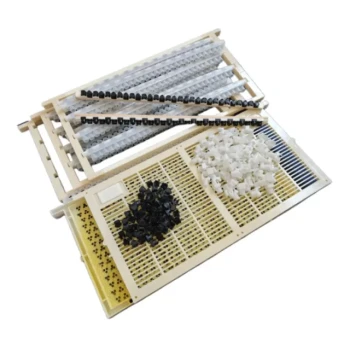
Professional queen rearing equipment provides the necessary control to safely integrate honeybees into populated environments. By utilizing specialized tools like cell cups and grafting needles, beekeepers can bypass random natural selection. This allows them to specifically breed for docility and low swarm tendencies, which are critical requirements for keeping bees in high-density urban settings.
By enabling an artificial breeding process, professional equipment allows for the optimization of genetic traits. This ensures honeybees are specifically adapted for residential areas, minimizing public disturbance and maximizing disease resistance.
The Mechanics of Selective Breeding
Precision in Genetic Selection
Professional rearing relies on tools such as specialized frames, cell cups, and grafting needles.
These instruments allow breeders to manually select larvae from colonies that exhibit the most desirable traits.
This moves the process from chance to a controlled artificial breeding strategy.
Optimizing for Urban Temperament
In a city, a bee's temperament is its most vital genetic trait.
Using professional equipment to isolate gentle genetic lines ensures that the resulting bees are docile.
This significantly reduces the risk of stinging incidents in areas where hives are close to sidewalks or neighbors.
Controlling Swarm Instincts
Natural honeybee colonies have a strong biological drive to swarm, which can cause public alarm in urban centers.
Selective breeding helps propagate genetic lines with a low tendency to swarm.
This keeps the colony population stable and prevents the chaotic spectacle of a swarm in a busy city street.
The Role of Standardization in Genetic Research
Creating a Uniform Environment
While rearing equipment handles the biology, standardized hive-making machinery supports the research data.
Uniform physical environments help eliminate external variables that could skew observations.
This ensures that a bee's performance is attributed to its genetics rather than a quirk of its housing.
Correlating Genotypes with Phenotypes
Improving genetics requires rigorous data analysis.
Automated management systems record performance metrics like winter survival and honey yield.
This data allows researchers to accurately link specific genetic markers to real-world physical traits (phenotypes).
Understanding the Trade-offs
The Requirement for Skill
Possessing professional equipment does not guarantee superior genetics on its own.
Tools like grafting needles require significant manual dexterity and experience to use effectively without damaging the larvae.
Equipment Cost vs. Scale
Investing in specialized breeding hardware represents a significant upfront cost.
For small-scale hobbyists, the expense may outweigh the benefits unless the goal is specifically to produce queens for a wider community.
Making the Right Choice for Your Goal
To determine if professional rearing equipment is the right step for your apiary, consider your primary objectives:
- If your primary focus is Urban Safety: Prioritize grafting tools and cell cups to breed exclusively for gentleness and swarm resistance.
- If your primary focus is Genetic Research: Invest in standardized hive machinery to ensure your data on traits and phenotypes is statistically valid.
- If your primary focus is Colony Health: Focus on selection for disease resistance to ensure your hives survive in resource-competitive urban environments.
Mastering these tools transforms beekeeping from a passive hobby into a precise science that benefits both the bees and their human neighbors.
Summary Table:
| Equipment Type | Primary Function | Urban Benefit |
|---|---|---|
| Grafting Needles | Precise larvae transfer | Enables selection of gentle genetic lines |
| Cell Cups & Frames | Artificial queen cell creation | Increases success rate of controlled breeding |
| Hive-Making Machinery | Standardized hive production | Eliminates housing variables for genetic research |
| Automated Management | Performance data recording | Links specific genotypes to high honey yield/survival |
Elevate Your Apiary Genetics with HONESTBEE
Are you a commercial apiary or a distributor looking to supply the growing urban beekeeping market? At HONESTBEE, we provide more than just tools; we provide the foundation for genetic excellence. From high-precision grafting needles and cell cups to professional-grade hive-making and honey-filling machinery, our comprehensive wholesale portfolio is designed to meet the rigorous demands of modern beekeeping.
Why partner with us?
- Complete Equipment Spectrum: Access everything from specialized breeding hardware to essential industry consumables.
- Commercial Scalability: Our tools are built for professionals who require consistency, durability, and efficiency.
- Expert Support: We understand the nuances of honey-themed production and cultural merchandise to help your brand stand out.
Take the next step in professionalizing your honeybee production. Contact us today to explore our wholesale offerings and discover how we can help you deliver superior genetics and equipment to beekeepers worldwide.
References
- Agnès Fortier, Catalina Agnès. Butiner la ville ?. DOI: 10.4000/etudesrurales.23583
This article is also based on technical information from HonestBee Knowledge Base .
Related Products
- Retractable Chinese Queen Rearing Grafting Tools Equipment
- No Grafting Queen Rearing Kit: System for Royal Jelly Production and Queen Rearing
- Nicot Queen Rearing Kit for Beekeeping and Grafting in Nicot System
- Premium Nicot Style Queen Rearing Kit with Hair Roller Bee Cages
- Stainless Steel Queen Grafting Tool for Beekeeping and Bee Queen Grafting
People Also Ask
- Which specialized tools are necessary for implementing standardized queen rearing? Scale Your High-Yield Apiary
- Why are specialized queen rearing tools necessary to mitigate winter hive losses? Boost Apiary Survival and Recovery
- What operational workflows and queen rearing tools are required for implementing instrumental insemination and isolated mating in commercial queen breeding programs?
- How do queen-rearing tools facilitate the sustainability and expansion of a commercial apiary? Drive Scalable Growth
- In what ways do modern queen rearing equipment and grafting tools improve competitiveness? Boost Breeding Success Rate