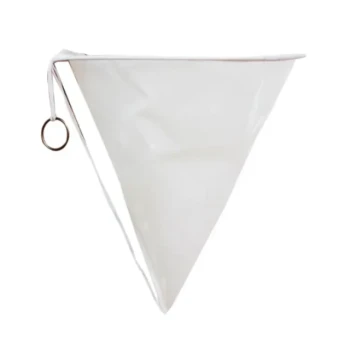
Effective honey pre-treatment relies on this dual approach to completely reset the honey's physical structure. The 200 µm conical strainer serves as a physical barrier to remove macroscopic debris and air, while the heating coil ensures the honey is fluid enough to pass through the filter while simultaneously destroying microscopic crystal structures.
Core Takeaway This combination creates a "blank canvas" by eliminating all uncontrolled crystallization centers. It transforms honey from a variable raw state into a uniform liquid, which is the absolute prerequisite for achieving a smooth texture through controlled seeding.
The Mechanics of Preparation
The Role of Physical Filtration
The 200 µm conical strainer addresses the visible imperfections in the raw product. Its primary function is to strip away large crystals, foreign impurities, and trapped air bubbles.
Without this step, these physical contaminants would act as unintended nucleation sites. These sites trigger crystallization prematurely and unevenly, leading to a gritty final texture.
The Role of Thermal Treatment
The heating coil, specifically set to 55 °C, performs two critical functions that a strainer cannot achieve alone. First, it significantly reduces viscosity, allowing the honey to flow efficiently through the fine mesh of the strainer.
Second, and perhaps more importantly, it melts residual crystalline nuclei. These are microscopic sugar crystals that are too small to be caught by the strainer but will cause rapid, uncontrolled hardening if left intact.
Why the Combination is Critical
Clearing Uncontrolled Cores
Neither method is sufficient on its own. Straining without heat is mechanically difficult and fails to address microscopic crystallization. Heating without straining leaves physical debris that ruins texture.
Used together, they clear uncontrolled primary crystallization cores. This ensures that no "rogue" crystals remain in the batch to dictate the structure of the honey.
Enabling Precise Guidance
The ultimate goal of this pre-treatment is to prepare the honey for the addition of controlled seed honey. By removing all natural crystallization triggers, you gain total control over the process.
This allows the seed honey to dictate the crystal size. The result is a final product characterized by finer crystals and a smoother texture, rather than the coarse, sandy texture of naturally crystallized honey.
Understanding the Trade-offs
Temperature Precision
The specific temperature of 55 °C is a calculated compromise. It must be high enough to melt the crystalline nuclei and lower viscosity, but not so high that it damages the honey's delicate enzymes or flavor profile.
Processing Throughput
Using a fine 200 µm mesh creates back-pressure. While the heating coil assists flow, this method inherently limits the speed of production compared to coarser filtration, trading processing volume for higher quality texture control.
Making the Right Choice for Your Goal
To determine if this specific pre-treatment protocol aligns with your production needs, consider your desired end product:
- If your primary focus is Creamed Honey: You must use this combination to eliminate natural crystals, ensuring the seed honey is the sole driver of texture.
- If your primary focus is Liquid Honey: You should utilize the strainer for clarity, but ensure the heat exposure is minimal to preserve the raw characteristics of the honey.
This protocol is the industry standard for converting raw honey into a controlled substrate ready for precise texturing.
Summary Table:
| Component | Primary Function | Impact on Honey Quality |
|---|---|---|
| 200 µm Conical Strainer | Removes large crystals, debris, and air bubbles. | Eliminates visible impurities and unintended nucleation sites. |
| Heating Coil (55 °C) | Lowers viscosity and melts microscopic nuclei. | Ensures smooth flow through mesh and prevents premature hardening. |
| Combined System | Resets honey to a uniform liquid "blank canvas." | Enables total control over texture through precise seed honey addition. |
Elevate Your Honey Production with HONESTBEE
Achieving the perfect creamed honey texture requires the right equipment. HONESTBEE provides professional-grade beekeeping tools and machinery designed specifically for commercial apiaries and distributors. From precision heating coils and filtration systems to honey-filling machines, we supply everything you need to transform raw honey into premium, high-value products.
Ready to upgrade your processing line?
Contact our specialists today to explore our wholesale equipment solutions and see how we can help you achieve superior honey quality.
References
- Mario Meixner, Margot Dasbach. Influence of Stirring Parameters on Creaminess of Spring Blossom Honey Measured by Crystal Size, Whiteness Index and Mouthfeel. DOI: 10.3390/foods12010048
This article is also based on technical information from HonestBee Knowledge Base .
Related Products
- Conical Nylon Honey Strainer Filter Bag for Beekeeping and Honey Filtration
- Professional Cone-Shaped Honey Filter with Reinforced Steel Ring
- Nylon Honey Strainer Square Filter Cloth for Honey Filters
- Stainless Steel Triangle Support Honey Strainer and Filters
- Stainless Steel Double Layer Honey Strainer Sieve Filters
People Also Ask
- What is the primary function of specialized filtering bags in honey purification? Enhance Quality & Equipment Life
- What are the primary functions of using muslin cloth or stainless steel filters? Ensure Pure and Marketable Honey
- What are the benefits of using a honey strainer for beekeepers? Achieve Clean, High-Quality Honey Efficiently
- What is the primary function of a honey strainer in beekeeping? Achieve Commercial Purity & Visual Clarity
- What can I use to strain honey? A Beekeeper's Guide to Choosing the Right Filter