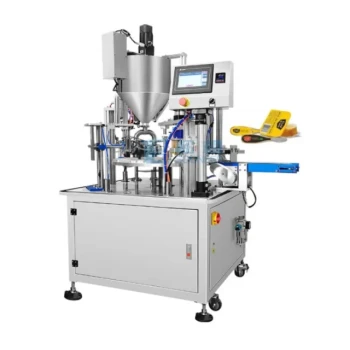
Industrial-grade honey filling and packaging equipment is a mandatory investment for premium honey seeking Geographical Indication (GI) certification because it guarantees the strict hygiene and standardization required for protected status. By automating the process, producers ensure precise dosage control and prevent secondary contamination, which are critical for meeting international safety standards and integrating the anti-counterfeiting measures that protect the brand's value.
The Core Takeaway: For honey intended for Geographical Indication certification, industrial equipment serves as a compliance engine rather than just a production tool; it safeguards the product's integrity against contamination and elevates it from a raw agricultural commodity to a traceable, high-value retail brand.
Protecting Product Integrity and Safety
Eliminating Secondary Contamination
Manual filling introduces significant risks of human contact and environmental exposure. Industrial-grade equipment operates in a closed environment, drastically reducing the risk of microbial contamination. This ensures the honey remains sterile from the tank to the final sealed bottle.
Controlling Moisture and Viscosity
Honey is a viscous, hygroscopic liquid, meaning it readily absorbs moisture from the air. Automated machinery minimizes air contact, preventing fermentation or spoilage caused by excess moisture absorption. This is vital for maintaining the specific chemical composition required for GI certification.
Extending Shelf Life
Premium honey requires a long, stable shelf life to reach international markets. High-specification sealing technology creates a hermetic barrier that manual capping cannot replicate. This preserves the honey's freshness and biological activity over extended periods.
Meeting Certification and Standardization Requirements
Achieving Precise Dosage Control
GI certification often mandates strict adherence to net weight regulations. Professional equipment ensures quantitative packaging, eliminating the variance and overflow losses associated with manual filling. This guarantees every unit sold meets the exact specifications declared on the label.
Enabling Anti-Counterfeiting Measures
A major value proposition of GI honey is its exclusivity, making it a target for fraud. Industrial packaging lines integrate anti-counterfeiting seals and labeling directly into the process. This security is practically impossible to achieve consistently with manual operations.
Standardizing for Export Markets
To enter high-end retail markets, products must look uniform and professional. Automated packaging transforms bulk honey into standardized commercial products, ensuring that every bottle, label, and seal looks identical. This consistency is a prerequisite for passing international market access standards.
Elevating Brand Value and Perception
Improving Competitiveness in Terminal Markets
Exporting honey in bulk typically relegates it to a low-value raw material status. In-house industrial packaging retains the value-add, allowing producers to sell a finished retail product rather than a commodity. This direct control over the final presentation is essential for commanding premium prices.
Aligning with Consumer Expectations
Consumers view packaging quality as a proxy for product quality, especially for health or medicinal honey. Industrial-grade encapsulation signals safety and purity, building the trust necessary to convince consumers to pay a premium. A secure, professional seal validates the product's status as a high-end good.
Understanding the Trade-offs
Capital Investment vs. Operational Scale
While essential for certification, industrial lines represent a significant upfront cost. Producers must ensure their volume justifies the expense, as these machines are designed for efficiency and may be underutilized in very small batch operations.
Maintenance and Technical Expertise
Operating high-precision machinery requires a shift in workforce skills. Reliability depends on regular maintenance and calibration, meaning producers must invest in technical training or support services to prevent downtime and maintain dosage accuracy.
Making the Right Choice for Your Goal
To maximize the value of your honey production, align your equipment choice with your specific strategic objectives:
- If your primary focus is obtaining Geographical Indication (GI) status: Prioritize equipment that offers integrated anti-counterfeiting sealing and precise weight control to meet strict regulatory audits.
- If your primary focus is entering international retail markets: Invest in machinery that ensures a hermetic seal and high-gloss, standardized labeling to extend shelf life and compete visually on shelf.
- If your primary focus is increasing profit margins: Shift from bulk exports to an in-house automated filling line to capture the added value of a finished consumer product.
Investing in industrial packaging is the definitive step that transitions a honey producer from a raw material supplier to a protected, global brand owner.
Summary Table:
| Feature | Manual Filling | Industrial-Grade Equipment | GI Certification Benefit |
|---|---|---|---|
| Contamination Control | High risk (human/air contact) | Closed system, sterile environment | Meets international safety standards |
| Dosage Accuracy | Variable/inconsistent | Precise quantitative control | Complies with net weight regulations |
| Sealing Quality | Basic/variable | Hermetic sealing technology | Extends shelf life for global export |
| Anti-Counterfeiting | Difficult to implement | Integrated security seals/labels | Protects brand exclusivity and value |
| Market Perception | Low-value commodity | Professional, uniform packaging | Commands premium retail pricing |
Transform Your Honey Into a Certified Global Brand
Transitioning from bulk supply to a premium, Geographical Indication (GI) certified brand requires the right technical foundation. HONESTBEE specializes in empowering commercial apiaries and distributors with the high-precision tools needed to dominate the market.
Our comprehensive wholesale portfolio includes:
- Advanced Honey Filling & Packaging Lines: Ensure precise dosage and anti-counterfeiting security.
- Specialized Machinery: From hive-making to honey-processing and industrial filling.
- Beekeeping Equipment & Consumables: A full spectrum of professional-grade tools.
- Cultural Merchandise: Honey-themed products to enhance your retail presence.
Let HONESTBEE help you capture more value and ensure your honey meets the world's strictest standards.
References
- Marcelo Fernandes Pacheco Dias, Eliane Macedo Sobrinho Santos. Knowing in Order to Value: Strategies To Publicize Beekeeping Activities in the Jequitinhonha River Valley. DOI: 10.24857/rgsa.v19n4-056
This article is also based on technical information from HonestBee Knowledge Base .
Related Products
- Double Nozzle Small Honey Filling Machine Honey Sachet Packing Packaging Equipment
- Small Honey Filling Machine Sachet Packing Equipment Single Nozzle
- Fully Automatic Honey Filling Packaging Machine for Processing Line
- Precision Automated Packaging Turntable Honey Spoon Filling Sealing Packing Machine
- Economy Small Honey Filling Machine Honey Bottle Filler Packaging Machine
People Also Ask
- How does industrial honey-filling machinery support Robinia pseudoacacia stands? Maximize Your Acacia Honey Yield
- What value do retail packaging equipment and filling technologies provide in the honey distribution process? Maximize ROI
- What is honey filling equipment used for? Optimize Your Bottling with Precision Automation
- What role does precision filling equipment play in cost control? Maximize Honey Profits & Market Growth
- Why is precision temperature control necessary for red honey filling? Preserve Amorpha fruticosa Color and Aroma