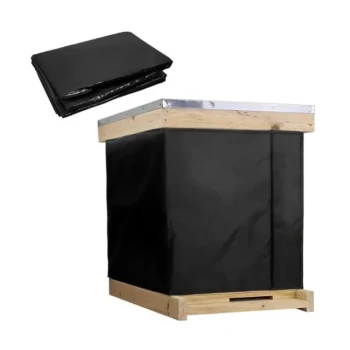
Upward airflow is a critical survival mechanism for wintering bees. The warm air generated by the bee cluster naturally rises, carrying moisture produced by their respiration. Strategically placed upper vents allow this hot, humid air to escape rather than hitting the cold ceiling, condensing into water, and dripping back down to chill the colony.
The primary goal of upward airflow is not cooling, but moisture management. By allowing rising warm air to carry humidity out of the hive, you prevent internal condensation that leads to "wet cold"—a condition far more lethal to honey bees than low temperatures alone.
The Physics of the Winter Cluster
Heat and Convection
Bees survive winter by forming a cluster and vibrating their wing muscles to generate heat.
Because warm air is less dense than cold air, this heat naturally rises toward the top of the hive. This creates a thermal column that moves upward, carrying the byproduct of the bees' metabolism with it.
The Moisture Component
Respiration creates water vapor. As the cluster generates heat, it simultaneously pumps moisture into the air.
Without a way to exit, this warm, moist air accumulates at the highest point of the hive structure.
The Lethal Danger of Condensation
The Condensing Surface
If the hive is sealed at the top, the warm, moist air eventually contacts the inner cover or ceiling.
In winter, this surface is often very cold. When the warm air hits the cold surface, the water vapor instantly turns into liquid water (condensation).
The "Wet Bees" Scenario
Once condensation forms on the ceiling, it inevitably drips back down onto the cluster.
While bees are remarkably resilient to dry cold, they cannot survive being wet and cold.
The cold water soaks the bees, destroying their ability to insulate the cluster, often leading to colony death.
Common Pitfalls to Avoid
The Trap of Over-Insulation
It is a common mistake to seal a hive too tightly in an attempt to retain heat.
Excessive insulation without proper venting traps moisture, leading to damp, stagnant air and the growth of mildew.
Balancing Ventilation and Drafts
While airflow is essential, it must be controlled.
You need small openings at both the bottom and top to create a gentle "chimney effect" for airflow.
However, the hive must still be protected from strong external winds to prevent the airflow from becoming a chilling draft that strips away heat faster than the bees can generate it.
Managing Your Hive for Winter Survival
To ensure your colony survives the winter, you must balance heat retention with moisture elimination.
- If your primary focus is moisture control: Ensure there is a top entrance or vent to allow humid air to escape before it condenses.
- If your primary focus is heat retention: Use windbreaks and moderate insulation, but never seal the top of the hive completely.
- If your primary focus is airflow mechanics: maintain small openings at both the bottom and top of the hive to facilitate the necessary rising air current.
Dry cold is manageable for a healthy colony, but a wet, sealed hive is a death sentence.
Summary Table:
| Feature | Purpose in Winterization | Impact on Bee Health |
|---|---|---|
| Upward Airflow | Removes humidity generated by bee respiration | Prevents moisture buildup and "wet cold" |
| Top Ventilation | Provides an exit for rising warm, moist air | Stops condensation from dripping onto the cluster |
| Bottom Entrance | Facilitates a gentle "chimney effect" | Ensures continuous, fresh air circulation |
| Windbreaks | Protects from strong external gusts | Maintains heat while allowing controlled ventilation |
| Moisture Control | Balances insulation with air exchange | Eliminates mold, mildew, and freezing dampness |
Maximize Overwintering Success with HONESTBEE
Protecting your commercial apiary requires more than just knowledge—it requires the right professional-grade equipment. At HONESTBEE, we specialize in supporting commercial apiaries and distributors with a full spectrum of high-quality beekeeping tools and advanced machinery.
Whether you need precision hive-making machines to build perfectly vented boxes, honey-filling machines for your harvest, or essential industry consumables, our portfolio is designed to enhance your operational efficiency and colony survival rates.
Ready to scale your beekeeping business? Contact us today to explore our wholesale offerings and discover how our specialized hardware and expertise can deliver long-term value to your operations.
Related Products
- Professional Insulated Winter Hive Wrap for Beekeeping
- Stainless Steel Round Beehive Air Vents for Ventilation
- Inner Beehive Cover for Beekeeping Bee Hive Inner Cover
- Three-Layer Ventilated Beekeeper Suit with Structured Fencing Veil
- Professional Insulated Plastic Bee Hives
People Also Ask
- What are the steps to properly wrap a beehive for winter? Ensure Your Colony Survives the Cold
- When is the best time to wrap a beehive for winter? A Guide to Perfect Winterization Timing
- How do professional insulation wraps provide protection for bee colonies? Optimize Winter Survival & Energy Efficiency
- What are the technical benefits of using winter wraps for beehive insulation? Boost Colony Survival & Hive Health
- What are the benefits of using insulated covers for hives? Ensure Colony Survival and Health