The Unseen Forces in the Back of the Truck
A beehive is not a simple box of cargo. It's a dense, self-regulating city with a population of 50,000. When you place it in a vehicle, you become responsible for managing the invisible forces acting upon it: momentum, thermodynamics, and the biological stress response of an entire colony.
Most failures in complex systems happen not because of a single, dramatic event, but because a small, overlooked detail cascaded into a catastrophe. Moving a beehive is a masterclass in managing these details. The difference between a successful relocation and a dead colony often comes down to understanding the physics at play.
Principle 1: Taming Momentum
The first challenge is inertia. A sudden stop or a sharp turn exerts immense force on the hive’s internal structure. Your goal is to make the hive an extension of the vehicle itself, not a separate object sliding around in the back.
The Pendulum Effect
The most critical detail is the orientation of the frames. Positioned perpendicular to the direction of travel, they can swing like pendulums during acceleration or braking. This motion crushes bees and can detach heavy honeycombs, leading to a disastrous internal collapse.
- Action: Always orient frames so they are parallel to the direction of travel. This ensures the forces are distributed across the rigid structure of the frames, not against their weakest points.
The Anchor
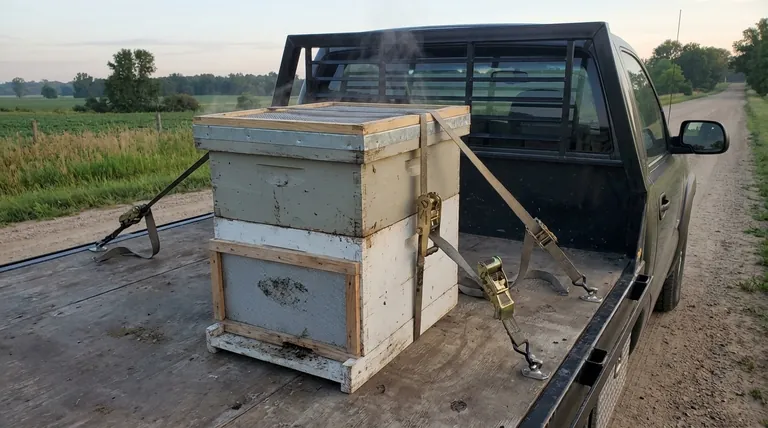
A non-slip mat is a good start, but it's like using a seatbelt without bolting the seat to the car's frame. It only addresses minor friction. To truly secure the hive, you need to anchor it.
- Action: Use heavy-duty ratchet straps to lash the hive securely to the vehicle's tie-down points. This eliminates any chance of sliding or tipping, unifying the hive and vehicle into a single mass.
Principle 2: Managing Thermodynamics
A stressed, confined bee colony generates a staggering amount of heat. Without proper management, the internal temperature of a hive can rise to lethal levels within minutes, effectively cooking the colony from the inside out. This is not a risk; it's a certainty if ignored.
The Heat Exchange System
Your primary defense against this thermal runaway is ventilation. You are not just giving them "air"; you are creating a heat exchange system that allows the colony to regulate its temperature.
- Action: Never seal a hive completely. Use a screened moving top or a screened entrance. This allows heat and moisture to escape while keeping the bees safely contained. Transporting in an open truck bed is ideal for maximum airflow.
The Strategic Advantage of Night
Moving at night or pre-dawn is the industry standard for a simple thermodynamic reason: the cooler ambient temperature provides a larger buffer against overheating. It also leverages the bees' natural behavior, as the entire foraging force is home and settled.
Principle 3: Ensuring Structural Integrity
A standard Langstroth hive is a stack of heavy boxes held together by gravity and a bit of bee propolis. Road vibrations and bumps can easily cause these boxes to shift, separate, and fall apart.
From a Stack to a Monolith
You must convert this stack of individual components into a single, solid unit.
- Action: Use a dedicated strap to cinch the hive components together vertically, from the bottom board to the outer cover. This simple action transforms the hive from a fragile stack into a monolithic block, immune to the shearing forces of the road.
A System of Solutions
A successful hive move is an exercise in systems thinking. Each precaution you take addresses a specific, powerful force.
| System Risk | Engineering Principle | Professional Solution |
|---|---|---|
| Physical Instability | Tame Momentum & Inertia | Anchor hive with ratchet straps; orient frames parallel to travel. |
| Colony Overheating | Manage Thermodynamics | Ensure constant airflow with screened tops and entrances. |
| Hive Separation | Maintain Structural Integrity | Cinch hive components vertically into a single, solid unit. |
| Human Error | Mitigate Risk | Move at night when bees are calm and temperatures are low. |
For commercial apiaries and equipment distributors, executing these principles at scale requires equipment that can be trusted trip after trip. At HONESTBEE, we supply the professional-grade tools—from heavy-duty straps to perfectly engineered screened moving equipment—that turn these principles into practice. We understand that your hives are not just inventory; they are a valuable, living asset. Protecting them during their most vulnerable moments is our first priority.
To ensure your next move is built on a foundation of sound engineering and reliable equipment, Contact Our Experts.
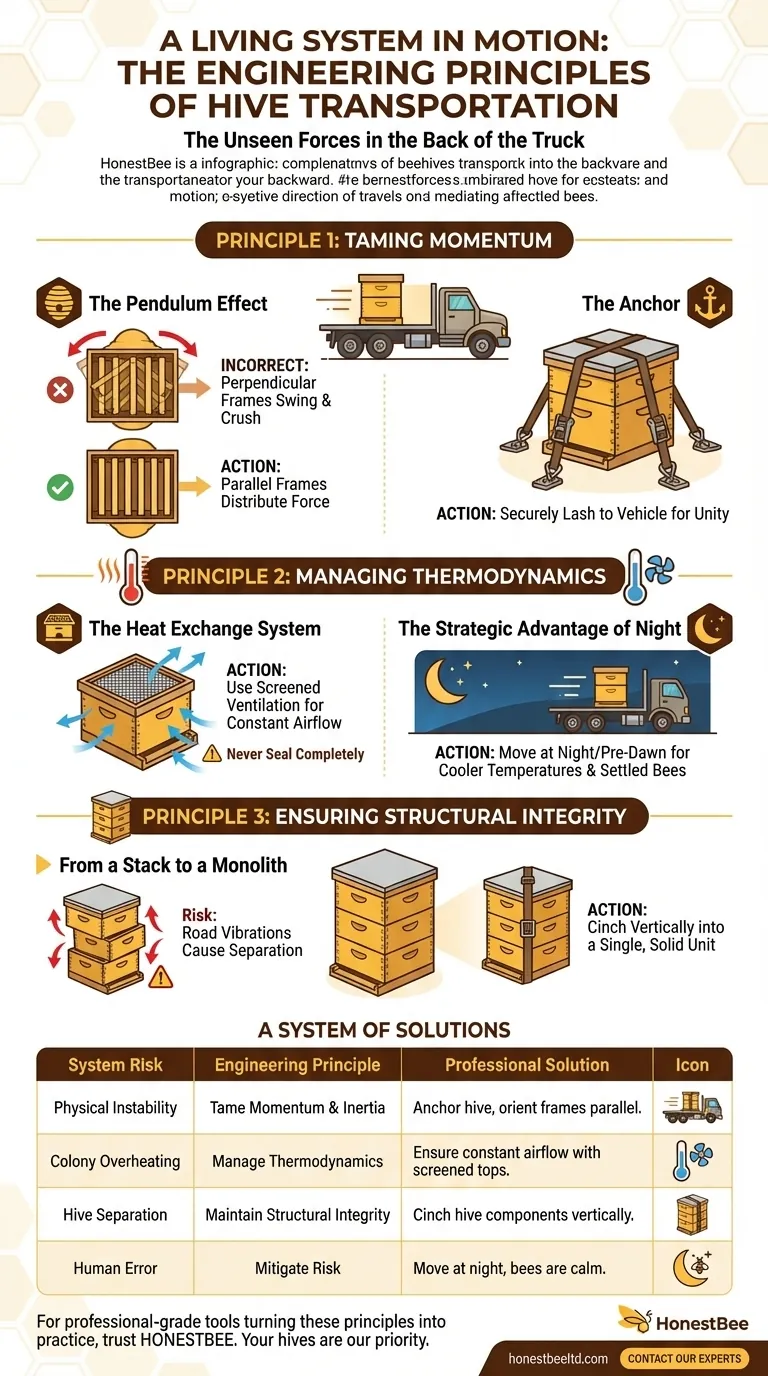
Visual Guide
Related Products
- Stainless Steel Round Beehive Air Vents for Ventilation
- Wholesales Dadant Size Wooden Bee Hives for Beekeeping
- Metal Hive Feet Bee Hive Stand for Ant Protection
- Metal Bee Hive Stand Bee Box Stand for Beekeeping
- Wooden Bee Hive Frames for Beekeeping and Wholesale
Related Articles
- How to Optimize Beehive Ventilation: Prevent Disease and Boost Colony Health
- The Silent Killer in the Hive: Why Moisture, Not Cold, Is Winter's Greatest Threat
- Beyond the Bee Box: Why Your First Apiary Investment Determines Your Success
- The Precision of Chaos: Navigating the Biological Risks of Commercial Beehive Transportation
- Beyond the Box: Why Hive Architecture Is Your Apiary's Core Operating System













