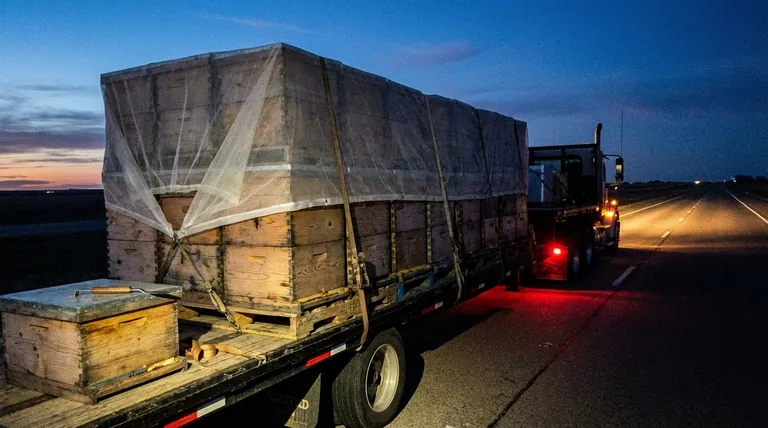
The Midnight Migration
Picture a flatbed truck on a rural highway in the dead of night. It's not carrying steel beams or lumber. It's carrying a city of 20 million lives—a silent, humming cargo of 400 beehives.
This isn't just transportation; it's a carefully orchestrated migration.
The core challenge of moving a commercial apiary is not logistical, but biological. The entire operation is a high-stakes negotiation with the instincts of an ancient superorganism. A single miscalculation can lead to catastrophic failure.
Hacking the Bee's Internal Compass
Bees operate on an incredibly precise internal GPS. Forager bees memorize the exact location of their hive, down to the inch, and can navigate miles to find their way back.
This remarkable ability is also their greatest vulnerability during a move.
This led beekeepers to discover a fundamental rule, a sort of psychological hack for the colony's collective mind:
- Move a hive less than three feet. The change is small enough for returning foragers to easily find the new entrance.
- Or, move it more than two miles. The distance is so great it forces the bees' navigation systems to perform a hard reset. They abandon the old map and create a new one.
Anything in between is the danger zone. A move of 50 feet or half a mile is disastrous. The bees will continuously return to the exact blade of grass where their home once stood, confused and unable to reorient, until they perish.
The Chronobiology of a Colony
The second non-negotiable principle is timing. The entire operation must happen after dusk and before dawn.
A beehive is more than the box; its true value is its workforce of forager bees. During the day, tens of thousands of these workers are out in the fields. Moving the hive during daylight hours would be like moving a factory and leaving its entire workforce behind.
By waiting until nightfall, beekeepers ensure every bee is home. The city is whole. Only then can the journey begin.
The Architecture of a Mass Migration
Scaling this delicate process to hundreds of hives for commercial pollination requires an architecture of efficiency and safety. Every piece of equipment is designed to mitigate a specific biological or physical risk.
The Foundation: Pallets and Straps
Commercial hives are almost never handled individually. They are arranged in groups of four on heavy-duty wooden pallets.
This isn't just for speed.
A pallet creates a single, stable unit that a forklift can lift smoothly, minimizing the jarring vibrations that cause stress to the colony. The hives are then strapped tightly to the pallet, and the pallets to the truck, preventing shifts that could break the hives apart. The integrity of the equipment is paramount; a failed strap doesn't just mean a dropped box—it means chaos and colony loss.
For commercial operators, sourcing durable, standardized pallets and high-tensile strapping isn't an expense; it's a core part of their risk management strategy.
A Breathable Fortress: Nets and Ventilation
Once loaded, the entire truck is draped in a large, specialized net. This serves two purposes. It contains any bees that might escape, ensuring public safety along the route. More importantly, it provides peace of mind.
But containment creates another threat: heat.
A colony generates a tremendous amount of heat. Sealing a hive completely, especially during transport, can quickly lead to overheating and death. Entrances are blocked, but with screened covers that allow for crucial airflow. The net, too, must allow for ventilation. The system is a breathable fortress, designed for security and life support.
The Unseen Enemies: Stress and System Failure
Even with a perfect plan, the journey itself is an assault on the colony's senses. The vibration and confinement are inherently stressful, making the bees more susceptible to disease and pests in the following weeks.
The greatest threat, however, is a logistical failure.
A truck breakdown at 3 AM is an inconvenience for a normal shipment. For a truckload of bees, it's a ticking bomb. As the sun rises, the temperature inside the hives begins to climb. What was a managed risk in the cool of the night becomes an existential threat in the light of day.
This is why every component in the system must be relentlessly reliable. The operation is only as strong as its weakest link.
A successful move isn't about brute force. It's an act of engineered harmony—a deep understanding of biology translated into mechanical precision. The goal is for the bees to wake up in a new location as if nothing happened at all.
Executing this level of precision requires equipment built for the task. From the pallets that form the foundation to the nets that provide a final layer of safety, every component matters. To ensure your operations are built on a foundation of reliability and biological understanding, Contact Our Experts.
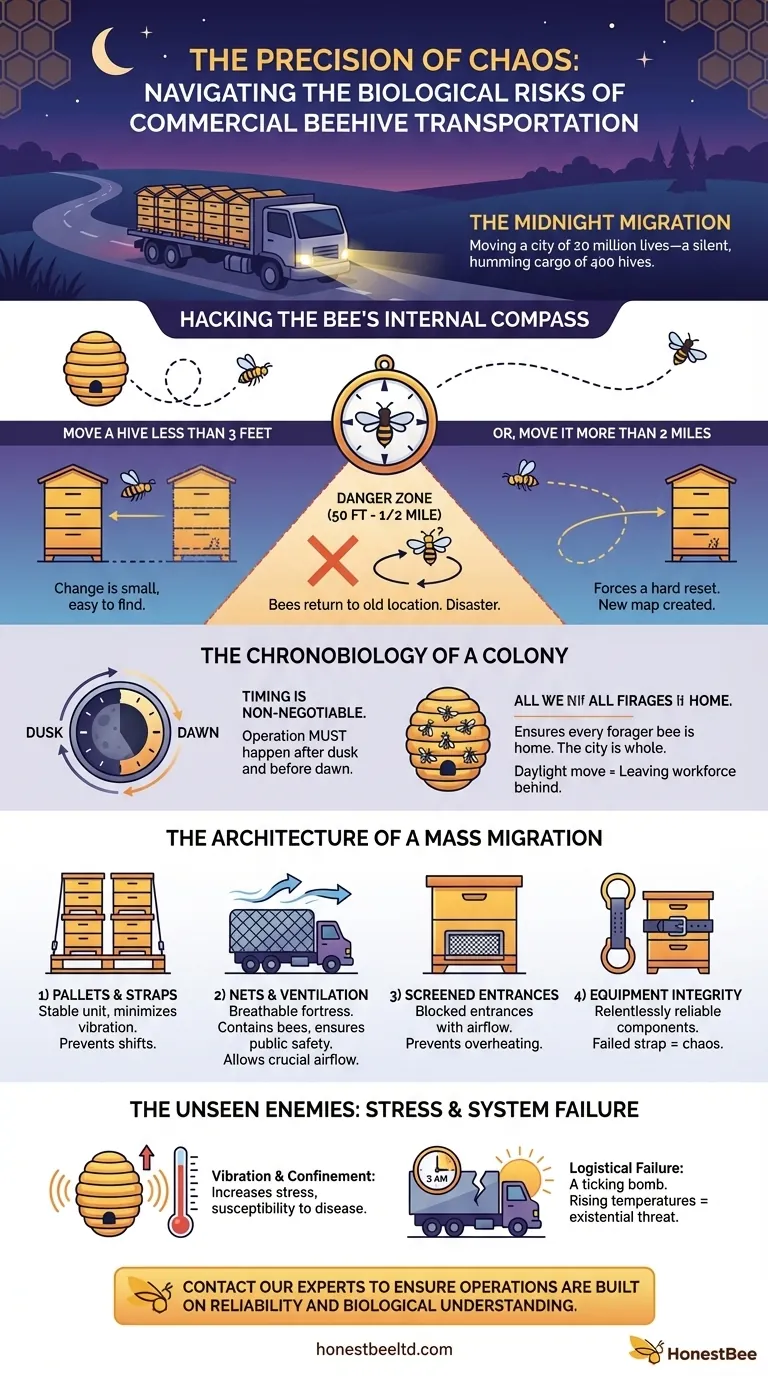
Visual Guide
Related Products
- Stainless Steel Round Beehive Air Vents for Ventilation
- Wholesales Dadant Size Wooden Bee Hives for Beekeeping
- Metal Hive Feet Bee Hive Stand for Ant Protection
- Metal Bee Hive Stand Bee Box Stand for Beekeeping
- Wooden Bee Hive Frames for Beekeeping and Wholesale
Related Articles
- How to Optimize Beehive Ventilation: Prevent Disease and Boost Colony Health
- Beyond the Bee Box: Why Your First Apiary Investment Determines Your Success
- The Silent Killer in the Hive: Why Moisture, Not Cold, Is Winter's Greatest Threat
- How to Choose the Right Beehive: A Practical Guide for Every Beekeeper
- Beyond the Box: Why Hive Architecture Is Your Apiary's Core Operating System













