The Benevolent Tyranny of Small Spaces
When we want something to grow—a business, a plant, a family—our first instinct is to give it room. We see open space as a resource, a landscape of opportunity.
In the world of a new bee colony, this intuition is dangerously wrong.
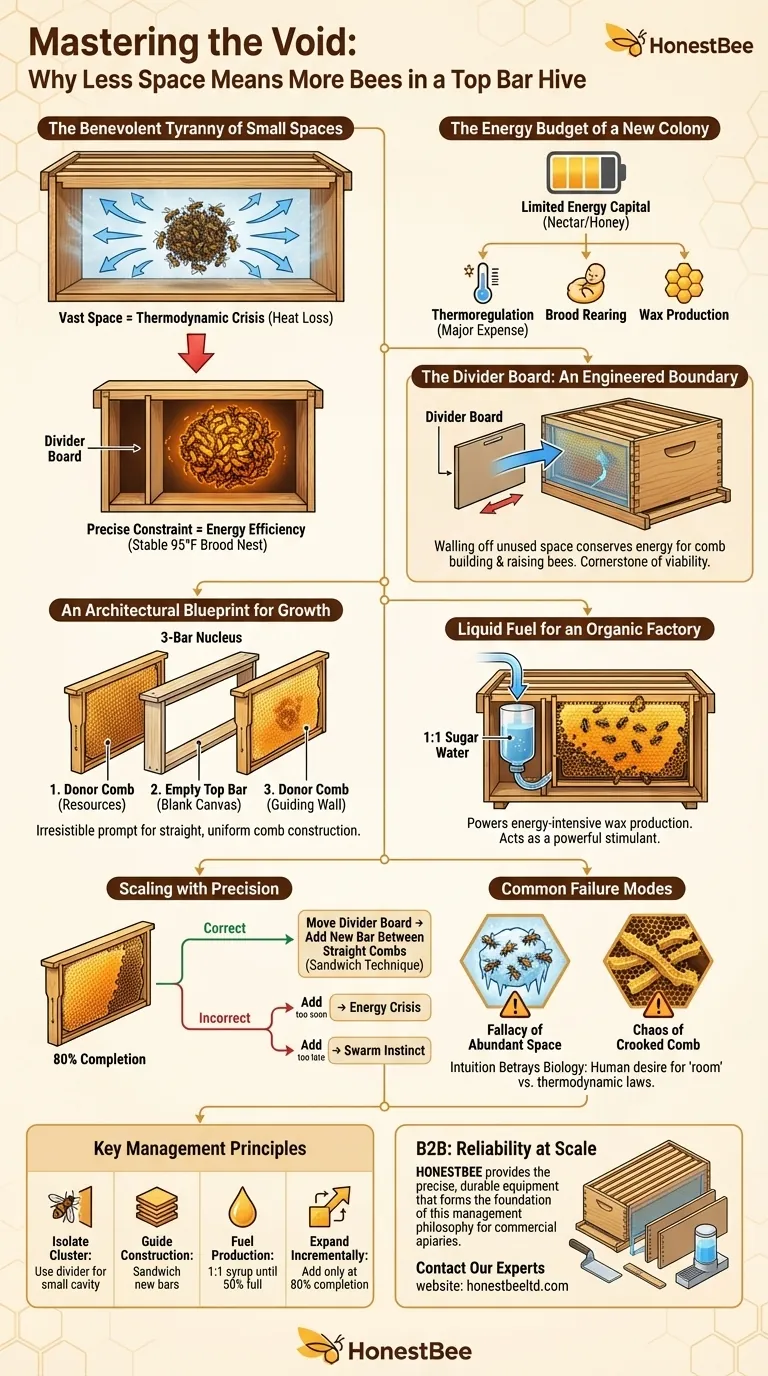
For a fledgling colony in a horizontal top bar hive, a vast, empty space is not an opportunity; it's a thermodynamic crisis. Their survival hinges on a single, brutal law of physics: maintaining the brood nest at a stable 95°F (35°C). In a cavernous, empty hive, this is a battle against entropy they are destined to lose.
The art of establishing a new top bar colony is not about providing freedom, but about imposing a precise, strategic constraint.
The Energy Budget of a New Colony
Think of a new colony as a startup with limited seed capital. Their capital is energy, derived from nectar and honey. Every task—raising young, foraging, defending the hive, and producing wax—draws from this same finite budget.
The single greatest expenditure is thermoregulation.
The Divider Board: An Engineered Boundary
The most critical tool in top bar beekeeping is the humble divider board. Its function is profound: it transforms a large, indefensible cavity into a small, resource-efficient microclimate.
By walling off the unused portion of the hive, the divider board allows the colony to stop spending its energy on heating empty air and instead invest it in what matters: building comb and raising the next generation of bees. For commercial operations, where efficiency is paramount, a durable, well-fitting divider board is not an accessory; it is the cornerstone of colony viability.
An Architectural Blueprint for Growth
Success begins by giving the bees a clear, manageable, and immediate task. Don't give them a blueprint for a mansion; give them the plans for a single, perfect room.
The 3-Bar Nucleus
The initial setup is a tight, three-bar cluster designed to channel the bees' building instinct.
- A Comb of Resources: Place a donor comb with brood, bees, and food. This is the colony's anchor.
- A Blank Canvas: Place a single, empty top bar next to it.
- A Guiding Wall: Place a second donor comb on the other side of the empty bar.
This configuration creates an irresistible architectural prompt. The two existing combs act as perfect guides, compelling the bees to build straight and true on the empty bar between them. This is where equipment quality is non-negotiable; perfectly uniform top bars are essential for creating this flawless guide.
Liquid Fuel for an Organic Factory
A new colony's demand for carbohydrates is immense. Wax production is one of the most energy-intensive tasks a bee can perform.
Providing a continuous supply of 1:1 sugar water via an internal feeder is not just "feeding"—it's providing the raw material for construction. This consistent resource flow acts as a powerful stimulant, fueling the organic factory and accelerating comb production.
Scaling with Precision
Your role as the beekeeper is that of a systems manager, expanding the colony's environment just one step ahead of its growth curve.
When to Add a New Bar
Adding space too soon reintroduces the energy crisis. Adding it too late triggers the colony's swarm instinct, as they perceive they have run out of room.
The signal is clear: once the bees have drawn out the newest comb to about 80% completion, it is time to expand.
The Expansion Protocol
The process is simple but must be precise:
- Move the divider board down by one position.
- Place a new empty bar directly adjacent to the most recently completed comb.
- Crucially, place this new bar between two existing straight combs whenever possible. This "sandwich" technique is the most effective way to prevent the construction of chaotic, unmanageable cross-comb.
Common Failure Modes: When Intuition Betrays Biology
The most common failures in top bar hives stem from a single psychological error: projecting our human desire for "room to grow" onto a system governed by the laws of thermodynamics.
The Fallacy of Abundant Space
Never start a colony with the entire hive cavity open to them. If nighttime temperatures drop, a small cluster in a large space will face a terrible choice: abandon their brood to cluster for warmth or freeze while trying to protect it. Often, they do the former, and the colony collapses.
The Chaos of Crooked Comb
Cross-comb—where bees build across multiple bars—makes hive inspections impossible without causing massive destruction. It is not a failure of the bees, but a failure of the architect. It is a direct result of providing ambiguous guidance, often caused by inconsistent equipment or by adding new bars at the edge of the cluster instead of between straight guides.
Key Management Principles
| Strategy | Purpose | Critical Action |
|---|---|---|
| Isolate the Cluster | Conserve energy, manage temperature | Use a divider board to create a small, tight cavity. |
| Guide Construction | Ensure straight, manageable combs | Start with a 3-bar setup and add new bars between existing straight combs. |
| Fuel Production | Stimulate rapid wax building | Provide continuous 1:1 sugar syrup until the hive is at least 50% full. |
| Expand Incrementally | Prevent stress and swarming | Add a new bar only when the last one is 80% complete. |
Managing a top bar hive is an exercise in systems thinking. The beekeeper acts as an architect, creating an environment that channels the colony's powerful biological instincts toward productive growth. This requires not only knowledge but also equipment that is as precise and reliable as the management strategy itself.
For commercial apiaries and equipment distributors, success at scale depends on this reliability. HONESTBEE provides the high-quality, durable top bars, divider boards, and feeders that form the foundation of this management philosophy, ensuring that every colony has the best possible start.
If you are ready to build a more resilient and productive apiary based on sound engineering and biological principles, we can help. Contact Our Experts
Visual Guide
Related Products
- Top Bar Beehive for Beekeeping Wholesales Kenya Top Bar Hive
- Long Langstroth Style Horizontal Top Bar Hive for Wholesale
- HONESTBEE Top Bar & Bottom Bar Forming Machine | Bee Frame Machine
- HONESTBEE Square Top Hive Bee Feeder Top Bee Feeder
- HONESTBEE Round Hive Top Bee Feeder for Syrup
Related Articles
- How to Inspect Top Bar Hives Without Damaging Comb: A Beekeeper’s Guide
- Beyond Pest Control: The Operational Logic of the Kenyan Top-Bar Hive
- How Top Bar Hives Naturally Boost Bee Health and Simplify Beekeeping
- How to Optimize Honey Storage in Top Bar Hives for Healthier Colonies
- Hive Architecture and the Winter Paradox: Why Heat Retention Isn't Enough