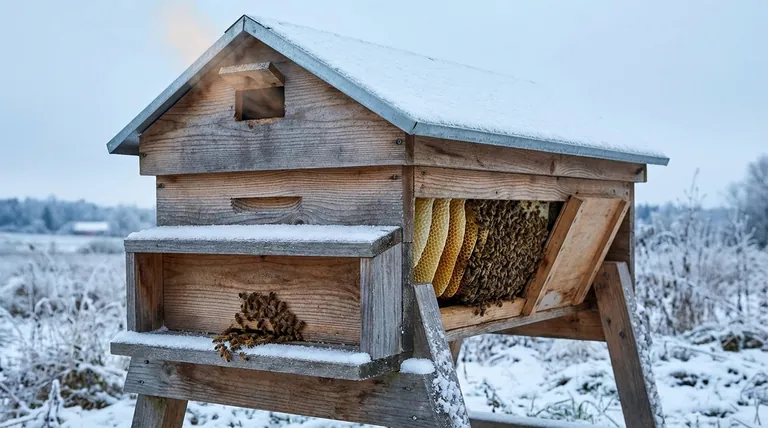
The Langstroth Fallacy
Ask a beekeeper about winter, and they’ll talk about temperature, food, and insulation. These are the right variables, but for a top-bar hive, they are often applied through the wrong mental model.
The vast majority of beekeeping literature is built around the vertical Langstroth hive. In that world, bees move up. They eat their way from the bottom box to the honey stores stacked above. The solution to winter is always "up."
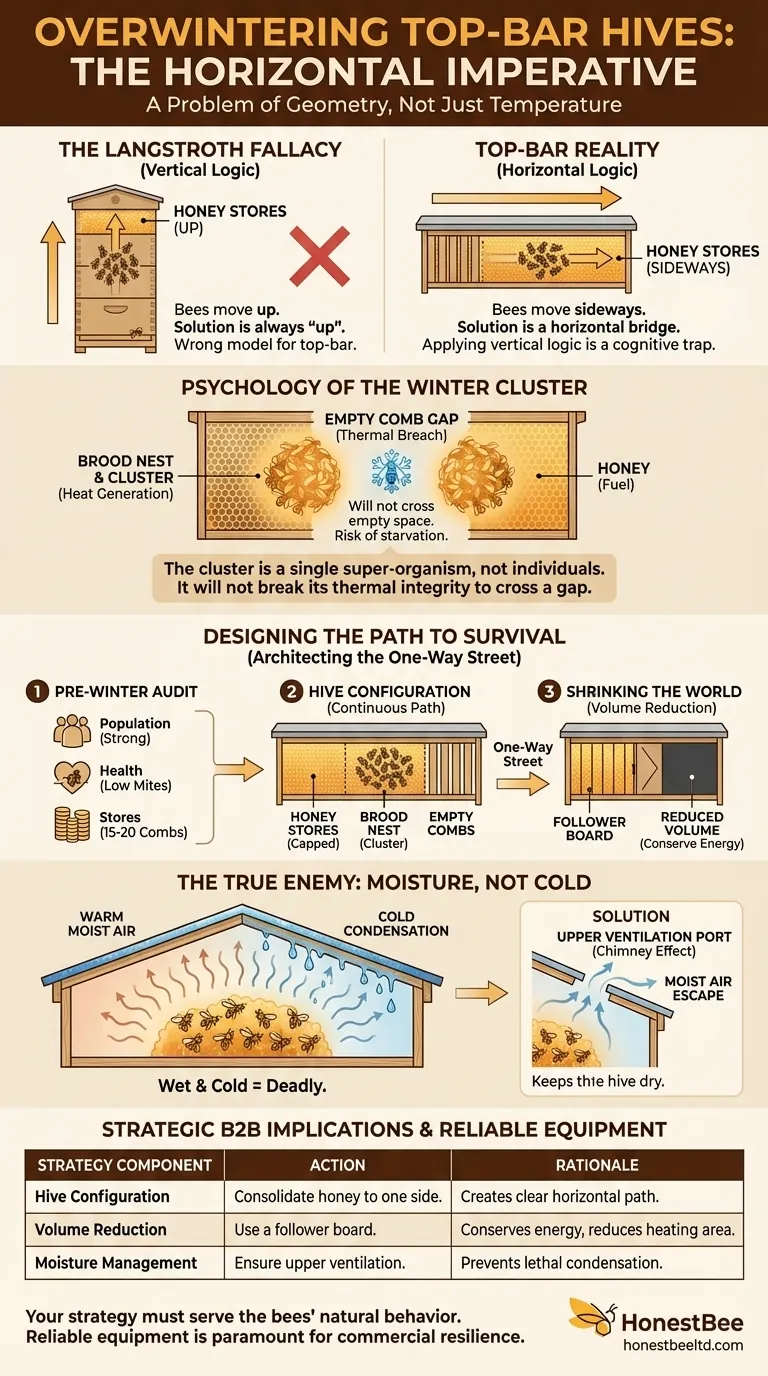
A top-bar hive is a different universe. It's a horizontal plane. Here, the solution to winter is "sideways." Applying vertical logic to a horizontal system is a recipe for disaster. It's a cognitive trap that can lead to a colony starving to death just inches away from life-saving honey.
The Psychology of a Winter Cluster
To understand why this geometric difference is so critical, you have to understand the mind of a winter cluster. It is not a group of individual bees exploring for food. It is a single, super-organism whose primary directive is to generate heat.
The cluster moves slowly, cohesively, consuming the honey it is directly touching to fuel its collective furnace. It will not break apart and cross a gap of empty comb in the dead of winter to find a new food source. That would be suicidal—a breach of thermal integrity.
If honey stores are on both sides of the brood nest, the cluster will consume the honey on one side and then stop. The path is broken. They will freeze and starve, unaware of the feast waiting just beyond the empty comb. Your job is not to feed the bees, but to build them a bridge they cannot fail to cross.
Designing the Path to Survival
Configuring a top-bar hive for winter is an act of architecture. You are designing a one-way street from the colony's starting point to its final honey stores. This should be done in the fall, before the first deep cold sets in.
Step 1: The Pre-Winter Audit
Before rearranging anything, you must assess the colony's fundamentals.
- Population: Is the colony strong and populous enough to generate sufficient heat?
- Health: Is the varroa mite load low? A sick colony has no chance.
- Stores: Do they have enough food? A strong colony needs 15-20 full combs of capped honey for a moderate winter.
A weak or sick colony with infinite food will still perish. Health is the prerequisite for any wintering strategy.
Step 2: Architecting the One-Way Street
This is the most critical physical step. You must create an uninterrupted, logical path for the bee cluster. The order of the combs should be:
- Honey Stores: All combs of fully capped honey are consolidated at one end of the hive.
- Brood Nest: The combs containing eggs, larvae, and pupae are placed directly next to the honey.
- Empty Combs: Any empty or partially drawn combs are placed on the far side of the brood nest.
The cluster will begin winter on the empty combs where the last brood emerged, and slowly, methodically, eat its way sideways into the honey pantry you've created.
Step 3: Shrinking the World
Once the combs are arranged, use a follower board to reduce the internal volume of the hive. It should be placed directly against the last comb, walling off the unused space.
This is a profound act of energy conservation. By reducing the space, you reduce the BTUs required to keep it warm. The bees can dedicate more of their honey reserves to generating heat for themselves, not for empty air.
The True Enemy: Moisture, Not Cold
Bees can handle the cold. They have been doing it for millennia. What they cannot handle is being wet and cold. The real killer in most hives is condensation.
A winter cluster breathes, releasing a significant amount of warm, moist air. When this air hits the cold inner surface of the hive roof, it condenses into water. This water drips down onto the cluster, chilling and killing the bees. A well-insulated but poorly ventilated hive becomes a death trap.
The solution is counter-intuitive: you need a hole. A small upper entrance or ventilation port, just 3/8-inch, allows this warm, moist air to escape. It's a chimney that vents the colony's respiration out of the hive before it can turn into a deadly rain.
| Strategy Component | Action | Rationale |
|---|---|---|
| Hive Configuration | Place all honey to one side of the brood nest. | Creates a clear, horizontal path for the cluster to access food. |
| Volume Reduction | Use a follower board to shrink the internal space. | Conserves the colony's energy by reducing the area to heat. |
| Moisture Management | Ensure a small upper ventilation port is open. | Prevents lethal condensation by allowing moist air to escape. |
Your strategy must serve the bees' natural behavior. The equipment you use is not just a box; it's a tool that either enables or obstructs that behavior. For commercial apiaries and distributors, the reliability of that equipment—from the hive bodies to the follower boards—is paramount. A well-designed follower board isn't a feature; it's the difference between a colony wasting energy or conserving it.
At HONESTBEE, we build beekeeping supplies designed for the realities of commercial operations, where success is measured colony by colony, season after season. Let us help you equip your apiaries for resilience. Contact Our Experts
Visual Guide
Related Products
- Top Bar Beehive for Beekeeping Wholesales Kenya Top Bar Hive
- Long Langstroth Style Horizontal Top Bar Hive for Wholesale
- HONESTBEE Square Top Hive Bee Feeder Top Bee Feeder
- HONESTBEE Professional Hive Top Bee Feeder Feeding Solution
- Solid Bottom Board Australian Pine Wood Langstroth Bottom Board for Wholesale
Related Articles
- How to Inspect Top Bar Hives Without Damaging Comb: A Beekeeper’s Guide
- Beyond Pest Control: The Operational Logic of the Kenyan Top-Bar Hive
- How to Optimize Honey Storage in Top Bar Hives for Healthier Colonies
- Hive Architecture and the Winter Paradox: Why Heat Retention Isn't Enough
- How to Harvest Honey from Top Bar Hives Sustainably: A Bee-Friendly Guide



















