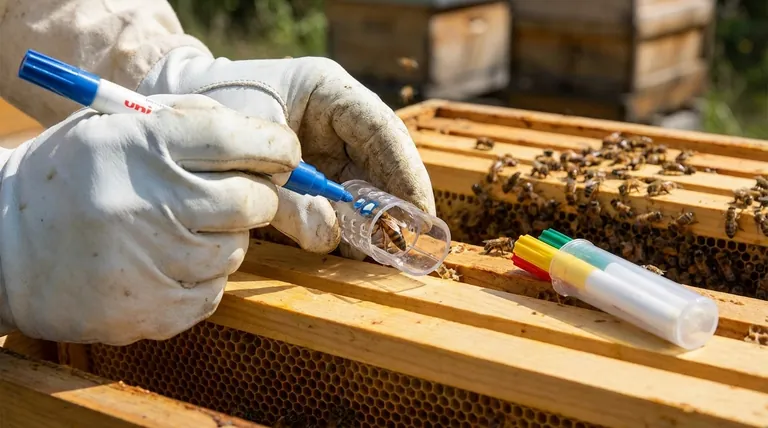
The Anxious Search
Open a beehive, and you're faced with a living system of 50,000 individuals. They move with a purpose you can't fully grasp. As a beekeeper, your most pressing question is simple, but the answer is buried in the chaos: Is the queen here, and is she healthy?
Finding one specific bee in that swirling mass is a daunting task. The minutes you spend searching are minutes of stress for both you and the colony. You are flying blind, relying on secondary signs when the primary source of the hive's vitality remains unseen. This is a problem of information asymmetry. The colony knows its state; you do not.
From Guesswork to Glances
A single dot of paint on the queen's thorax changes everything. It’s not just an ID tag; it's a fundamental shift in how you interact with the hive.
This small signal transforms a ten-minute, stressful search into a ten-second, confident glance. The cognitive load of "Where is she?" is replaced by the simple confirmation, "There she is."
This isn't just about saving time. It's about reducing disturbance to the colony and replacing your own anxiety with calm, data-driven oversight.
Predicting the Future of the Hive
A queen's vigor is directly tied to her age. Her egg-laying peaks in her first two years and then begins a slow decline. An aging queen means a shrinking population, lower honey production, and a colony more vulnerable to stress and disease.
The color code tells you her hatch year. This knowledge allows you to see the future. You can anticipate this decline and proactively requeen, ensuring the colony is always powered by a monarch in her prime. You move from reacting to problems to strategically preventing them.
Reading the Colony's Hidden History
Imagine you inspect a hive that should have a red-marked queen (from 2023), but instead, you find an unmarked one.
Without that initial data point, you might just assume all is well. But with it, you know a critical event has occurred. The colony has either swarmed (your old queen left with a portion of the bees) or superseded her (they raised a replacement themselves). The missing color tells a story of change, giving you vital context for your next management decision.
The International Language of Beekeeping
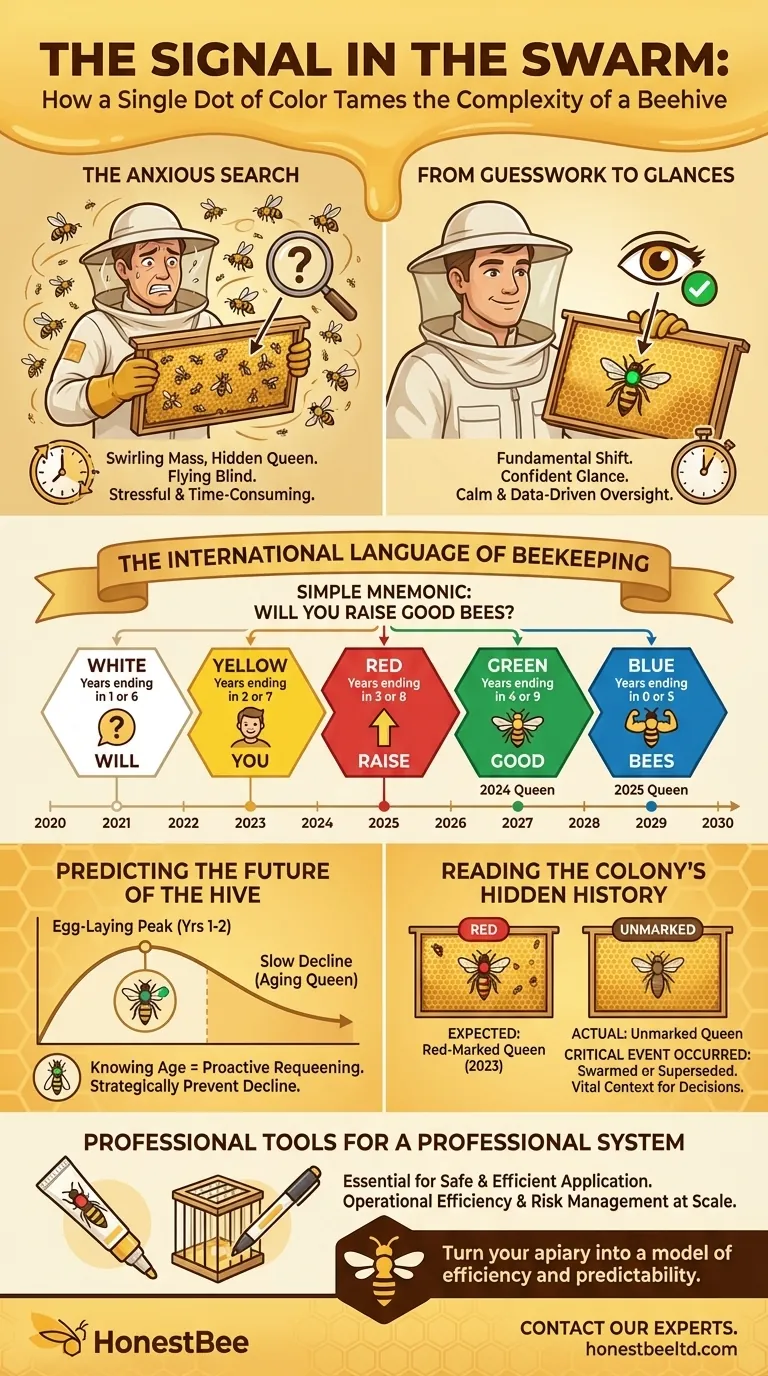
The system's genius is its simplicity. It’s an international standard that uses five colors in a repeating cycle, linking each color to the final digit of the year.
The mnemonic to remember the order is a simple question: Will You Raise Good Bees?
- White: Years ending in 1 or 6
- Yellow: Years ending in 2 or 7
- Red: Years ending in 3 or 8
- Green: Years ending in 4 or 9
- Blue: Years ending in 0 or 5
A queen hatched in 2024 is marked green. One from 2025 will be blue. This simple protocol works anywhere in the world.
| Year Ends In | Color | Mnemonic |
|---|---|---|
| 1 or 6 | White | Will |
| 2 or 7 | Yellow | You |
| 3 or 8 | Red | Raise |
| 4 or 9 | Green | Good |
| 0 or 5 | Blue | Bees |
Professional Tools for a Professional System
Of course, implementation requires care. Marking a queen involves gently handling the most important member of the colony. While the risk is minimal with the right technique, using dedicated tools like queen-marking tubes and cages is non-negotiable for safe and efficient application.
For commercial apiaries managing hundreds or thousands of colonies, this system isn't a quaint tradition; it's an essential pillar of operational efficiency and risk management. Scaling a beekeeping operation means scaling your ability to collect and act on reliable data quickly. A marked queen is your most fundamental data point.
Building a resilient, productive apiary requires more than just knowledge; it requires durable, professional-grade equipment. At HONESTBEE, we supply commercial beekeepers and distributors with the high-performance tools needed to implement systems like these at scale. From queen marking kits and hive tools to full-scale extraction equipment, our wholesale operations are built to support the backbone of the beekeeping industry.
To turn your apiary into a model of efficiency and predictability, you need a partner who understands the demands of commercial beekeeping. Contact Our Experts
Visual Guide
Related Products
- Stainless Steel Round Beehive Air Vents for Ventilation
- Wholesales Dadant Size Wooden Bee Hives for Beekeeping
- Metal Hive Feet Bee Hive Stand for Ant Protection
- Metal Bee Hive Stand Bee Box Stand for Beekeeping
- Wooden Bee Hive Frames for Beekeeping and Wholesale
Related Articles
- How to Optimize Beehive Ventilation: Prevent Disease and Boost Colony Health
- The Silent Killer in the Hive: Why Moisture, Not Cold, Is Winter's Greatest Threat
- Beyond the Bee Box: Why Your First Apiary Investment Determines Your Success
- The Precision of Chaos: Navigating the Biological Risks of Commercial Beehive Transportation
- Beyond the Box: Why Hive Architecture Is Your Apiary's Core Operating System













