The Psychology of a Silent Invasion
A beekeeper walks out to their apiary on a warm morning. In one hive, the familiar, productive hum is replaced by a frantic, disorganized chaos. A thin, dark line shimmers from the ground up the hive stand—an army of ants, systematically dismantling the colony from within.
This isn't just a pest problem. It's a system failure.
We have a cognitive bias for simple, direct actions. We see ants, so we reach for a powder to repel them. But this is like patching a leaky roof with paper. The real issue is structural. The ants didn't just appear; they exploited a flaw in the hive's defenses.
The goal isn't to fight ants. It's to design a system where fighting is unnecessary.
A War of Attrition, Not a Single Battle
Ants are a fundamentally different threat from a predator like a bear. A bear is a catastrophic, one-time event. Ants are a slow, grinding siege. They represent a "death by a thousand cuts" for the colony.
The Hidden Costs of an Infestation
- Resource Depletion: Ants are relentless thieves. They steal honey and pollen, the colony's fuel and protein. In severe cases, they consume bee larvae and eggs, directly attacking the colony's future.
- Defensive Stress: A constant state of invasion forces the bees into perpetual defense mode. Energy that should be spent on foraging, nursing brood, or producing honey is diverted to fighting endless waves of tiny intruders.
- System Collapse: For a strong, populous hive, a few ants are a nuisance. But for a new nucleus colony or a hive weakened by other stressors, a full-scale ant invasion is often the final, fatal blow.
For a commercial apiary, this isn't just one colony at risk. It's a systemic drain on productivity and a direct threat to the bottom line, multiplied across hundreds of hives.
The First Principle of Defense: Isolate the System
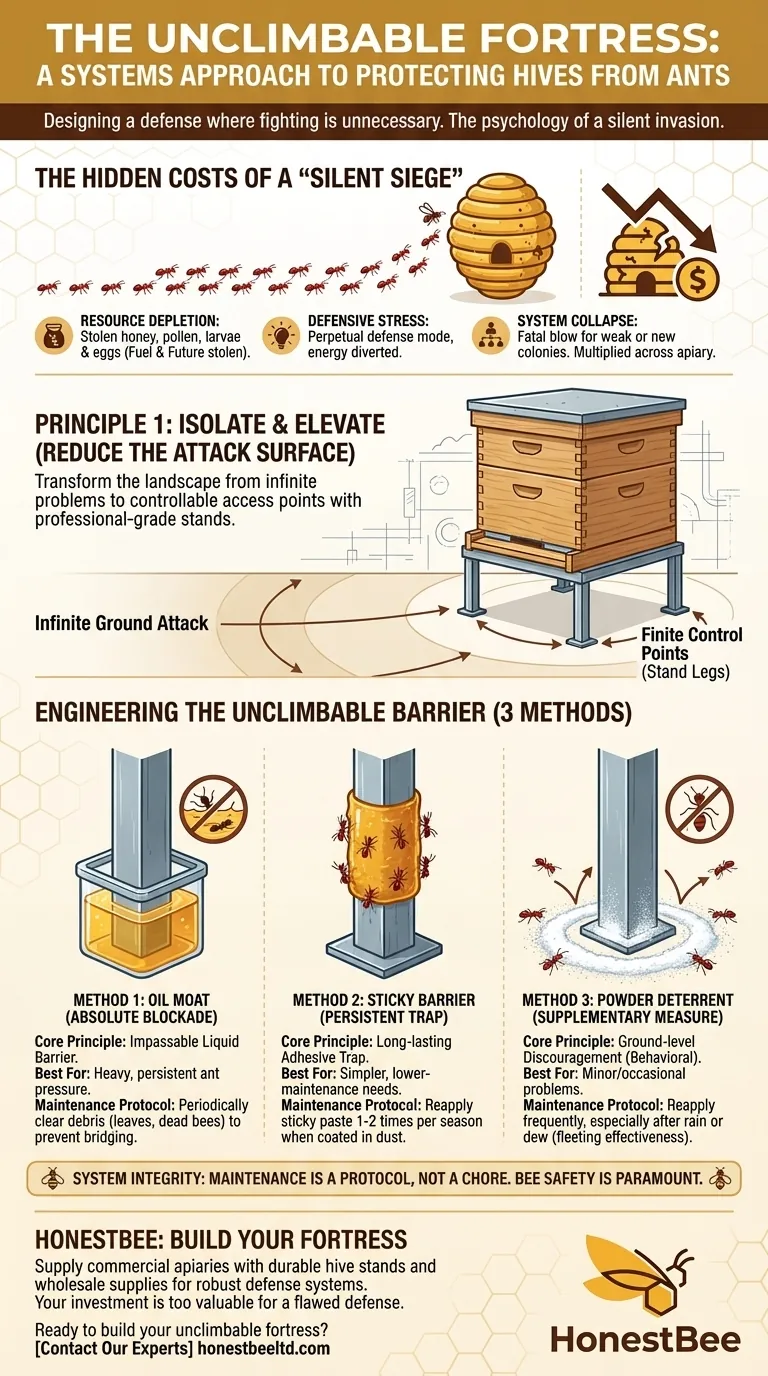
A beehive sitting on the ground has an infinite attack surface. Ants can approach from any direction, using any blade of grass or fallen leaf as a bridge.
The single most important step in ant defense is to elevate the hive on a stand.
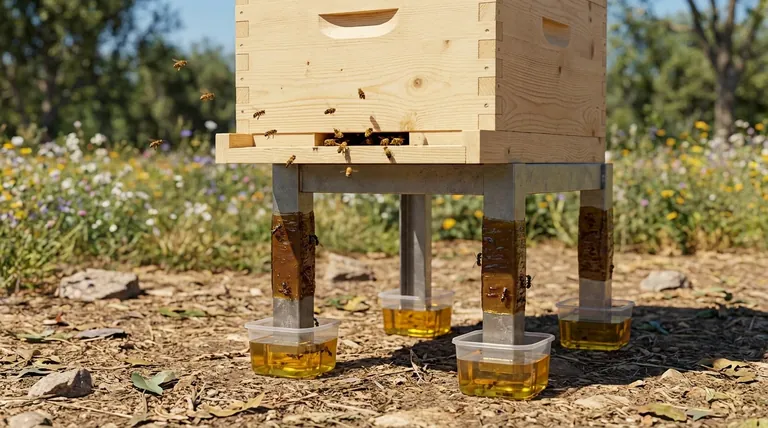
This isn't just about getting the hive off the wet ground. It is a strategic decision to reduce an infinite problem to a finite one. You transform the entire landscape into a handful of controllable access points: the legs of the hive stand.
This is where professional-grade equipment becomes critical. For large-scale operations, you need sturdy, reliable hive stands that can withstand the elements and the weight of a full honey harvest. This foundation is the bedrock of your entire defense system.
Engineering the Unclimbable Barrier
With the hive isolated, the next step is to make the legs of the stand impossible to climb. This is where you build your fortress walls.
H3: Method 1: The Oil Moat (The Absolute Blockade)
This is the most robust, "zero-trust" security model. By placing each leg of the hive stand into a small container filled with non-toxic oil (vegetable or mineral), you create a literal moat that ants cannot cross.
- How it works: It's a perfect physical barrier. Any ant that attempts to cross is trapped.
- Trade-off: Moats require maintenance. They can fill with leaves, dead bees, or other debris, which can form a bridge for ants. A regular check is part of the protocol.
H3: Method 2: The Sticky Barrier (The Persistent Trap)
A simpler, yet highly effective, alternative is to apply a band of a durable, sticky substance around each leg. Horticultural barrier pastes like Tanglefoot are designed for this purpose, remaining effective for months.
- How it works: The substance creates a surface that is too sticky for ants to traverse.
- Trade-off: The barrier will eventually become coated in dust and dead insects, reducing its effectiveness. It typically requires cleaning and reapplication once or twice a season.
H3: Method 3: The Powder Deterrent (A Supplementary Measure)
Powders like cinnamon or Diatomaceous Earth (DE) can be sprinkled in a ring on the ground around the hive stand. They work by disrupting the ants' scent trails or abrading their exoskeletons.
- How it works: They are behavioral deterrents, not physical barriers.
- Trade-off: Their effectiveness is fleeting. A single rain shower or heavy morning dew can wash them away, rendering them useless. They are best used as a secondary, temporary measure, not a primary defense.
System Integrity: Maintenance is a Protocol, Not a Chore
In a commercial operation, defense cannot be an afterthought. It must be a scheduled protocol. Viewing maintenance not as a chore but as a necessary procedure to ensure system integrity is key to long-term success.
| Method | Core Principle | Best For | Maintenance Protocol |
|---|---|---|---|
| Oil Moat | Impassable Liquid Barrier | Heavy, persistent ant pressure | Periodically clear debris |
| Sticky Barrier | Long-lasting Adhesive Trap | Simpler, lower-maintenance | Reapply 1-2 times per season |
| Powder Deterrent | Ground-level Discouragement | Minor or occasional problems | Reapply frequently, especially after rain |
For any method, bee safety is paramount. Barriers should only be applied to the middle of the stand legs, far from the hive entrance where bees might land.
Protecting a commercial apiary requires more than just a clever trick; it requires a robust, scalable defense system built on high-quality equipment. At HONESTBEE, we supply commercial apiaries and distributors with the durable hive stands and wholesale supplies needed to implement these strategies effectively across your entire operation. Your investment is too valuable to leave vulnerable to a flawed defense.
Ready to build your unclimbable fortress? Contact Our Experts
Visual Guide
Related Products
- Metal Hive Feet Bee Hive Stand for Ant Protection
- Professional Ant-Proof Beehive Stand with Integrated Moat for Beekeeping
- Wooden Bee Hive Frames for Beekeeping and Wholesale
- Professional Reversible Beehive Hive Entrance
- High Security Emlock Strap System
Related Articles
- How to Stabilize Beehive Stands in Wet Soil: Proven Techniques for Beekeepers
- How to Choose and Install a Beehive Stand for Pest Control and Colony Health
- The Unseen Foundation: Why a Beehive Stand Dictates Your Apiary's Success
- Beyond the Box: How a Simple Stand Prevents Compounding Failures in Beekeeping
- The Unseen Architecture of a Productive Apiary: Why Your Beehive Stand Height is a System Design Choice