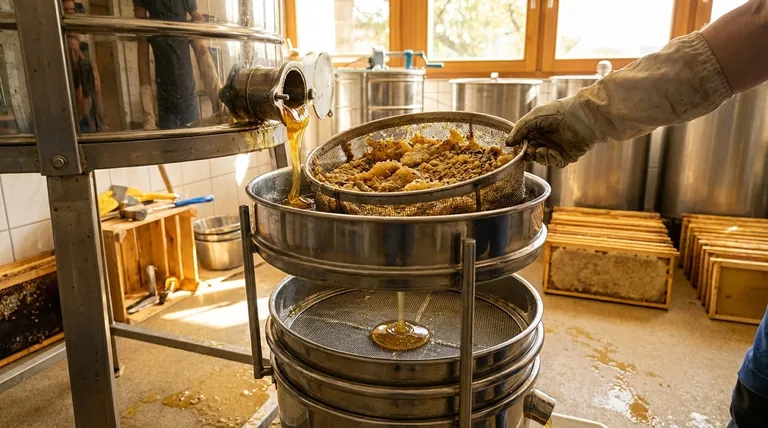
The Slow Agony of a Clogged Filter
Imagine the scene: it’s the peak of the harvest. Your extractors are running, and the air is thick with the sweet smell of honey. But over at the bottling tank, the flow has slowed to a trickle. A beautiful, viscous river of golden honey is being held hostage by a single component: the strainer.
This isn't a mechanical failure. It’s a crisis of calculation. The operator, aiming for perfectly clear, debris-free honey, chose a mesh screen that was too fine. Now, the entire operation is bottlenecked, a victim of the timeless conflict between perfection and throughput.
Choosing a strainer mesh isn't just a technical decision; it's a strategic one that reveals our operational priorities. It forces us to confront a fundamental trade-off: the purity of the final product versus the efficiency of the process.
Deconstructing the Mesh Number
To make an intelligent choice, we first have to understand the language of filtration. The system is simple, but its logic is inverse, which can be counterintuitive.
The Inverse Logic of Filtration
Mesh size is simply the number of openings in one linear inch of a screen.
- A 30 mesh screen has 30 openings per inch. The holes are relatively large, suitable for catching big chunks of wax or other debris.
- A 200 mesh screen has 200 openings per inch. The holes are tiny, like silk, designed to capture very fine particles.
The critical insight is this: as the mesh number increases, the size of the holes—and the particles that can pass through—decreases. Higher numbers mean finer filtration.
The Three Competing Forces in Every Apiary
In a commercial beekeeping operation, your choice of mesh is governed by a constant battle between three forces. Understanding them is the key to an efficient extraction line.
1. The Force of Purity (Target Particles)
What are you actually trying to remove? The answer defines your goal. For beekeepers, the targets are typically wax cappings, propolis, wood splinters from frames, and sometimes bee parts.
Defining the smallest particle you need to eliminate is your starting point. Protecting a pump from large debris requires a different strategy than producing crystal-clear honey for a premium market.
2. The Force of Resistance (Honey's Viscosity)
Honey is a classic high-viscosity liquid. It resists flow. This resistance is not constant; it changes dramatically with temperature.
A mesh that works perfectly for honey at 95°F (35°C) straight from a warming tank might completely stop the flow of cooler honey at 70°F (21°C). Ignoring viscosity is like trying to push a rope—you create backups and put unnecessary strain on your equipment. For thick fluids, you must err on the side of a coarser mesh.
3. The Force of Volume (Solids Loading)
How much debris do you expect? An extraction line dealing with uncapping wax and a high volume of raw honey has a very high "solids load."
A fine mesh screen in a high-load environment will clog almost instantly—a phenomenon called blinding. This forces constant shutdowns for cleaning, destroying your workflow and productivity.
The Psychology of a "Wrong" Choice
The technical trade-offs often mirror our own psychological biases. We fall into traps set by our own best intentions.
The Perfectionist's Trap: Going Too Fine
The desire for a flawless, pristine product is strong. This leads many to choose an unnecessarily high mesh number. The consequences are predictable:
- Drastically Reduced Flow Rate: Your process slows to a crawl.
- Increased Pressure Drop: Pumps work harder, increasing wear and energy costs.
- Constant Cleaning: Labor is wasted on cleaning clogged filters instead of processing honey.
The pursuit of absolute perfection cripples the efficiency of the entire system.
The Pragmatist's Gamble: Going Too Coarse
The opposite error is to prioritize speed above all else. A coarse mesh guarantees a fast flow, but at a significant risk.
- Contaminated Product: Unwanted particles remain, potentially leading to a lower-grade classification or requiring a second filtration pass.
- Damaged Equipment: Letting larger debris through can damage expensive pumps, valves, and bottling nozzles downstream.
This gamble on speed can result in costly repairs and a devalued final product.
A Framework for an Efficient Extraction Line
There is no single "best" mesh size. The solution for a commercial apiary is not a single screen, but a multi-stage filtration system that balances all competing forces. This approach respects both purity and throughput.
| Stage | Goal | Recommended Mesh Range (US Mesh) | Rationale |
|---|---|---|---|
| Stage 1: Scalping | Remove large debris (wax, bee parts) | 20 - 60 Mesh | Protects pumps and prevents the primary filter from blinding. Maximizes flow. |
| Stage 2: Polishing | Remove fine particles for clarity | 80 - 200 Mesh | Ensures a pure, high-quality final product ready for bottling. |
| High Viscosity Honey | Prioritize flow above all | Start with coarser meshes (e.g., 20-40) | Prevents system blockage, especially in cooler conditions or with crystallized honey. |
This tiered approach allows you to achieve exceptional purity without sacrificing the operational tempo your business depends on. It turns a single bottleneck into a smart, efficient process.
Building a robust and scalable extraction line requires more than just good intentions; it requires industrial-grade equipment designed for the unique challenges of honey. Selecting the right components is the foundation of a profitable operation. If you're looking to optimize your process, Contact Our Experts.
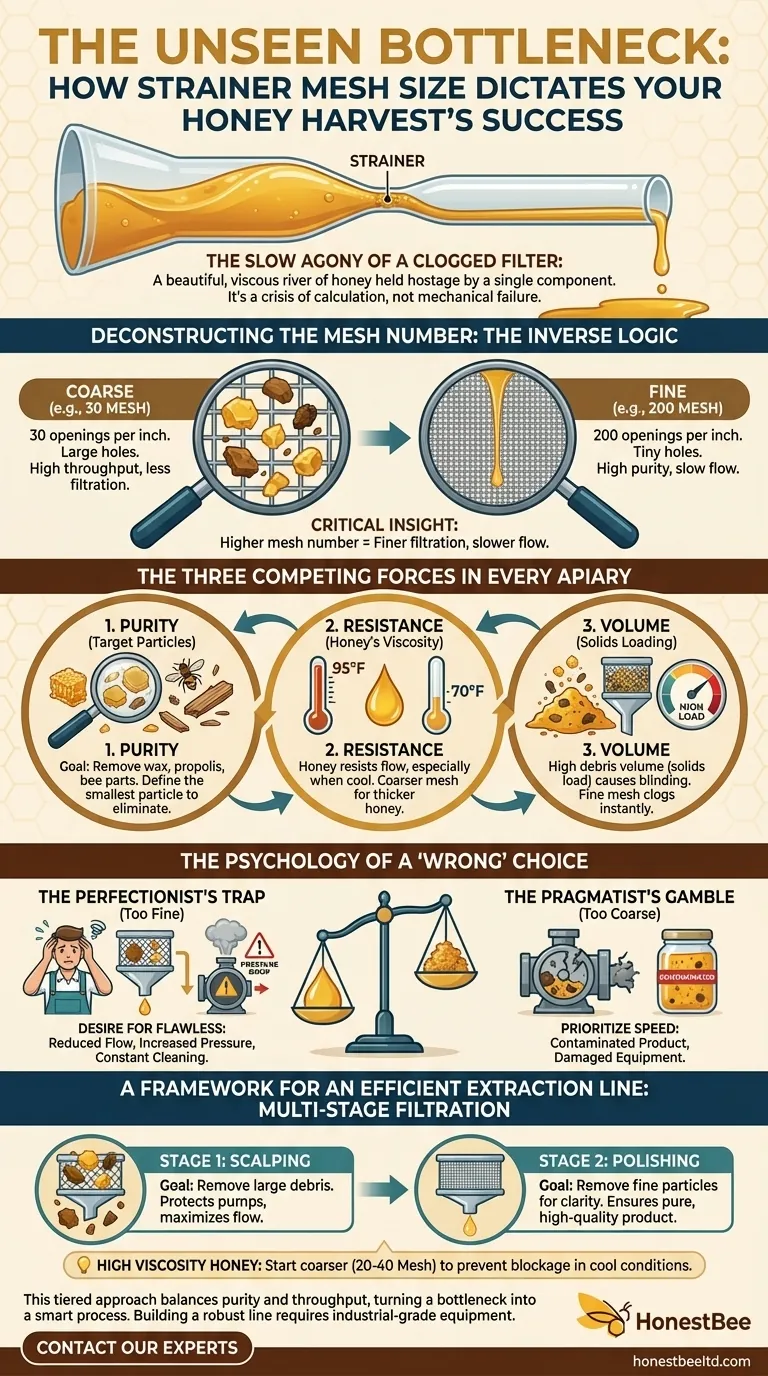
Visual Guide
Related Products
- Nylon Honey Strainer Square Filter Cloth for Honey Filters
- Conical Nylon Honey Strainer Filter Bag for Beekeeping and Honey Filtration
- Stainless Steel Triangle Support Honey Strainer and Filters
- Professional Stainless Steel Honey Filter with Support Handle
- Stainless Steel Double Layer Honey Strainer Sieve Filters
Related Articles
- How to Strain Honey Like a Pro: Science-Backed Methods for Maximum Purity
- The Last Gate: Why a Simple Strainer Defines Honey Quality at Any Scale
- The Unseen Guardian: Strainer Mesh Size as a First Principle in Honey Processing
- Clarity and Craft: The Critical Role of the Honey Strainer in Beekeeping
- From Hive to Jar: The Elegant Engineering of a Simple Honey Strainer