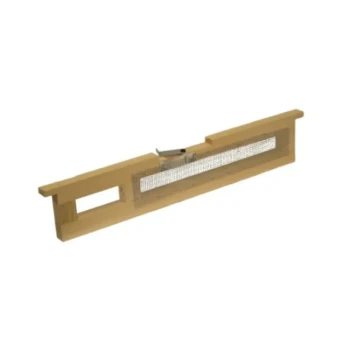
Specialized modified frames act as a precision docking system for Queen Banks, utilizing a central rectangular cutout to physically support and secure a large volume of caged queens. This modification is not merely structural; it is a critical interface that positions the queens within the colony's warmth while ensuring worker bees have the physical access required to keep the queens alive.
The core function of this modification is to balance thermal regulation with biological access. It holds queens in the warmest part of the cluster while guaranteeing the "bee-space" necessary for workers to feed and groom them through the mesh.
The Mechanics of the Modified Frame
The Central Rectangular Cutout
The defining feature of these frames is a modified central rectangular cutout.
Unlike a standard frame designed for wax foundation, this frame is engineered to act as a physical holder. It provides the structural support needed to stack or line up multiple queen cages securely, preventing them from shifting or falling to the bottom of the hive.
Strategic Positioning
The location of the cutout is deliberate.
By centering the cages, the frame ensures the queens are located in the core area of the winter cluster. This is the specific zone within the hive where the colony maintains the highest temperatures, which is vital for queen survival during colder periods.
Biological Support Systems
Enabling Thermal Regulation
Individual queens in cages cannot generate enough heat to survive on their own.
The modified frame's design places the queens directly into the colony's "boiler room." By mechanically fixing the cages in the center of the frame, the design leverages the collective body heat of the worker bees to maintain the queens' body temperature.
Preserving "Bee-Space"
Survival requires more than just warmth; it requires active care.
The structural design of the frame preserves sufficient bee-space around the cages. This gap is critical because it allows worker bees to move freely around the cages.
Facilitating Feeding and Care
Because the queens are confined, they are entirely dependent on external care.
The spacing provided by the frame ensures workers can access the cage mesh. This allows them to pass food to the queens and perform necessary grooming behaviors through the screen, preventing starvation and maintaining queen health.
Understanding the Trade-offs
The Risk of Incorrect Spacing
If a frame does not perfectly maintain the required bee-space, the system fails.
If the cages are packed too tightly without room for workers to circulate, the queens may die from starvation despite being warm. Conversely, too much space might discourage the cluster from tightening around the cages during extreme cold.
Dependency on Colony Strength
The frame facilitates storage, but it does not generate heat.
The success of this specialized frame relies entirely on the colony being strong enough to form a cluster large enough to cover the central cutout. If the cluster is too small, the precise positioning provided by the frame becomes irrelevant as the queens will be left exposed to the cold.
Making the Right Choice for Your Goal
The effectiveness of a Queen Bank relies on how well the hardware supports the biological needs of the hive.
- If your primary focus is Winter Survival: Ensure the frame's cutout centers the cages exactly where the cluster naturally forms to maximize thermal transfer.
- If your primary focus is Maintenance and Care: Verify that the frame design allows unobstructed worker movement around every side of the cage mesh to ensure consistent feeding.
Ultimately, the modified frame is a tool that converts the colony's natural heat and labor into a life-support system for multiple queens.
Summary Table:
| Feature | Function | Benefit |
|---|---|---|
| Central Rectangular Cutout | Securely holds and aligns multiple queen cages | Prevents shifting and maximizes storage capacity |
| Strategic Positioning | Centers cages in the core of the winter cluster | Ensures queens stay warm via the colony's natural heat |
| Engineered Bee-Space | Maintains specific gaps around the cage mesh | Allows worker bees to feed, groom, and care for queens |
| Structural Support | Replaces wax foundation with a rigid docking frame | Provides a durable, repeatable system for commercial use |
Maximize Your Apiary's Potential with HONESTBEE
Managing a large-scale queen bank requires precision and reliability. At HONESTBEE, we specialize in supporting commercial apiaries and distributors with a comprehensive wholesale selection of high-quality beekeeping tools and machinery.
Whether you need specialized hardware like hive-making and honey-filling machines or essential consumables to sustain your colonies, we provide the industrial-grade solutions you need to scale efficiently. Our expertise in beekeeping equipment ensures your queens are protected and your operations remain productive.
Ready to elevate your beekeeping business? Contact us today to discuss our wholesale offerings and discover how our specialized equipment can benefit your apiary.
References
- Leslie A. Holmes, Shelley E. Hoover. Queen honey bee (<i>Apis mellifera)</i> survival and colony performance after overwintering mated queens indoors. DOI: 10.1093/jee/toaf022
This article is also based on technical information from HonestBee Knowledge Base .
Related Products
- JZBZ Langstroth Queen Rearing Frame for Beekeeping
- Professional Wooden Requeening Frame for Beekeeping
- Assembled Wooden Bee Frames with Beeswax Foundation Ready to Use by HONESTBEE
- Heavy Duty Castellated Iron Frame Spacer for Honey Supers
People Also Ask
- Why use finishing colonies for queen cell capping? Secrets to Superior Queen Quality and Performance
- How do queen rearing frames and grafting needles function together? Master the Doolittle Method for High-Quality Queens
- What is the purpose of queen rearing frames? Master Controlled Queen Production for Your Apiary
- What are the functions of queen rearing frames and artificial queen cells? Master Bee Genetic Improvement
- What roles do professional queen rearing frames and artificial queen cells play? Scaling Your Queen Bee Production