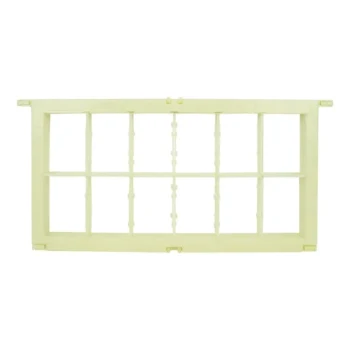
Standardized beehive frames function as a precise measurement grid, acting as both a biological habitat and a calibrated research tool. By physically measuring the surface area of specific frame contents—such as pollen storage and capped brood—technical personnel can convert complex colony behavior into quantifiable data points. This allows for the direct assessment of a colony's nutritional reserves and reproductive rate without ambiguity.
Core Takeaway: Standardization transforms the hive from a variable habitat into a consistent scientific instrument. By eliminating spatial variables, researchers ensure that changes in colony weight or brood area are directly attributable to feed quality and environmental factors, rather than hardware discrepancies.
The Frame as a Measurement Scale
Quantifying Nutritional Reserves
The primary utility of the standardized frame is its ability to serve as a physical scale. Researchers measure the specific area of pollen storage in square centimeters ($cm^2$).
This metric provides an accurate readout of the colony's "pantry," directly indicating the status of their nutritional reserves.
Calculating Reproductive Speed
Similarly, colony growth is quantified by measuring the area of capped brood in square centimeters ($cm^2$).
Because the frame dimensions are fixed, this measurement offers a reliable index of the queen's reproductive speed. This data is critical for determining how quickly a colony is expanding or recovering during specific seasons.
Eliminating Variables for Scientific Accuracy
Removing Spatial Bias
Standardized hive dimensions (typically 40x30x20 cm) create a uniform internal volume for all monitored colonies.
This uniformity eliminates variables related to spatial differences. It ensures that constraints on queen oviposition (egg-laying) or colony development are not caused by the hardware itself.
Isolating Environmental Impact
When the physical environment is held constant, external variables can be tested with high confidence.
For example, data derived from these frames allows for the scientific verification of specific foraging environments, such as banana plantations. Researchers can confirm if a specific environment effectively enhances colony strength during wintering based solely on the frame data.
Assessing Strength and Genetics
Population Density Metrics
Beyond surface area measurements, standardized equipment allows technicians to evaluate colony strength based on bee spaces.
By counting the number of "streets" (the spaces between frames) occupied by bees, personnel can rapidly assess the population density of a hive in a comparative manner.
Identifying Superior Stock
Standardized honey collection and metering equipment provide a uniform baseline for comparing yields.
This makes it easier to compare performance across different apiaries. It allows producers to objectively identify and promote superior genetic stock based on consistent production metrics.
Common Pitfalls to Avoid
The Requirement of Strict Uniformity
The validity of this data relies entirely on the physical precision of the equipment.
If frames or hive bodies deviate even slightly from the standardized dimensions, the "control" aspect of the experiment is lost. Variables regarding available space or thermal properties would be reintroduced, skewing the data on brood rearing and storage.
Data Interpretation Reliance
While the frames provide the raw data ($cm^2$), the accuracy of the insight depends on technical personnel.
Converting area measurements into conclusions about colony health requires consistent measurement techniques. Inconsistent manual measurement of the brood or pollen areas can lead to false conclusions regarding the value of a forage source.
Making the Right Choice for Your Goal
To effectively utilize standardized frames for data quantification, align your metrics with your specific objective:
- If your primary focus is Environmental Research: Prioritize measuring the area ($cm^2$) of pollen and capped brood to verify the nutritional impact of specific forage sources like banana plantations.
- If your primary focus is Genetic Breeding: Focus on honey yield metering and occupied "bee streets" to identify colonies with superior production traits and population density.
Standardization turns the biological complexity of a beehive into actionable, comparable data points.
Summary Table:
| Metric Category | Measurement Unit | Data Insight Provided |
|---|---|---|
| Nutritional Reserves | Area ($cm^2$) | Quantifies pollen storage and nutritional "pantry" status. |
| Reproductive Speed | Area ($cm^2$) | Measures capped brood to index queen oviposition and growth rate. |
| Colony Strength | Bee Spaces ("Streets") | Assesses population density and hive occupancy levels. |
| Genetic Quality | Standardized Metering | Identifies superior stock through uniform honey yield comparison. |
| Environmental Impact | Fixed Volume (cm) | Isolates external variables like forage quality from spatial bias. |
Scale Your Apiary Operations with HONESTBEE
Precision in beekeeping starts with standardized, high-quality hardware. HONESTBEE empowers commercial apiaries and global distributors by providing a comprehensive wholesale range of professional equipment.
From precisely engineered hive-making and honey-filling machines to essential consumables and cultural merchandise, we ensure your equipment is a reliable instrument for success. Our tools help you eliminate variables, identify superior genetics, and maximize your production efficiency.
Ready to elevate your beekeeping business with professional-grade solutions?
Contact HONESTBEE Today to discuss our wholesale offerings and how we can support your growth.
References
- B. Mohamed SHAWER, Takatoshi UENO. Banana Flowers (Musa sp.: Musaceae): an Essential Source of Nectar for Honeybee During the Dearth Period in Egypt. DOI: 10.5109/2232281
This article is also based on technical information from HonestBee Knowledge Base .
Related Products
- Wooden Bee Hive Frames for Beekeeping and Wholesale
- Professional Galvanized Steel Frame Rest for Beehives
- Assembled Wooden Bee Frames with Plastic Foundation for Durability and Convenience by HONESTBEE
- HONESTBEE Wired and Assembled Wooden Bee Frames Foundation for a Thriving Hive
- Plastic Bee Frame Beekeeping Hive Frames for Wholesale
People Also Ask
- How do wooden and plastic hive frames compare in terms of durability? Wood vs. Plastic Longevity & Repairability
- How does balancing the number of frames impact hive productivity? Optimize Your Apiary's Biological Output
- What are the main considerations when choosing between wooden and plastic bee hive frames? Optimize Your Apiary's Efficiency
- How should beehive frames be maintained to prolong their lifespan? 5 Pro Tips for Durable Beekeeping Equipment
- What is the primary function of frames within a beehive system? Structural Foundation and Hive Management