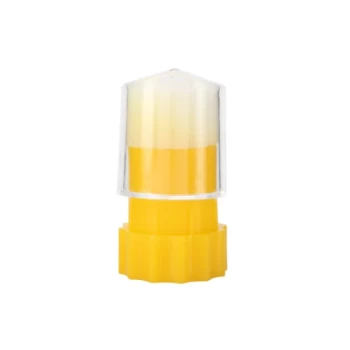
Queen marking serves as a visual anchor in the chaotic environment of a beehive. By applying a specialized mark to the queen's thorax, educators transform a dense population of worker bees into a navigable learning environment, allowing students to instantly locate the colony's leader and focus on critical biological processes.
While a queen bee is biologically distinct, she is visually elusive to the untrained eye. Marking creates an immediate focal point, converting the difficult task of identification into an accessible opportunity to witness egg-laying and colony dynamics in real-time.
Overcoming Visual Complexity
Instant Identification in Dense Colonies
An observation hive contains thousands of moving insects, creating a complex visual pattern that can be overwhelming for new learners.
Without a visual aid, finding the single queen is a time-consuming challenge that often leads to frustration.
Specialized marking allows viewers to cut through this visual noise, significantly enhancing the efficiency of the educational session.
Focus on Biological Behaviors
Once the queen is located via her mark, the educational focus can shift immediately from "hunting" to "observing."
This visibility is crucial for witnessing specific behaviors mentioned in the primary literature, such as egg-laying.
Students can clearly see the queen's movement across the comb as she inspects cells, a process that defines the colony's future.
Enhancing Data Context
Tracking Age and Lineage
Beyond simple visibility, the specific color of the mark provides a layer of data regarding the queen's history.
By using standard color codes, educators can teach students how to determine the queen's age and origin at a glance.
This turns the queen into a data point, allowing for discussions about longevity and genetic lineage.
Monitoring Colony Events
A marked queen serves as a status indicator for the colony's reproductive health.
If the marked queen disappears and is replaced by an unmarked one, it provides a clear lesson in swarming or supersedure (natural replacement).
This allows observers to track whether a colony has maintained its original leader or undergone a major reproductive event.
Understanding the Trade-offs
Handling Risks during Application
Applying a mark requires capturing and restraining the queen, which involves physical contact.
There is a slight risk of injuring the queen if the specialized tools are used incorrectly or if too much pressure is applied to the thorax.
Potential for Colony Rejection
The colony relies on pheromones to recognize their queen.
If the marking paint has a strong odor or if the queen is handled roughly, the worker bees may reject or "ball" the queen (kill her) upon her return.
Altering Natural Aesthetics
For educators aiming for a strictly "wild" simulation, a bright dot of paint may detract from the natural aesthetic.
However, in an educational setting, the gain in observational clarity generally outweighs the loss of visual naturalism.
Making the Right Choice for Your Educational Hive
Deciding to mark a queen requires balancing the need for immediate engagement with the welfare of the colony.
- If your primary focus is public engagement: Prioritize high-contrast marking to ensure visitors can spot the queen within seconds of viewing, maximizing the efficiency of short observation windows.
- If your primary focus is long-term biology: Use standardized color coding to teach students how to track age, lineage, and natural queen replacement over seasons.
Ultimately, a marked queen acts as a living cursor, guiding the observer's eye to the heart of the colony's operation.
Summary Table:
| Benefit | Educational Impact | Data/Insights Provided |
|---|---|---|
| Visual Anchoring | Instant identification in dense colonies | Reduces search time; focuses on behavior |
| Standardized Color Coding | Age and lineage tracking | Teaches longevity and genetic history |
| Colony Event Monitoring | Real-time observation of swarming | Tracks supersedure and reproductive health |
| Biological Clarity | Witnessing egg-laying processes | Deepens understanding of colony dynamics |
Elevate Your Beekeeping Operation with HONESTBEE
At HONESTBEE, we specialize in empowering commercial apiaries and distributors with the highest quality tools designed for precision and efficiency. Whether you are looking for specialized queen marking tools, hive-making machinery, or advanced honey-filling systems, our comprehensive wholesale portfolio has everything you need to succeed.
From essential industry consumables to unique honey-themed cultural merchandise, we provide the hardware and expertise to grow your business. Ready to optimize your apiary or restock your distribution channels?
Contact HONESTBEE Today to discover how our premium beekeeping equipment can add value to your professional operations.
References
- David Hall, Malcolm T. Sanford. Observation Bee Hives. DOI: 10.32473/edis-mg320-2014
This article is also based on technical information from HonestBee Knowledge Base .
Related Products
- One Hand Yellow Queen Marking Catcher Tube Cage Beekeeper Tool Accessory for Queen Bee
- Queen Bee Marking Tube Cage Bottle Catcher Holder with Clear Plastic Plunger Marker
- Queen Bee Marking Pen UNI Medium Point for Queen and Bee Marking
- Transparent Plastic Bee Catcher Queen Marker Tube Cage Beekeeping Tool Equipment
- Queen Bee Marking Pen POSCA Queen Marking Pens for Beekeeping Bee Markers
People Also Ask
- What tools are available to assist in safely marking a queen bee? Essential Gear for Professional Beekeepers
- What equipment is needed to mark a queen bee? A Simple 3-Tool Guide for Every Beekeeper
- Why are high-quality queen bee marking tools essential for pedigree tracking? Master Honey Bee Genetic Integrity
- What are the specific advantages of using international standard marking tools in queen bee production and management?
- What tools are recommended for marking a Queen bee? Ensure a Safe and Successful Mark