Specialized pollen substitutes serve as a critical lever for economic efficiency in modern apiculture, directly influencing a producer's ability to compete globally. By tailoring nutrition to specific bee species, producers can significantly increase the honey yield per hive while simultaneously driving down the unit cost of production. This dual advantage allows local honey to reach competitive price points that rival imported products in the international marketplace.
Core Takeaway: The shift toward scientifically formulated pollen substitutes moves honey production from a variable, nature-dependent practice to a precision industry. This stability enables producers to lower costs and boost yields, satisfying the strict volume and pricing demands of global trade.
The Economics of Specialized Nutrition
To understand how pollen substitutes impact competitiveness, one must look at the direct relationship between hive health and production economics.
Increasing Yield per Hive
The primary driver of competitiveness is volume. Efficient pollen substitutes ensure that bee colonies maintain peak health and population levels regardless of natural forage availability.
This consistent nutritional intake results in stronger colonies capable of producing a significantly higher volume of honey per hive compared to those relying solely on natural sources.
Lowering Unit Production Costs
As the yield per hive increases, the fixed costs of beekeeping (labor, equipment, land use) are spread across a larger volume of product.
This effectively lowers the unit production cost for every kilogram of honey produced. Lower overheads provide the financial flexibility needed to survive in aggressive international markets.
Reaching Competitive Price Points
International markets are highly price-sensitive. By achieving the cost efficiencies mentioned above, producers can offer their honey at a competitive price point.
This allows local producers to match or undercut the prices of mass-market imported honey, breaking down one of the most significant barriers to entry in global trade.
Meeting International Standards
Competitiveness is not just about price; it is about consistency and compliance with global expectations.
Tailoring to Specific Bee Species
Generic supplements often fail to maximize potential. The development of substitutes tailored to specific bee species ensures that the bees receive the exact macronutrients required for their biological makeup.
This biological optimization leads to a more predictable production cycle, which is essential for fulfilling large-scale international contracts.
Combining Quality with Efficiency
The international market demands a balance of high quality and low cost. Technical advancements in nutrition allow producers to meet recognized international market standards without sacrificing profitability.
By stabilizing the hive's input, producers can ensure a consistent output that aligns with the rigorous demands of export partners.
Understanding the Trade-offs
While specialized pollen substitutes offer significant economic advantages, they introduce new variables into the production ecosystem that must be managed.
Input Dependency
Moving from natural foraging to supplemented nutrition increases input costs. Producers must weigh the cost of purchasing or developing these substitutes against the projected increase in yield.
Technical Complexity
Successfully implementing these substitutes requires technical knowledge. Formulations must be efficient and correctly matched to the bee species; incorrect application can lead to wasted resources or suboptimal hive health.
The Need for Holistic Modernization
Nutrition is only one part of the equation. To fully capitalize on the increased yields from pollen substitutes, operations often require parallel investments in industrial-grade processing equipment to handle the higher volume without bottling necks or spoilage.
Making the Right Choice for Your Goal
The decision to integrate specialized pollen substitutes should be based on your specific operational targets.
- If your primary focus is Volume Scaling: Prioritize high-yield substitutes to maximize output per hive, reducing your fixed costs per unit to the absolute minimum.
- If your primary focus is Market Entry: Use the cost savings from increased efficiency to lower your final price point, making your product attractive to international buyers looking for competitive rates.
- If your primary focus is Consistency: Implement species-specific formulas to stabilize production cycles, ensuring you can meet strict delivery schedules for export contracts.
By treating bee nutrition as a controllable variable rather than an environmental chance, you position your operation to dictate terms in the global market rather than simply reacting to them.
Summary Table:
| Factor | Natural Forage Only | Specialized Pollen Substitutes | Impact on Competitiveness |
|---|---|---|---|
| Honey Yield | Variable/Seasonal | High & Consistent | Higher volume for global export |
| Production Cost | High per unit | Low per unit (Economy of Scale) | Enables competitive price points |
| Colony Health | Environment-dependent | Optimized per Bee Species | Predictable production cycles |
| Market Position | Local/Niche | International/Wholesale | Reliable supply for large contracts |
Maximize Your Apiary's Global Potential with HONESTBEE
Transition from nature-dependent yields to a high-performance precision industry. HONESTBEE empowers commercial apiaries and distributors with the tools needed to dominate the international market. From high-efficiency pollen substitutes to industrial-grade honey-filling and hive-making machinery, we provide the full spectrum of equipment and consumables required for large-scale success.
Why Partner with HONESTBEE?
- Wholesale Excellence: Comprehensive supplies for distributors and commercial operations.
- Industrial Scalability: Advanced machinery to handle increased yields without bottlenecks.
- End-to-End Solutions: Everything from specialized hardware to honey-themed cultural merchandise.
Ready to lower your production costs and boost your honey yields? Contact us today to explore our wholesale offerings!
References
- Retno Widowati, Nonon Saribanon. Optimizing Demand for Pollen Substitute for Beekeeping in Indonesia. DOI: 10.4108/eai.11-10-2021.2319607
This article is also based on technical information from HonestBee Knowledge Base .
Related Products
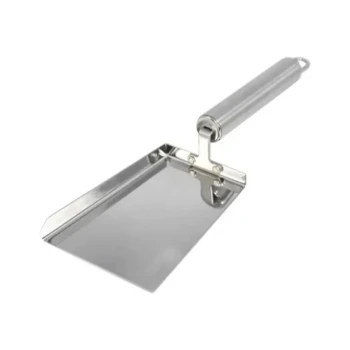
- Heavy-Duty Ergonomic Stainless Steel Pollen Shovel
- Heavy-Duty Ergonomic Grip Galvanized Pollen Shovel
- Removable Plastic Pollen Trap With Ventilated Tray for Bees Pollen Collector
- Plastic Bee Pollen Trap Strips Comb Catcher Collector
- 30 cm Plastic Entrance Hole Bee Pollen Trap and Collector
People Also Ask
- How is pollen cleaned after it has been dried? Master Efficient Separation for Pure Bee Pollen
- What methods are used to clean harvested bee pollen? Scale Your Beekeeping Operations with the Right Technique
- How can harvested bee pollen be cleaned to remove impurities? Efficient Methods for Commercial and Hobbyist Beekeepers
- How do bee pollen collection tools affect the quality of bee pollen used in functional dairy ice cream production?
- What is the technical significance of using specialized cutting tools for propolis? Master Precision Pollen Harvesting