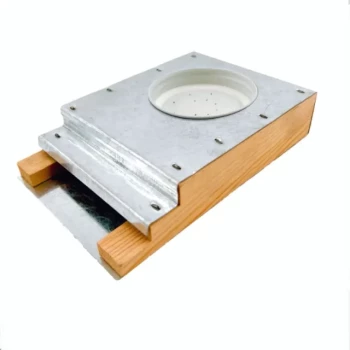
In a Top Bar hive, correct feeder positioning relies on utilizing the hive's horizontal capacity rather than vertical stacking. The feeder should be placed directly on the bottom floor of the empty cavity, situated behind the active colony area. To grant the bees access, you must modify the divider board—either by propping it up with small sticks or creating specific access holes—before sealing the top of the hive with empty bars to protect the colony.
Success depends on placing the feed within the hive’s secure internal cavity while ensuring the colony can easily transit past the divider board without compromising the hive's seal against pests or robber bees.
Internal Positioning Strategy
Utilizing the Empty Cavity
Unlike vertical hives that require adding boxes, a Top Bar hive utilizes the unused space at the back of the hive body.
You should locate the "empty cavity," which is the section of the hive currently unoccupied by drawn comb or the active bee cluster.
Floor-Level Placement
According to standard protocols, the feeder apparatus sits directly on the bottom board (the floor) of this empty section.
This keeps the weight of the feed stable and allows you to use various feeder types, such as jars or reservoirs, provided they fit under the lid.
Managing Bee Access
The divider board (often called a follower board) separates the colony from the empty cavity. You must create a passage for the bees to travel from their comb to the food source.
The "Propping" Method
The simplest method to create access is to manipulate the divider board itself.
You can prop the divider board up slightly using small sticks or wedges. This creates a gap along the floor, allowing bees to crawl underneath the board to reach the feeder.
The "Port" Method
Alternatively, you can modify the divider board physically.
Drilling access holes through the board creates a permanent gateway. If you choose this route, ensure you have plugs or corks available to close these holes when feeding is not in progress.
Securing the Hive Environment
Once the feeder is positioned and access is established, you must maintain the hive's defensive perimeter.
Resealing the Top
You must return the empty top bars to their position over the feeder cavity.
This effectively seals the "roof" of the hive. Leaving this area open or covered only by the external roof can encourage robbing by other insects or lead to heat loss.
Common Pitfalls to Avoid
Risk of Robbing
Internal feeding is generally safer than external feeding, but it is not risk-free.
If the empty top bars do not fit tightly over the feeder cavity, the smell of syrup can attract wasps or robber bees. Ensure the seal is tight to keep the colony secure.
Distance from the Cluster
In colder weather, bees may be reluctant to break their cluster to travel to the empty cavity.
If the temperature drops, the feeder must be placed as close to the divider board as possible. If the bees cannot reach the food without chilling, the feeder becomes useless.
Making the Right Choice for Your Goal
Select the access method that best aligns with your equipment capabilities and climate conditions.
- If your primary focus is simplicity and speed: Use the propping method with sticks, as it requires no permanent modification to your equipment and allows for immediate feeding.
- If your primary focus is thermal efficiency: distinct access holes in the divider board are superior, as they minimize the drafts that can occur when lifting the entire board.
Proper positioning ensures your colony remains nourished without exposing them to unnecessary stress or competition.
Summary Table:
| Aspect | Positioning Detail | Best Practice/Method |
|---|---|---|
| Location | Empty cavity | Behind the divider board at the back of the hive |
| Placement | Floor-level | Sit directly on the bottom board for stability |
| Bee Access | Propping Method | Use sticks to lift the divider board slightly |
| Bee Access | Port Method | Drill permanent holes with plugs for controlled entry |
| Protection | Top-sealing | Use empty bars to seal the cavity and prevent robbing |
| Weather | Cold Sensitivity | Place feeder close to the cluster to prevent chilling |
Scale Your Beekeeping Business with HONESTBEE
Are you a commercial apiary or a distributor looking for high-quality, reliable beekeeping solutions? At HONESTBEE, we specialize in providing a comprehensive wholesale offering designed to meet the rigorous demands of industrial beekeeping.
Our portfolio includes:
- Advanced Machinery: Hive-making machines and automated honey-filling systems.
- Professional Tools: A full spectrum of durable hardware and equipment for large-scale operations.
- Essential Consumables: Every industry-standard supply needed to keep your colonies productive.
- Merchandise: Unique honey-themed cultural goods to expand your retail reach.
Maximize your efficiency and secure your supply chain with our expert support. Contact us today to explore our wholesale catalog!
Related Products
- Rapid Bee Feeder White Plastic 2L Round Top Feeder for 8 or 10-Frame Bee Hives
- White Plastic 0.5L Beekeeping Entrance Feeder for Bees
- HONESTBEE Entrance Bee Feeder Professional Hive Nutrition Solution for Beekeeping
- HONESTBEE Professional Entrance Bee Feeder Hive Nutrition Solution
- Boardman Entrance Bee Feeder Durable Galvanized Steel and Wood Construction for Beekeeping
People Also Ask
- What should be done with feeders and equipment after feeding bees? Essential Steps for Apiary Health
- What should be done if feed in a feeder is not consumed by the bees? Prevent Hive Mold with Prompt Feed Management
- What is the necessity of specialized internal or entrance feeders? Secure Your Hive with Professional Feeding Tools
- How do bee feeders work to preserve colony health during nectar shortages? Essential Guide for Beekeepers
- How quickly does a medium to strong colony usually empty a feeder? A Beekeeper's Guide to Hive Health