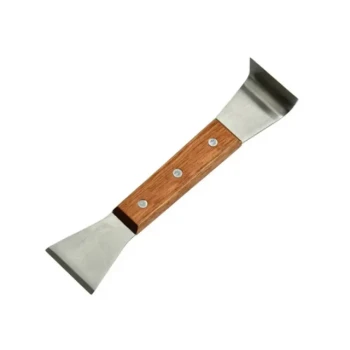
A regular hive tool is the fundamental utility instrument for beekeepers, essentially functioning as a specialized, flat mini-crowbar. It typically features a long, flat steel blade with a sharp bevel on one end and a shorter, curved edge on the other, designed specifically to pry apart hive components sealed by propolis.
The standard hive tool relies on simple leverage to break propolis seals without destroying wooden ware. Its dual-ended design facilitates both pushing and pulling actions, making it the most versatile and ubiquitous tool in the apiary.
The Anatomy of the Standard Tool
The Flat Blade (The Chisel)
The primary end of the tool is a long, flat blade featuring a sharp bevel. This end is designed to operate like a chisel.
It provides the necessary leverage to pry apart heavy hive boxes (supers) that have been glued together by bees. It is also the primary surface used for "push scraping"—removing burr comb or propolis from flat surfaces.
The Curved End (The Scraper)
The opposite end of the tool is shorter and bent at a nearly 90-degree angle. This curve transforms the end into a hook-like feature.
This section is primarily used as a "pull scraper" for cleaning frames. It is also essential for prying between frames to separate them before lifting, offering a different angle of leverage than the flat end.
Physical Dimensions and Features
A standard hive tool is almost exclusively made from a thin, flat metal bar.
While sizes can vary, the typical dimensions are approximately 9 inches in length, 1.75 inches in width, and 1.25 inches in height at the bent end. Many models also include a teardrop-shaped opening near the curved end, which serves as a nail remover.
Functional Applications
Separating Hive Bodies
The bees seal every gap in the hive with propolis, a resinous glue. The regular hive tool is essentially a wedge.
You insert the sharp, flat end between boxes to crack this seal. Without this mechanical advantage, opening a hive without damaging the equipment is nearly impossible.
Frame Manipulation
Once the hive is open, the tool is used to dislodge frames.
Beekeepers use the curved end to hook and pull frames apart, or the flat end to lever them up. It is also used to push frames back down if they are sitting too high.
General Utility
Beyond the hive structure, the tool acts as a general-purpose implement.
It is frequently used to open bee packages, pry open paint cans, pack fuel into a smoker, and even crush pests like Small Hive Beetles found inside the colony.
Understanding the Trade-offs
The Lifting Limitation
While the regular hive tool is excellent for prying and scraping, it lacks the specialized "J-hook" feature found on some other models.
This means that while you can separate frames easily, lifting them out often requires more manual dexterity or pinching with fingers, as the standard curved end is designed more for scraping than vertical lifting.
Potential for Damage
The bevels on a regular hive tool are sharp.
If used carelessly, the flat end can easily gouge the wood of the hive boxes or frames. When scraping frames, it requires a steady hand to avoid shaving off layers of the wooden top bars.
Making the Right Choice for Your Goal
While the regular hive tool is the industry standard, understanding its strengths helps you use it more effectively.
- If your primary focus is general maintenance: The regular hive tool is the best all-around choice due to its superior scraping ability and ruggedness for prying boxes apart.
- If your primary focus is brood inspection: You must use the curved end carefully to separate frames laterally before attempting to lift them, ensuring you do not roll or crush bees.
Mastering the regular hive tool is the first step in beekeeping, as it serves as the extension of your hand within the hive.
Summary Table:
| Feature | Description | Primary Use |
|---|---|---|
| Flat Blade | Sharp, chiseled bevel end | Prying hive boxes & push scraping |
| Curved End | 90-degree bent hook | Frame manipulation & pull scraping |
| Material | High-strength flat steel | Durability & mechanical leverage |
| Nail Remover | Teardrop-shaped cutout | Pulling nails and general maintenance |
| Dimensions | Approx. 9" L x 1.75" W | Compact, portable hand tool |
Elevate Your Beekeeping Operation with HONESTBEE
Equip your commercial apiary or distribution business with the industry's most reliable tools. HONESTBEE specializes in supplying high-quality beekeeping equipment, from fundamental hand tools like the regular hive tool to advanced honey-filling and hive-making machinery.
Whether you need bulk consumables or specialized hardware, we provide the comprehensive wholesale solutions your business deserves.
Ready to scale your production? Contact us today to explore our full portfolio and discover how our expertise can drive your success.
Related Products
- HONESTBEE Classic Pry Bar Hive Tool with High Visibility Finish for Beekeeping
- HONESTBEE Professional Long Handled Hive Tool with Precision Cutting Blade
- HONESTBEE Premium Italian Style Hive Tool with Hardwood Handle
- Professional Dual-End Stainless Steel Hive Tool for Beekeeping
- HONESTBEE Professional Mini J-Hook Hive Tool for Beekeeping
People Also Ask
- What specific challenges do beekeeping hive tools address during hive maintenance? Essential Solutions for Apiaries
- Why are specialized beekeeping tools essential for executing colony health monitoring processes? Enhance Hive Precision
- What are some essential tools for beekeepers? Start Your Apiary with the Right Gear
- What are the essential tools and gear for basic beekeeping? Equip Your Apiary for Success and Safety
- What is the purpose of adding crystalline soda when disinfecting beekeeping tools? Boost Sterilization Efficiency