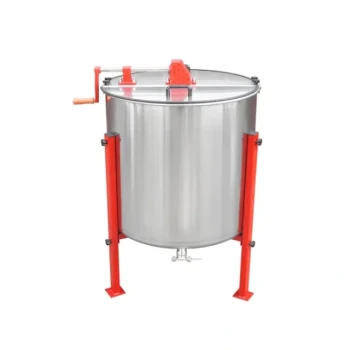
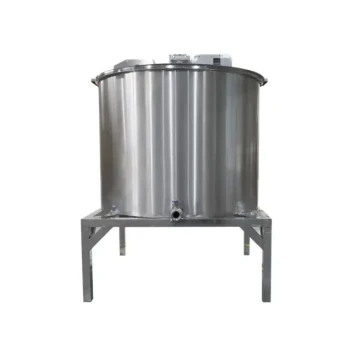
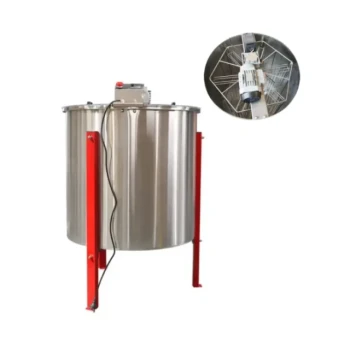
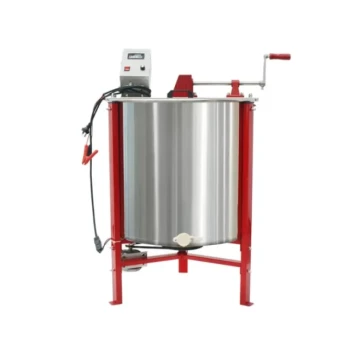
Tangential honey extractors are specialized devices that extract honey from one side of a frame at a time, requiring the operator to flip the frames midway through the process to clear the second side. Available in both manual and electric models, they are specifically designed to serve the needs of beekeepers with smaller operations or fragile combs.
Core Takeaway Tangential extractors prioritize comb preservation and affordability over speed. While the requirement to manually flip frames increases labor, their gentle extraction force makes them the ideal choice for hobbyists and those managing delicate or older honeycombs.
The Mechanics of Tangential Extraction
Frame Orientation and Extraction
In a tangential extractor, the frames are placed in a basket-style arrangement where the honeycomb faces outward, perpendicular to the drum wall.
As the basket spins, centrifugal force pulls the honey out of the outward-facing cells. Because the inner-facing cells are pressed against the center, they cannot empty until the frame is turned around.
The "Flip" Requirement
The defining characteristic of this workflow is the mid-cycle pause.
After spinning the first side, the operator must stop the machine, manually remove or rotate the frames to expose the opposite side, and resume spinning. This effectively doubles the number of cycles required compared to radial extractors.
Why Choose Tangential: The Deep Benefits
Unmatched Gentleness
The primary technical advantage of tangential extraction is the protection it offers to the wax.
Because the frames are positioned broadly against the basket, the extraction force is distributed across a larger surface area of the comb. This prevents the "blowouts" that can occur in radial extractors, making tangential models excellent for preserving older, weaker, or uncapped fragile combs.
Accessibility for Beginners
Tangential extractors are typically smaller, simpler, and less expensive than their radial counterparts.
They often come in 2-frame, 4-frame, or 9-frame capacities. This makes them a cost-effective entry point for hobbyists who do not need the high-volume throughput of commercial machinery.
Power Flexibility
These units accommodate different infrastructure needs through two main drive types:
- Manual Models: Operated by a hand crank, these are cost-effective and sufficient for very small apiaries where electricity is unavailable or unnecessary.
- Electric Models: These utilize a motor to spin the basket, increasing efficiency and consistency, though the operator must still intervene to flip the frames.
Understanding the Trade-offs
The Efficiency Cost
The necessity of flipping frames makes tangential extraction a more time-consuming process.
You are effectively running two spin cycles for every batch of frames, plus the time required to handle the frames in between. For an operation with dozens of hives, this labor cost accumulates quickly.
Limited Capacity
Tangential extractors generally handle fewer frames per batch than radial extractors of the same barrel diameter.
While a radial unit might fit 20 frames like spokes on a wheel, a tangential unit of the same size may only accommodate 4 to 8 frames along the perimeter. This limits their viability for medium-to-large scale commercial operations.
Making the Right Choice for Your Goal
When selecting an extractor, align the equipment with your specific operational priorities.
- If your primary focus is protecting fragile comb: Choose a tangential extractor, as the distributed force prevents wire blowouts and wax damage on delicate frames.
- If your primary focus is budget and starting small: Choose a manual 2-frame or 4-frame tangential model to minimize upfront costs while learning the craft.
- If your primary focus is time efficiency: You should likely look for a radial extractor, as the tangential "flip" process will become a bottleneck as your hive count grows.
Select the tool that respects both your budget and the integrity of your harvest.
Summary Table:
| Feature | Tangential Extractor Detail |
|---|---|
| Extraction Method | One side at a time (perpendicular to drum) |
| Frame Handling | Requires manual flipping midway |
| Best For | Hobbyists, fragile or older combs, small apiaries |
| Key Advantage | Maximum protection against wax "blowouts" |
| Capacity | Low to medium (typically 2-9 frames) |
| Drive Types | Manual hand-crank or electric motor options |
Elevate Your Beekeeping Efficiency with HONESTBEE
Whether you are a growing commercial apiary or a global distributor, HONESTBEE provides the professional-grade equipment you need to succeed. Our comprehensive wholesale catalog includes:
- High-Precision Machinery: From honey-filling machines to automated hive-making equipment.
- Complete Tool Range: Durable honey extractors, specialized hardware, and essential beekeeping consumables.
- Brand Growth Assets: Unique honey-themed cultural merchandise to enhance your retail presence.
Ready to scale your operation or stock your shelves with premium beekeeping gear? Contact us today to explore our wholesale solutions and let HONESTBEE be your partner in the industry.
Related Products
- Electric 4 Frame Tangential Honey Extractor
- Commercial Electric 12 Frame Honey Extractor Spinner Motorized Honey Extractor
- Stainless Steel Manual 8 Frame Radial Honey Extractor Machine for Beehives
- Manual Hand Crank 4 Frame Honey Extractor Centrifuge for Beekeeping
- 6 Frame Manual Stainless Steel Honey Extractor Beekeeping Equipment
People Also Ask
- What are the characteristics of electric honey extractors? Boost Your Apiary Efficiency with Automated Technology
- What are the disadvantages of using an electric honey extractor? Weighing Cost, Power, and Comb Safety
- What are the advantages of an electric honey extractor? Boost Efficiency and Scale Your Honey Production
- What are the advantages of electric honey extractors? Boost Harvest Speed & Efficiency
- What are the technical advantages of electric honey extractors? Maximize Yield and Protect Your Bee Colony