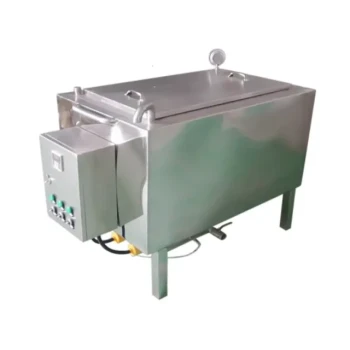
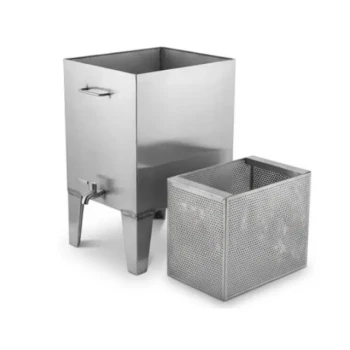
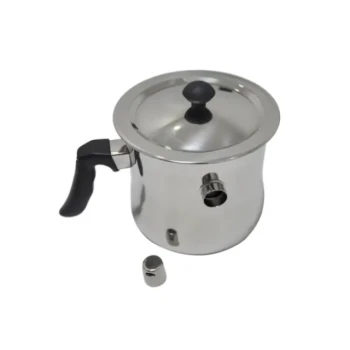
Large industrial-grade heated water tanks function as the critical clarification vessels in the final stage of beeswax processing. These tanks maintain the wax in a liquid state at a precise temperature, allowing gravity to separate fine impurities from the pure wax before it is cast into blocks.
The core value of these tanks lies in prolonged thermal clarification. By holding wax at a stable 75-80°C, they allow microscopic contaminants to settle out of the solution, ensuring the final product meets high purity and sensory standards.
The Mechanics of Thermal Clarification
Precision Temperature Control
The primary function of these steel tanks is to maintain a specific thermal environment. They hold the liquid beeswax at a controlled temperature range of 75-80°C.
This temperature is critical because it keeps the wax fully liquid and fluid without overheating it. Overheating can degrade the chemical structure of the wax, so stability here is paramount.
Gravity-Based Separation
Once the temperature is stabilized, the tanks utilize gravity as a purification tool. The wax is held in this state for extended periods.
During this time, fine impurities that are heavier than the wax slowly sink. This allows for a natural separation process that does not require chemical additives.
Achieving Final Product Quality
Mechanical Sediment Removal
As the fine impurities settle, they form a layer of sediment at the bottom of the tank.
The industrial tank design allows for the mechanical removal of this bottom layer. This physical separation ensures that the contaminants do not re-mix with the clarified wax above.
Enhancing Sensory Attributes
The process goes beyond simple cleaning; it refines the aesthetic quality of the product.
By removing these fine particulates, the process significantly enhances the sensory quality of the final beeswax blocks. This results in a product with superior texture and visual purity.
Understanding the Trade-offs
Time Investment vs. Throughput
This method relies on "prolonged clarification," meaning it is not an instant process.
To achieve high purity, the wax must sit undisturbed for a significant duration. This creates a bottleneck in production speed compared to faster, force-filtration methods.
Energy Consumption
Maintaing large volumes of wax at 75-80°C requires consistent energy input.
Operators must balance the cost of heating these large steel tanks against the increased value of the purified final product.
Optimizing Your Purification Process
To get the most out of industrial heated tanks, you must align your operational parameters with your quality goals.
- If your primary focus is Maximum Purity: Ensure the residence time in the tank is maximized to allow even the finest particles to settle completely.
- If your primary focus is Production Efficiency: Monitor the sediment buildup closely to schedule mechanical removal at the earliest optimal moment to reduce cycle times.
By strictly controlling temperature and allowing gravity time to work, you transform raw processed wax into a premium industrial product.
Summary Table:
| Feature | Function | Benefit |
|---|---|---|
| Temperature Control | Maintains 75-80°C | Prevents wax degradation while keeping it fluid |
| Gravity Separation | Prolonged thermal clarification | Natural settling of microscopic contaminants |
| Sediment Removal | Mechanical bottom-layer extraction | Physical isolation of impurities from pure wax |
| Sensory Refinement | Final stage purification | Enhances texture, color, and visual purity |
Elevate Your Wax Production with HONESTBEE
Are you looking to scale your beeswax processing or upgrade your apiary’s efficiency? HONESTBEE specializes in serving commercial apiaries and distributors with high-performance industrial equipment. From specialized hive-making and honey-filling machines to large-scale industrial heated water tanks, we provide the full spectrum of beekeeping tools and machinery designed for durability and precision.
Our comprehensive wholesale offering ensures you have access to the essential hardware and industry consumables needed to produce premium-grade wax and honey products. Contact HONESTBEE today to discuss how our professional equipment solutions can optimize your workflow and increase your market value.
References
- Stefan Bogdanov. Beeswax: quality issues today. DOI: 10.1080/0005772x.2004.11099623
This article is also based on technical information from HonestBee Knowledge Base .
Related Products
- Electric Commercial Beeswax Melter for Factory Use
- Professional Stainless Steel Honey Filtering Machine with Water Bath Heating for Beekeeping
- Stainless Steel Heated Honey Tank Warming Heating Tank
- Steam Beeswax Melter Wax Warmer for Wax Processing
- Plastic Honey Uncapping Tub Tank for Beekeeping
People Also Ask
- Why might a commercial beekeeper prefer an electric beeswax melter? Maximize Profit with Speed & Scale
- What safety precautions should be taken when melting beeswax? A Guide to Flammable Wax Handling
- What types of beeswax melters are available for different scales of beekeeping? Solar vs. Electric Melters Compared
- What are the three popular methods for melting beeswax? Safely Process Your Wax with Ease
- How do you melt beeswax without making a mess? Master Safe & Clean Techniques