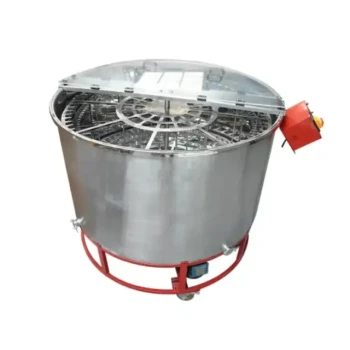
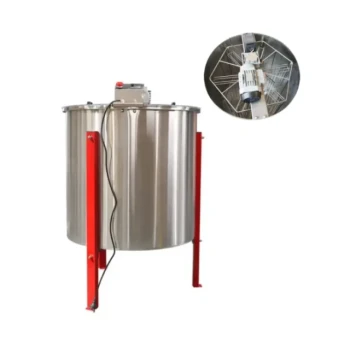
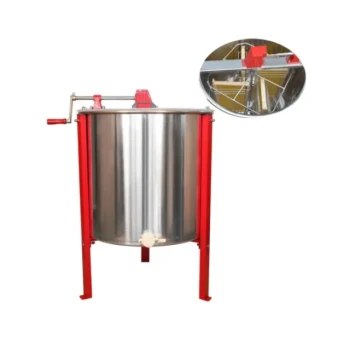
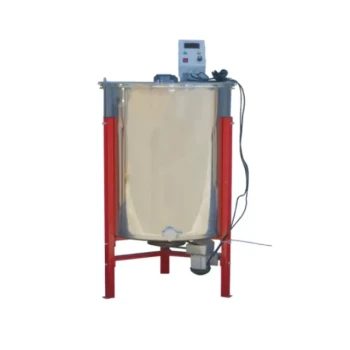
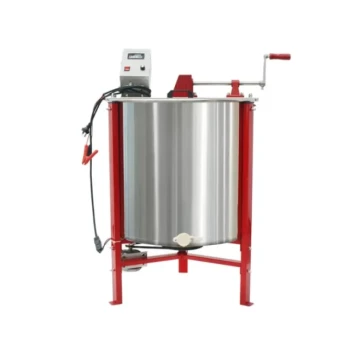
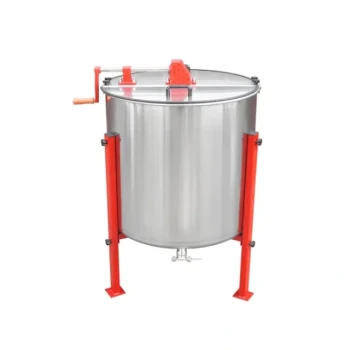
The two primary styles of honey extractors are Tangential and Radial. These distinctions refer to how the honeycomb frames are positioned inside the drum relative to the center shaft. While extractors are also categorized by their power source (manual or motorized), the frame orientation is the fundamental mechanical difference that dictates efficiency and workflow.
The core difference lies in efficiency and frame handling. Tangential extractors extract one side of a frame at a time and require manual flipping, making them cost-effective for hobbyists. Radial extractors spin honey from both sides simultaneously, offering the speed and volume required for larger operations.
Tangential Extractors: The Hobbyist Standard
Tangential extractors are the most common entry point for new beekeepers. They are generally simpler in design and more affordable, though they require more hands-on interaction during the harvest.
Frame Orientation
In this style, the frames are loaded with the flat side of the comb facing the drum wall. The frame sits tangent to the circle of the drum.
The Extraction Process
Because the frame faces the wall, centrifugal force only pulls honey from the distinct side facing outward.
Once the first side is empty, the operator must stop the machine, physically flip the frame over, and spin it again to extract the second side.
Typical Capacity
These units typically have a smaller form factor. Most models hold between 3 to 6 frames at a time.
Radial Extractors: Efficiency for Scale
Radial extractors are designed to minimize labor. They are the preferred choice for growing apiaries and commercial operations where time is a critical resource.
Frame Orientation
Frames are loaded like the spokes of a wheel, radiating outward from the central shaft. The top bar of the frame usually faces the drum wall.
The Process
This design utilizes the slight upward angle of the honeycomb cells. Centrifugal force pulls the honey out of both sides of the comb simultaneously.
Because both sides are extracted at once, no frame flipping is required. You load the extractor once and run a single cycle.
Typical Capacity
Radial extractors offer a much wider range of volume. While small units exist, they can typically hold anywhere from 4 to over 100 frames in a single load.
Another Layer: Manual vs. Motorized
Beyond the mechanical style (Tangential vs. Radial), the primary reference notes that extractors are further categorized by how they generate spin.
Manual Extractors
These utilize a hand crank and a gearbox. They are cost-effective (often $100 to $300) and suitable for hobbyists with a small number of hives who don't mind the physical effort.
Motorized Extractors
These use an electric motor to control speed and duration. Pricing usually starts around $300 and can exceed $1,500 for commercial models. They allow the beekeeper to uncap the next set of frames while the current batch is spinning.
Understanding the Trade-offs
Choosing between these styles requires balancing your budget against the value of your time.
Labor Intensity vs. Upfront Cost
Tangential extractors are significantly cheaper to manufacture and buy. However, the requirement to flip frames mid-cycle doubles the time spent spinning and increases the physical handling of fragile wax combs.
Volume Throughput
Radial extractors are more expensive but offer superior throughput. By eliminating the flipping step and generally holding more frames per batch, they drastically reduce the total hours spent in the honey house.
Making the Right Choice for Your Goal
Select your extractor based on your current hive count and your future expansion plans.
- If your primary focus is a small hobby (1-5 hives): A manual tangential extractor provides the most cost-effective solution for low-volume harvesting.
- If your primary focus is efficiency and expansion: A motorized radial extractor is the standard investment, allowing you to process large volumes without constant manual intervention.
- If your primary focus is commercial production: Look for high-capacity horizontal or radial electric machines designed for industrial operations managing 200+ colonies.
The right extractor turns a sticky, exhausting chore into a streamlined, efficient harvest.
Summary Table:
| Feature | Tangential Extractors | Radial Extractors |
|---|---|---|
| Frame Orientation | Facing the drum wall (tangent) | Radiating from center (spokes) |
| Extraction Method | One side at a time (manual flip) | Both sides simultaneously |
| Best Suited For | Hobbyists (1-5 hives) | Commercial & Growing Apiaries |
| Standard Capacity | 3 - 6 frames | 4 - 100+ frames |
| Labor Intensity | High (Stop and flip required) | Low (Single cycle extraction) |
Streamline Your Honey Production with HONESTBEE
Maximize your apiary's efficiency with professional-grade honey extraction solutions. HONESTBEE specializes in catering to commercial apiaries and distributors, providing a comprehensive wholesale catalog that ranges from high-capacity radial motorized extractors and honey-filling machines to essential consumables and specialized hardware.
Whether you are scaling your operation or stocking a distribution line, we deliver the tools and expertise to turn a labor-intensive chore into a high-yield harvest.
Ready to upgrade your equipment? Contact us today to explore our wholesale offerings!
Related Products
- HONESTBEE 72 Frame Industrial Electric Honey Extractor for Beekeeping
- Commercial Electric 12 Frame Honey Extractor Spinner Motorized Honey Extractor
- HONESTBEE 6 Frame Self Reversing Electric Honey Extractor for Beekeeping
- HONESTBEE 3-Frame Manual Acrylic Honey Extractor
- Stainless Steel Manual 8 Frame Radial Honey Extractor Machine for Beehives
People Also Ask
- What is the importance of balancing honeycomb frames within a honey extractor? Ensure Stability and Protect Machinery
- How is honey separated from the frames after they are uncapped? Efficient Extraction Methods for High Yields
- What are the main benefits of using a honey extractor? Maximize Yields and Protect Your Honeycomb
- What are the recommended methods for removing honey from the honeycomb? Top Extraction Techniques for Maximum Efficiency
- How do manual honey extractors compare to electric honey extractors? Choosing the Right Tool for Your Apiary Growth