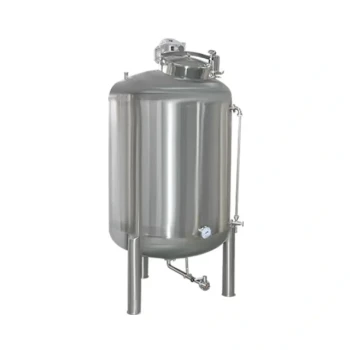
The primary function of a sedimentation tank is natural clarification. By allowing honey to enter a stationary phase, the tank utilizes gravity to separate micro-impurities from the finished product. Lighter particles, such as air bubbles and wax fragments, rise to the surface due to buoyancy, while heavier sediments sink, resulting in a clean, transparent liquid that meets professional quality standards.
By leveraging specific gravity, sedimentation tanks remove microscopic air bubbles and wax particles that mechanical filtration often misses, directly elevating the honey's clarity and commercial grade.
The Mechanics of Natural Clarification
The Principle of Specific Gravity
Sedimentation relies entirely on the difference in density between liquid honey and suspended impurities. Instead of forcing honey through a mesh, the tank creates a motionless environment where gravity acts as the separation mechanism.
The Separation Process
During this stationary phase, often called "maturation," distinct separation occurs. Buoyancy causes lighter materials—specifically micro-air bubbles introduced during extraction and fine beeswax particles—to float to the top. Conversely, heavier foreign particles naturally settle at the bottom.
Final Removal
Once the stratification is complete, the operator can easily skim the foam and debris layer from the surface. This leaves the main body of the honey purified, without the mechanical stress or heat often associated with aggressive processing methods.
Impact on Commercial Quality
Achieving High Transparency
The presence of air bubbles or wax creates cloudiness in honey. Sedimentation is the specific technical step required to eliminate this haze. It produces the high-clarity, glass-like appearance that consumers associate with premium products.
Market Valuation and Grading
In the wholesale and retail markets, visual clarity is a primary indicator of quality. A sedimentation tank directly influences the quality grade of the honey. By removing the physical impurities that cause turbidity, the product qualifies for higher market valuations and meets the strict sensory expectations of commercial distributors.
Understanding the Trade-offs
Time vs. Efficiency
The sedimentation process is passive and time-consuming. Unlike active filtration, which is immediate, a sedimentation tank (or maturator) requires the honey to sit undisturbed for an extended period to be effective.
Sedimentation vs. Filtration
It is critical to understand that sedimentation is not a replacement for initial filtration. Filtration intercepts large solids like bee parts and visible debris. Sedimentation is a secondary finishing step designed to polish the product by removing the microscopic fines and air that filters let through.
Making the Right Choice for Your Goal
To determine the role of a sedimentation tank in your production line, consider your end-product requirements.
- If your primary focus is Mass-Market Speed: Rely on fine filtration for rapid throughput, accepting that some micro-bubbles may remain in the final bottle.
- If your primary focus is Premium Retail Quality: Prioritize a dedicated sedimentation phase to ensure the crystal-clear transparency required for top-tier pricing.
Ultimately, the sedimentation tank transforms standard extracted honey into a professional-grade product by allowing physics to do the final polishing.
Summary Table:
| Feature | Mechanism | Primary Impurities Removed | Impact on Quality |
|---|---|---|---|
| Natural Clarification | Specific gravity separation | Wax particles & micro-bubbles | High transparency & polish |
| Separation Layering | Buoyancy & sedimentation | Lighter debris & heavy fines | Uniform liquid consistency |
| Passive Finishing | Stationary maturation | Microscopic haze & turbidity | Higher market valuation |
Elevate Your Honey Quality with HONESTBEE
Are you a commercial apiary or distributor looking to achieve professional-grade clarity for your honey? HONESTBEE specializes in providing the full spectrum of beekeeping machinery—from advanced sedimentation tanks and honey-filling machines to durable hive-making equipment. We empower commercial producers to optimize their production lines and command top-tier pricing in the wholesale market.
Ready to upgrade your processing efficiency? Contact HONESTBEE today to discover how our comprehensive equipment and consumables portfolio can grow your beekeeping business!
References
- A Pribadi, Cut Rizlani Kholibrina. Financial Analysis of Beekeeping Practices at Acacia crassicarpa Plantation Forest in Riau Province, Indonesia. DOI: 10.7226/jtfm.29.2.136
This article is also based on technical information from HonestBee Knowledge Base .
Related Products
- Professional Honey Storage Tank with Agitation System
- Stainless Steel Uncapping Tank with Stand and Strainer
- Stainless Steel Honey Storage and Settling Tank with Double Strainer
- Plastic Honey Uncapping Tub Tank for Beekeeping
People Also Ask
- What economic role do honey storage tanks play? Boost Your Revenue Through Strategic Inventory Management
- What roles do industrial honey storage tanks and filtration meshes play in processing? Ensure Purity & Consistency
- What is the purpose of a honey storage tank? Streamline Your Honey Processing for Quality & Efficiency
- What are honey storage tanks used for? Essential Features for Quality Preservation and Profit
- How do large honey storage tanks and gravity fall filling systems improve honey packaging efficiency and safety?