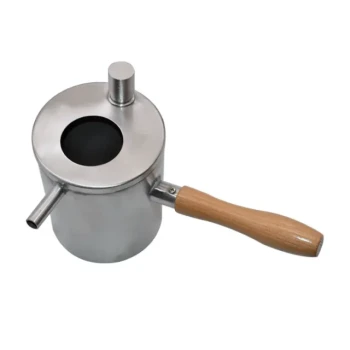
After extraction in a honey press, the pressed wax remains inside the sieve bucket and must be physically removed before you can process a new batch of honeycomb. Rather than being a waste product, this residue—often called the "capping" or "slumgum" depending on the source—still contains valuable resources that can be recovered.
The pressed wax is not trash; it is a byproduct rich in residual honey. Whether you choose to strain it for extra yield or consume it directly, it requires specific handling immediately after the press cycle finishes.
Immediate Post-Press Actions
Clearing the Sieve Bucket
Once the pressing plate is retracted, the compressed wax cake sits at the bottom of the perforated stainless steel basket.
You must remove this compressed wax entirely to clear the way for the next load. Leaving old wax in the basket reduces the volume available for fresh honeycomb and hampers extraction efficiency.
Maximizing Your Yield
Secondary Straining
Even after high-pressure extraction, the wax usually retains a significant amount of honey.
To recover this, place the pressed wax onto a straining setup. Gravity will slowly pull the remaining liquid out of the wax structure.
Time Requirements
This is not an instant process. Under optimal conditions, effective dripping takes approximately one day.
Allowing this time ensures you capture the maximum volume of honey possible, minimizing waste from the harvest.
Utilization Options
Direct Consumption
If you prefer not to wait for secondary straining, the mixture is perfectly edible.
The pressed wax-and-honey combination can be packaged and consumed immediately as chunk honey. This offers a raw, textural eating experience that appeals to many natural food enthusiasts.
Wax Storage and Processing
Once the honey has been fully dripped or rinsed out, the remaining solid is pure beeswax.
This material can be rendered (melted and filtered) to create blocks of clean wax. These blocks can be stored indefinitely or used for making candles, balms, and other hive products.
Understanding the Trade-offs
Time vs. Throughput
Performing a secondary strain requires extra space and equipment to hold the wax for 24 hours.
If you are processing a high volume of honey rapidly, you may find that the logistical cost of storing dripping wax outweighs the value of the small amount of honey recovered.
Processing Effort
Consuming the wax as chunk honey is the path of least resistance.
Rendering the wax for storage, however, requires heating and filtering equipment. You must weigh the value of the clean wax against the labor required to render it.
Optimizing Your Post-Press Workflow
- If your primary focus is maximum honey yield: Dedicate a separate straining station for the pressed wax and allow it to drip for at least 24 hours before rendering the wax.
- If your primary focus is zero-waste simplicity: Package the pressed residue immediately as edible chunk honey to avoid the labor of rendering or long-term storage.
By viewing the pressed wax as a secondary harvest rather than refuse, you significantly increase the total value derived from your hive.
Summary Table:
| Post-Press Option | Action Required | Primary Benefit | Processing Time |
|---|---|---|---|
| Secondary Straining | Gravity dripping on mesh | Captures 100% of residual honey | ~24 Hours |
| Direct Consumption | Packaging as 'chunk honey' | Zero waste and immediate use | Instant |
| Wax Rendering | Melting and filtration | Produces pure, storable beeswax | Varies |
| Sieve Clearing | Manual removal of wax cake | Maintains press efficiency | Instant |
Scale Your Honey Production with HONESTBEE
At HONESTBEE, we empower commercial apiaries and distributors with the professional-grade tools needed to turn every harvest into high-value products. Whether you are scaling up with our high-efficiency honey-filling machines or upgrading your extraction line with industrial honey presses, our comprehensive wholesale solutions are designed for your growth.
From specialized beekeeping machinery to essential consumables and honey-themed cultural merchandise, we provide the hardware and expertise to optimize your workflow and maximize your yield. Contact us today to discuss our wholesale offerings and discover how we can streamline your operations from hive to market.
Related Products
- Stainless Steel Honey Press Wax Press with Tank
- 10L Stainless Steel Honey Wax Press Extractor for Wax Cappings
- Honey Wax Separating Wax Press with Metal Screw Wax Separator Machine
- Beeswax Machine Press Embosser Wax Foundation Mold Printer Bee Hive Equipment Making Sheet
- Stainless Steel Jack Type Honey Comb Press Machine Wax and Honey Separator
People Also Ask
- What is the procedure for pressing honey? A Simple, Low-Cost Method for Small-Scale Beekeepers
- What other functions can a honey press serve besides honey extraction? Discover Versatile Multi-Purpose Uses
- What are the fundamental differences between manual honey presses and centrifugal honey extractors? A Guide for Pros
- What features contribute to the portability of a honey press? Compact Designs for Mobile Beekeeping
- What is the procedure for extracting honey using a honey press? A Guide to Maximum Yield